Union of the Germ-Cells
egg and towards
where it is very large and conspicuous, and I have since observed it also in the sea-urchin (Fig. 69).
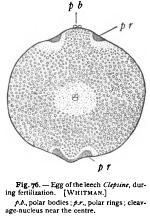
The most profound change in the ovum is, however, the migration of the germinal vesicle to the periphery, and the formation of the polar bodies. In many cases either or both these processes may occur before contact with the spermatozoon (echinoderms, some vertebrates). In others, however, the egg awaits the entrance of the spermatozoon (annelids, gasteropods, etc.), which gives it the necessary stimulus. This is well illustrated by the egg of Nereis. In the newly-discharged egg the germinal vesicle occupies a central position, the yolk, consisting of deutoplasmspheres and oil-globules, is uniformly distributed, and at the periphery of the egg is a zone of clear perivitelline protoplasm (Fig. 43). Soon after entrance of the spermatozoon the germinal vesicle moves towards the periphery, its membrane fades away, and a radially directed mitotic figure appears, by means of which the first polar body is formed (Fig. 71). Meanwhile the protoplasm flows towards the upper pole, the perivitelline zone disappears, and the egg now shows a sharply marked polar differentiation. A remarkable phenomenon, described by Whitman in the leech ('78), and later by Foot in the earthworm ('94), is the formation of " polar rings," a process which follows the entrance of the spermatozoon and accompanies the formation of the polar bodies. These are two ring-shaped cytoplasmic masses which form at the periphery of the egg near either pole and advance thence towards the poles, the upper one surrounding the point at which the polar bodies are formed (Fig. 76). Their meaning is unknown, but Foot ('96) has made the interesting discovery that they are probably of the same nature as the yolk-nuclei (p. 121).
2.
Paths of the Germ-nuclei (Pro-nuclei) 1 After the entrance of the spermatozoon both germ-nuclei move through the egg-cytoplasm and finally meet one another. The paths traversed by each vary widely in different forms. In general two classes are to be distinguished, according as the polar-bodies are formed before or after entrance of the spermatozoon. In the former case (echinoderms) the germ-nuclei unite at once. In the latter case the sperm-nucleus advances a certain distance into the egg and then pauses while the germinal vesicle moves towards the periphery, and gives rise to the polar-bodies (Ascaris, annelids, etc.). This significantfact proves that the attractive force between the two nuclei is only exerted after the formation of the polar-bodies, and hence that the entrance-path of the sperm-nucleus is not determined by such attraction. A. second important point, first pointed out by Roux, is that the path of the sperm-nucleus is curved, its " entrance-path " into the egg forming a considerable angle with its "copulation-path " towards the egg-nucleus.
These facts are well illustrated in the sea-urchin egg (Fig. 77), where the egg-nucleus occupies an eccentric position near the point at which the polar bodies are formed (before fertilization). Entering the egg at any point, the sperm-nucleus first moves rapidly inward along an entrance-path that shows no constant relation to the position of the egg-nucleus and is approximately but never exactly radial, i.e. towards a point near the centre of the egg. After penetrating a certain distance its direction changes slightly to that of the copulationpath, which, again, is directed not precisely towards the egg-nucleus, but towards a meeting-point where it comes in contact with the egg-nucleus. The latter does not begin to move until the entrancepath of the sperm-nucleus changes to the copulation-path. It then begins to move slowly in a somewhat curved path towards the meetingpoint, often showing slight amceboid changes of form as it forces its way through the cytoplasm. From the meeting-point the apposed nuclei move slowly toward the point of final fusion, which in this case is near, but never precisely at, the centre of the egg.
These facts indicate that the paths of the germ-nuclei are deter1 The terms "female pro-nucleus," "male pro-nucleus" (Van Beneden), are often applied to the germ-nuclei before their union. These should, I think, be rejected in favour of Hertwig's terms egg-nucleusand sperm-nucleus, on two grounds: (i) The germ-nuclei are true nuclei in every sense, differing from the somatic-nuclei only in the reduced number of chromosomes. As the latter character has recently been shown to be true also of the somatic nuclei in the sexual generation of plants (p. 196), it cannot be made the ground for a special designation of the germ-nuclei. (2) The germ-nuclei arc not male and female in any proper sense (p. 183).