Practical Carpentry
angle, fig, equal, angles, degrees, called, circle and polygon
The Quantity of an Angle
is estimated by the arc of any circle contained between the two sides or lines forming the angle ; the junction of the two lines, or vertex of the angle, being the center from which the arc is described. As the circum ferences of all circles are proportional to their diameters, the arcs of similar sectors also bear the same proportion to their respective circum ferences; and, consequently, are proportional to their diameters and, of course, also their radii or semi-diameters. Hence, the proportion which the arc of any circle bears to the circumference of that circle determines the magnitude of the angle. From this it is evident that the quantity or magnitude of the angles does not depend upon the length of the sides or radii forming them, but wholly upon the number of degrees contained in the arc cut from the circumference of the circle by the opening of these lines. The circumference of every circle is divided by mathematicians into 360 equal parts, called degrees; each degree being again subdivided into 60 equal parts, called minutes, and each minute into 60 equal parts called sec onds. Hence, it follows that the arc of a quarter circle or quadrant includes 90 degrees; that is, one-fourth part of 360 degrees.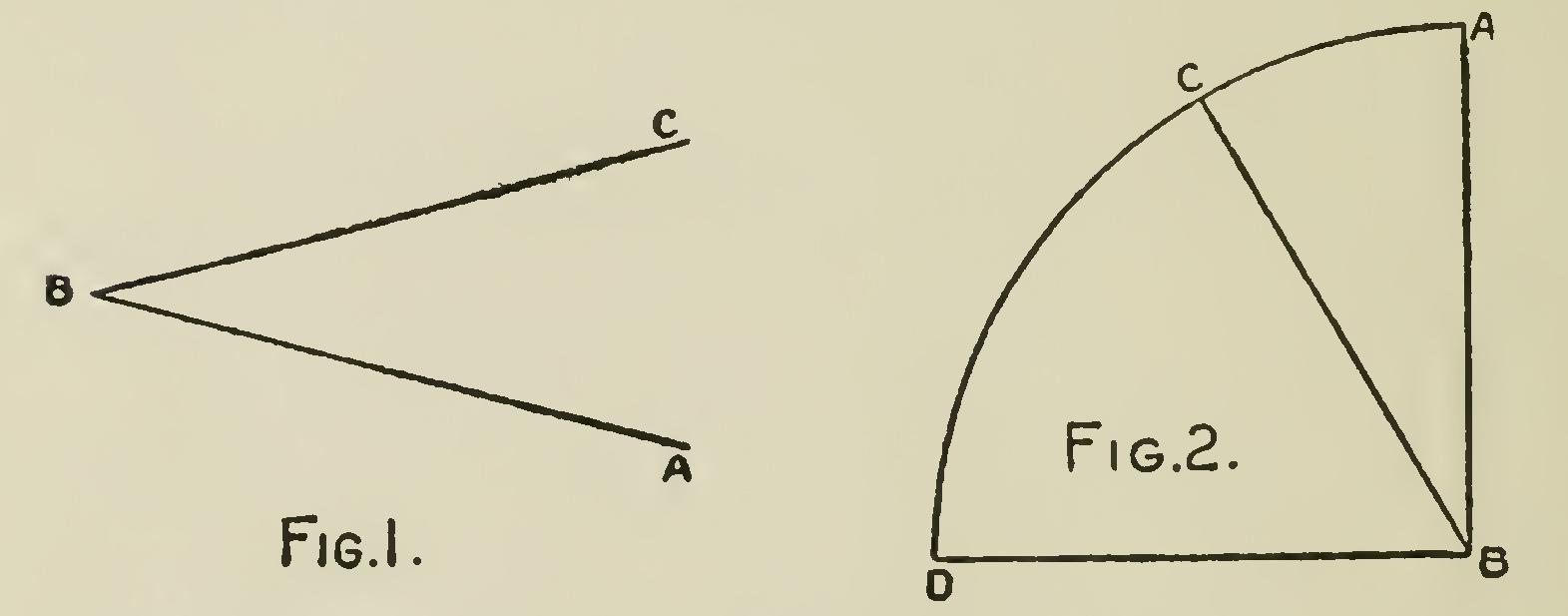
A Right Angle is produced by one straight line standing upon another so as to make the adjacent angles equal, and is an angle of 90 degrees. This is what workmen call "square," and is the most useful figure they employ.
An Acute Angle is less than a right angle, or less than 90 degrees.
An Obtuse Angle is greater than a right angle, or more than 90 degrees.
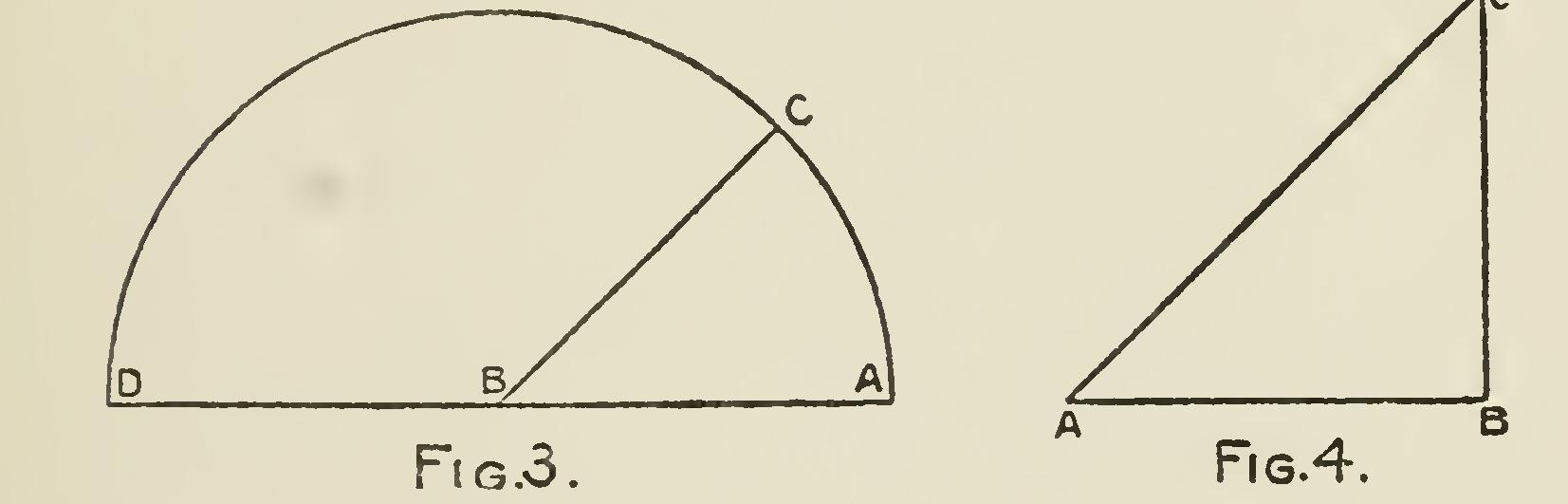
The number of degrees by which an angle is less than 90 degrees is called the complement of the angle. For example, in Fig. 2, angle C B D is the complement of the angle A B D because angle A B C, plus angle C B D, is equal to a right angle or one of 90 degrees, or angle A B D.
The difference between an obtuse angle and a semi=circle, or 180 degrees, is called the supple ment of that angle. For example, in Fig. 3, angle C D B is the supplement of the angle A D B because angle C D B, added to angle A C B, is equal to a semi-circle or an angle of 180 degrees.
Plane Figures are bounded by straight lines, and are named according to the number of sides which they contain. Thus, the space included within three straight lines, forming three angles, is called trilateral figure or triangle.
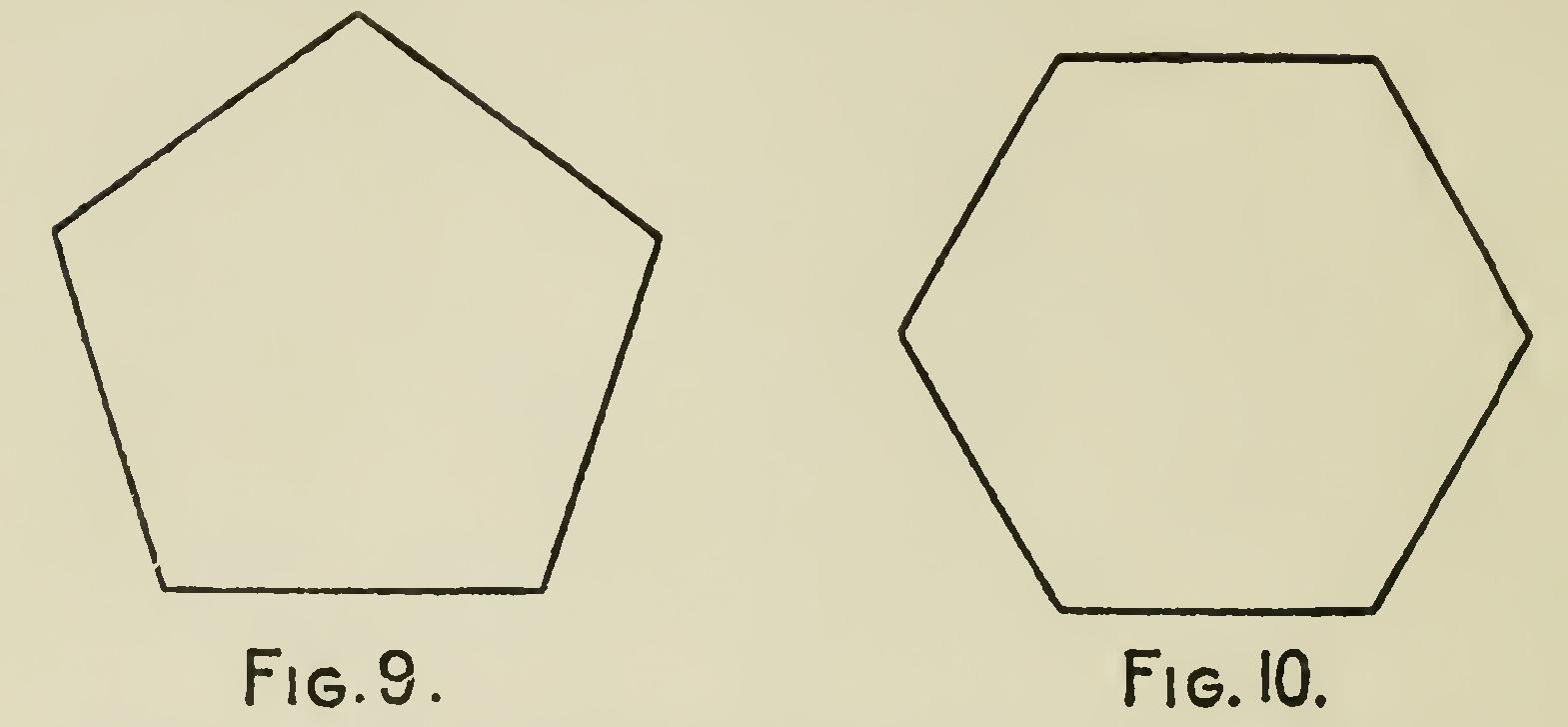
A Right=angled Triangle has one right angle : The sides forming the right angle are called the base and perpendicular; the side opposite the right angle is named hypothenuse. See Fig. 4, A B C is a right-angled triangle—A B is the base, C B is the perpendicular and A C is the hypothe nuse. An isosceles triangle has only two sides
equal; an equilateral triangle has all its sides of equal length. An acute-angled triangle has all its angles acute, and an obtuse-angled triangle has one of its angles only obtuse.
Quadrilateral Figures are literally four-sided figures; they are also called quadrangles, because they have four angles.
A Parallelogram is a figure whose opposite sides are parallel, as A B C D, in Fig. 5.
A Rectangle is a parallelogram having four right angles, as A B C D, in Fig. 5.
A Square is an equilateral rectangle, having all its sides and angles equal, like Fig. 5.
A Diagonal is a straight line drawn between two opposite angular points of a quadrilateral figure, or between any two angular points of a polygon. Should the figure be a parallelogram, the diagonal will divide it into two equal tri angles, the opposite sides and angles of which will be equal to one another. Let A B C D, Fig. 6, be a parallelogram; join A C, then A C is a diag onal, and the triangles A D C and A B C, into which it divides the parallelogram, are equal.
A Polygon is a portion of a plane terminated on all sides by straight lines. A regular polygon has all its sides and angles equal, and an irregular polygon has its sides and angles unequal.
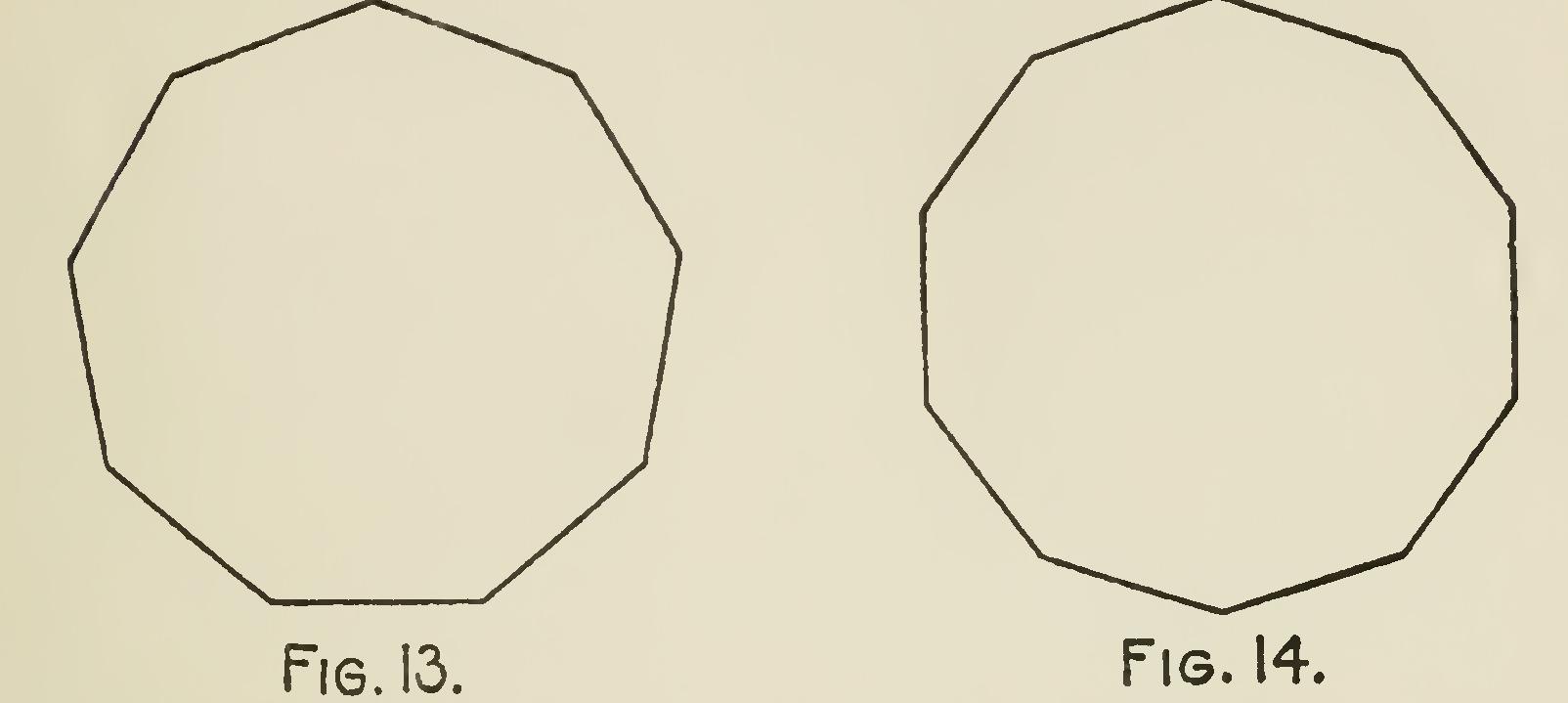
Polygons are named according to the number of their sides or angles, as follows : A Triangle is a polygon of three sides. See Fig. 7. A Square is a polygon of four sides. See Fig. 8. A Pentagon is a polygon of five sides. See Fig. 9. A Hexagon is a polygon of six sides. See Fig. 10.
A Heptagon has seven sides. See Fig. 11.
An Octagon has eight sides. See Fig. 12.

A Nonagon has nine sides. See .
13.
A Decagon has ten sides. See Fig. 14.
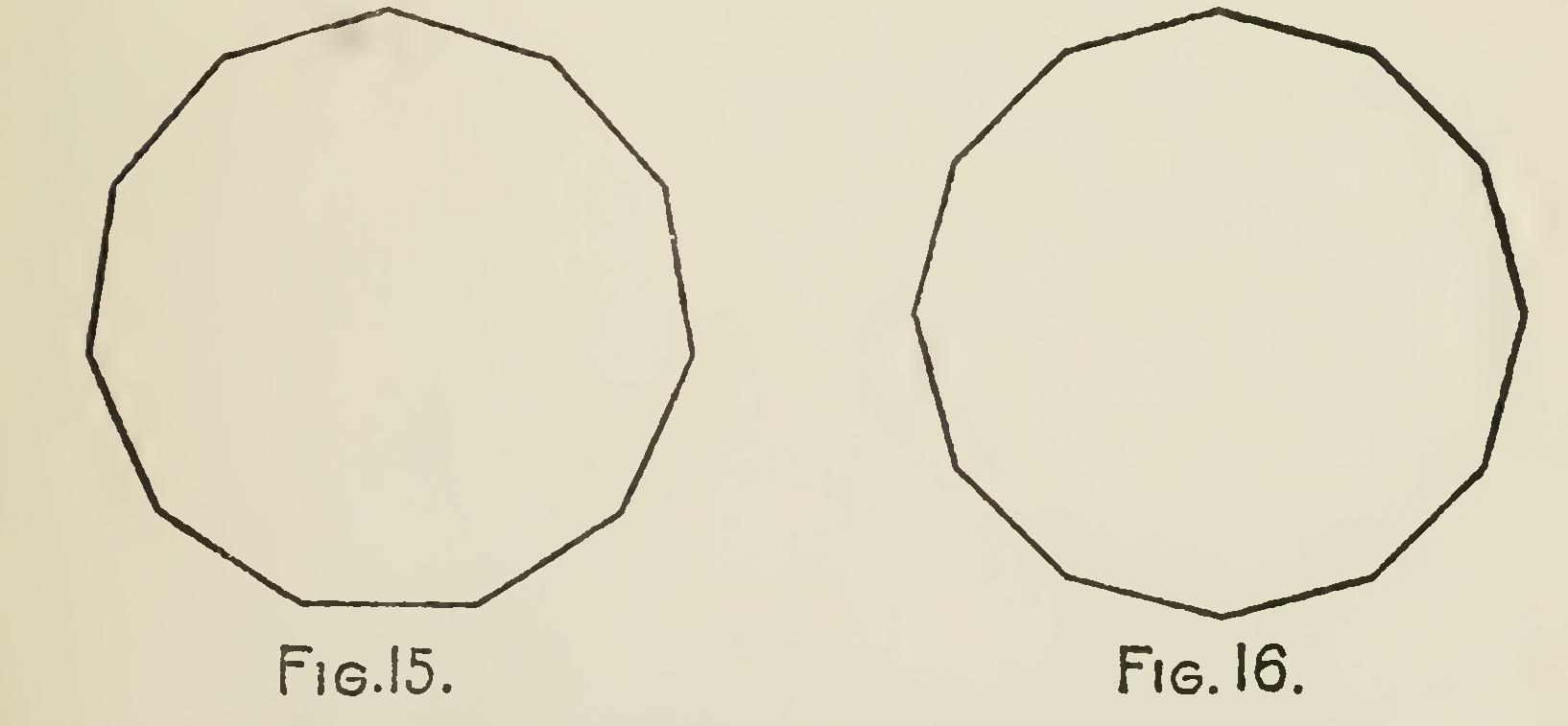
An Undecagon has eleven sides. See Fig. 15.
A Dodecagon has twelve sides. See Fig. 16.
Figures having more than twelve sides are generally designated polygons, or many-angled figures.
A Circle is a plane figure bounded by one uni formly curved line, called the circumference, every part of which is equally distant from a point within, called the center, as A in Fig. 17.
The Radius of a Circle is a straight line drawn from the center to the circumference; hence, all the radii of a circle are equal, as AB, AD, AC, AE, in Fig. 17.
The Diameter of a Circle is a straight line drawn through the center and terminated on each side by the circumference; consequently the circum ference is exactly twice the length of the radius, and, therefore, the radius is sometimes called the semi-diameter. See B A C, Fig. 17.