Framing for Windows
fig, window, sash, transom, inches, air and casing
With the removal of the difficulty involved in the use of screens, it is not improbable that casements will eventually replace largely the old-fashioned double-hung sash for residence work, as most people appreciate their beauty as well as their great superiority as ventilators, particularly during warm weather.
Transom Window-Frame. Fig. 29 shows a detail of a transom window-frame, allowing for a three-inch bar with hinged transom light. This has the appearance of a moulded transom bar. The sash being hung the same as in the ordinary window, it allows it to be lowered at will, leaving no open joints for the wind and rain to get in when closed. It is well-nigh impossible to construct a transom when hung with butts, and have it weatherproof. In such cases, the most satisfactory way is to hang the sash at the bottom similar to that shown at the right in Fig. 29. This makes a fairly tight job and is simple in construction.

Fig. 29. Framing for Transom Windows.
A Triple Window.
A triple window, with two side sash casements, while the center sash is stationary, presents an interesting problem in window framing.
Fig. 30 shows detailed sections through the sills of both the ceni?er and side windows. Both the outside sill and the inside stool continue through in line, and should be. in one piece; Fig. 30. Triple Window Arrangement—Framing for Side Casements and Center Sash.

and the casements have an additional sill, as shown, which raises the sash sufficiently to clear the stool. The writer has used this method many times in actual practice, and same has always given satisfaction.
Framing for Octagon Bay. Another point in the construction of windows is in bay win dows of the octagon pattern. Many bay win Fig. 31. Construction at Corner, Octagon Bay.
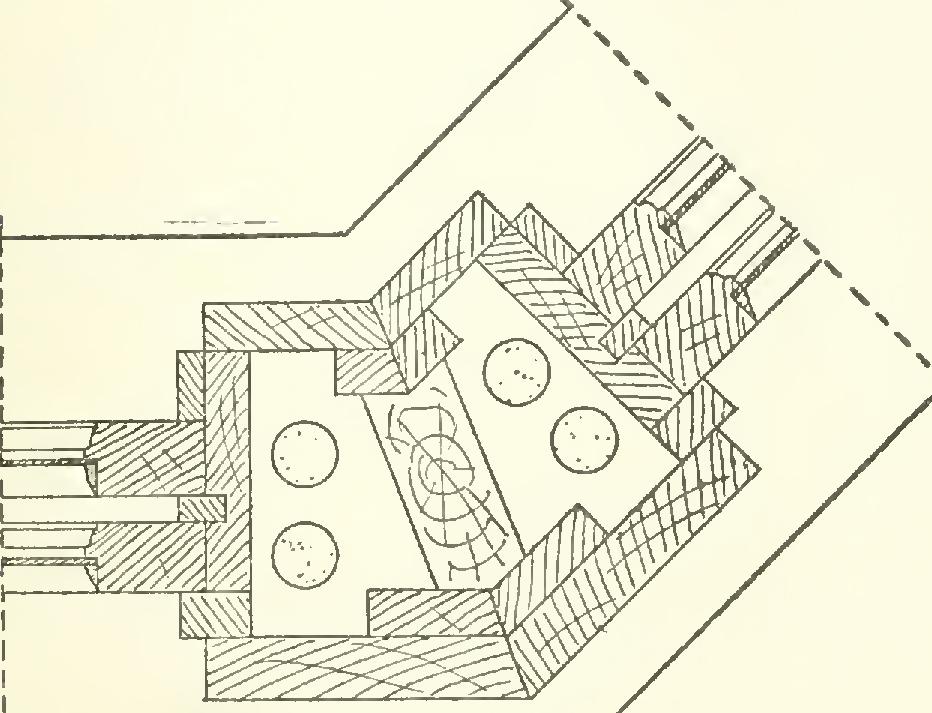
doves are made so that the casings join in the angle. When casings join in this manner, it is necessary to know just how to set the stud ding, and just the exact width of outside casing necessary to use to make room for the weights, and have it finish up right on the inside.
Referring to Fig. 31, it will be seen that it requires an outside casing at least 7 inches wide to get the frame in; and then the studding must be set directly in the center of the angle. ever the frames join as in this case, it is best to set a 2 by 4 stud in the angle as shown. It
prevents the frames from drawing apart in the miter. The sketch shows that 7 inches is the least width of casing that will do; and this would leave the inside casing to finish up only about inches in width. The outside casings should be 8 inches wide; then the inside casing would finish up about 41/2 inches, which is a better width to make the finish.
It is much better to leave a space of six to eight inches or more between the windows when this can be done, and put on siding with mitered corners. It makes a nicer looking job, and is easier to finish on the inside, when each frame is independent of the other. Care should be taken in setting frames for a bay window, to get them evenly divided and all set to the same height exactly, so that in spacing up the siding there will be no difficulty in coming out right.
A Simple Window Ventilator. Among the several theories as to the proper method of ventilating rooms where numbers of persons may he congregated at one time, there is one detail upon which the advocates of the several systems are agreed—namely, that the supply of fresh air should be admitted above the heads of the occupants of the room. This applies equally to warm-air or cold-air inlets, the reason being that the fresh air rapidly mixes with the air in the room without causing a draught to strike the occupants.
There are many houses, schools, and other premises where regular systems of ventilation will never be installed, but vet which should be supplied with some means of changing the air in their rooms. In the course of his professional Fig. 32. Arrangement for Window Ventilating.
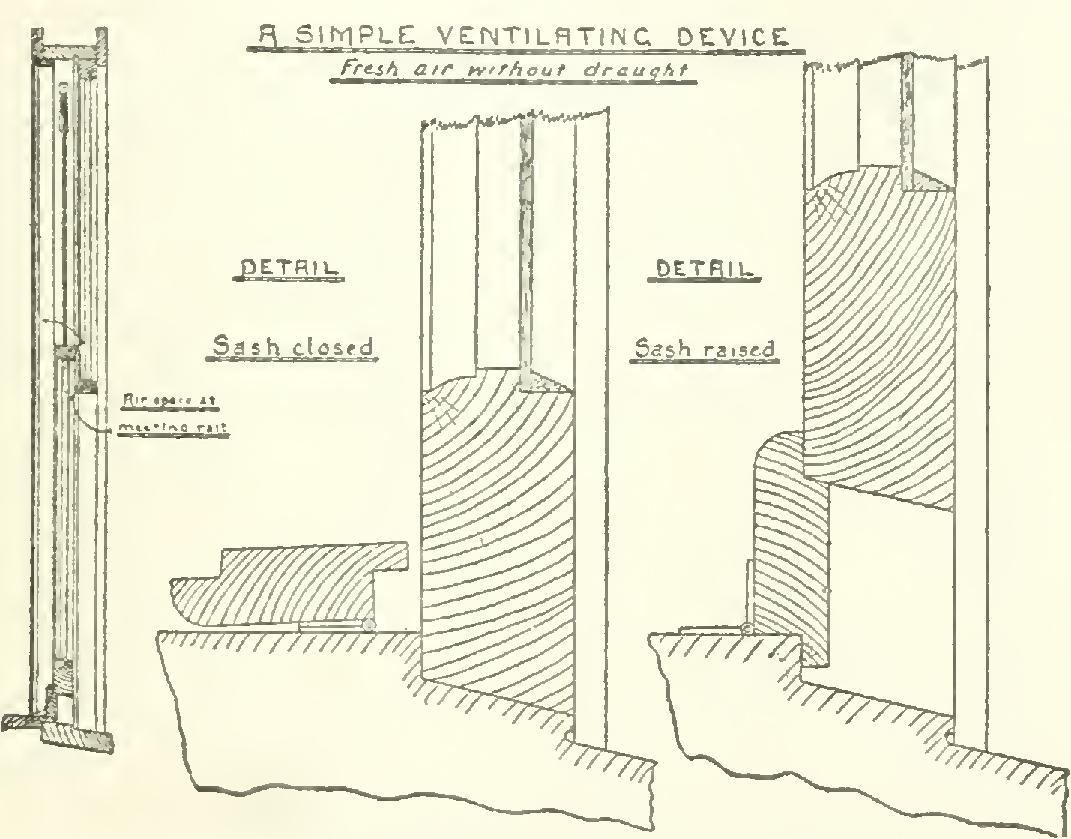
duties, the writer has been able to meet the needs of many rural and small town schools for some cheap and easy means of ventilation, by a simple device which is illustrated in Fig. 32.
It has, of course, nothing new in the idea, for most writers on ventilation have suggested that a strip of wood could be employed at the bottom of the window-sash, so as to admit air at the meeting rails. The writer has found it best, however, to hinge the strip to the stop or to the window-board, and also to rabbet it as shown.