Framing for Windows
sill, window, sash, shingles, frame and fig
FRAMING FOR WINDOWS One of the most important parts of house framing is the construction connected with the window openings. This is a comparatively simple matter, yet it should be done with care to insure against leaks. One of the best ways Fig. 22. Simple Window Construction.

to frame to prevent leaks is to gain the jamb into the sub-sill, letting the end of this sill pro ject same as for window sill, and only notch out enough of the back corners to fit nicely in opening for the window as shown by the sec tional drawing, Fig. 22. The joints should be set in white lead, and well painted on the outside.
Single-Sash Windows. How to make a win dow-frame for the attic, or a single-sash frame for any place, which will admit of hanging so that the sash can be opened and at the same time keep out the snow and rain in stormy Fig. 23. Framing for Single-Sash Windows.

weather, is a problem that has caused the car penter more or less study for years.
We have found no better way to accomplish the work than the arrangement shown in Fig. 23.
The sill is made with a lip and then rabbeted, as shown at A. The sash is also rabbeted to fit the sill. The sill is plowed at B; and the stool rabbeted to fit into the sill. This allows the sash to be hung at the top; and when closed over the rabbeted sill with the lip, it prevents rain and snow from beating in under the sash. If the sash is tightly closed, it is just about storm-proof—so nearly so that not enough rain or snow will get through to do any damage.
With the ordinary window sill, it is impossi ble to hang a single sash either at the top or on the side, on account of the bevel on the sill; and then the stool is in the way. Our experience has been that almost any attempt to hang a single sash in the frame such as ordinarily made, results in a very unsatisfaCtory job. If the window happens to be in some place much exposed, it will be found to be a great annoyance on account of leaks.
A frame constructed with the sill and sash rabbeted as shown in the sketch is as near storm-proof as it is possible to get and have the sash hung so that it can be opened readily.
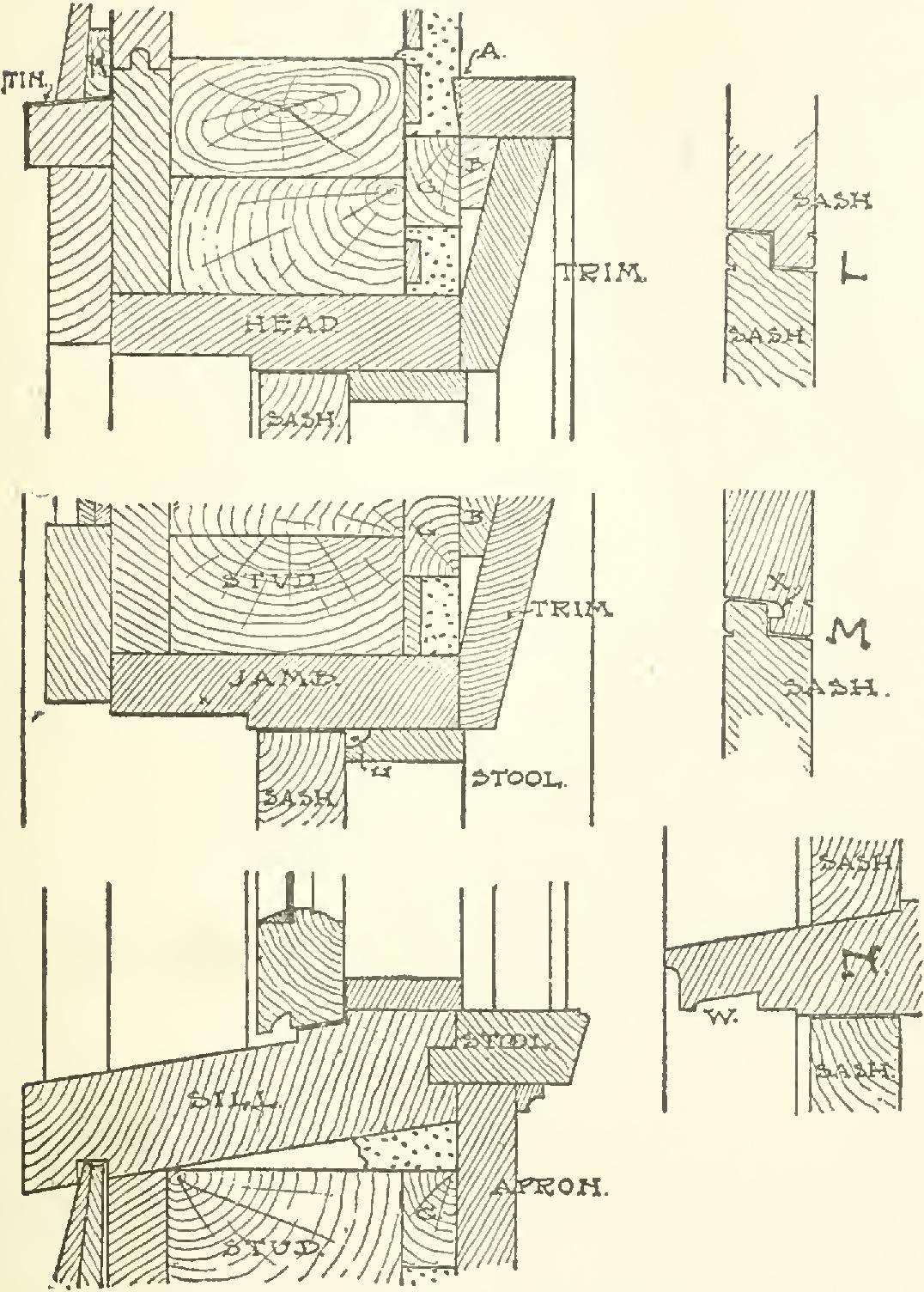
Outward-Opening Casements. Fig. 24 illus trates the construction of an ordinary casement window opening out. The construction is quite simple, and is of the type commonly used in well-constructed frame buildings of the medium class.
The wall is constructed of 2 by 4-inch studs placed 16 inches on centers and doubled about sides, head, and sill of each window opening.
The exterior of the wall is covered with matched sheathing boards, laid diagonally or horizontally, preferably the former way, and well nailed to every stud. Over this sheathing is placed a heavy building paper well lapped and tacked, and carried under outside architraves of windows. Over the sheathing paper the shingles, clapboards, or other final enclosing material are placed.
The course of shingles over window-caps and in similar places is given the required cant by means of a cant strip K, tacked to the sheath ing boards. The shingles at jambs of windows butt against the outside architraves of same, which architraves should, for this reason, be at least one and one-quarter inches thick. The course of shingles under the window-sills are fitted up in a groove on the under side of the sill. Shingles should be well nailed with two galvanized nails to each shingle, and any shingle over six inches should be split.
At the top of the figure is a vertical section taken through the head of the window. The head of the frame is rebated, and extends from the outside architrave to the trim. The window cap is flashed with tin as shown, extending up under shingles about 6 inches. Copper is usually used for this flashing in the better class of cottages.
The trim is worked out of material, is blocked at the back (B), and has a 'Vs-inch back-band. The back-band has a feathered edge at A, which is planed off to fit the uneven Fig. 24. Framing for Outward-Opening Casements.