Stair Building
line, pitch-board, inches, square, tread, string and run
STAIR BUILDING Although an entire volume can be devoted to the structure and kinds of stairs, we shall here dwell upon them only so far as the Steel Square is concerned in obtaining the run and rise.
To lay out a stairway properly and construct it, is an art in itself. The principles involved in the construction—even of ornamental types of stairs—are comparatively simple, but are in general only imperfectly understood, even by the workmen themselves who may be engaged in erecting them. It is exceedingly important for the carpenter to understand them.
How to Determine the Height and Run. —In laying out stairs with the square, it is necessary first to determine the height from the top of the floor from which the stairs start, to the floor on which they are to land; also the run or distance of their horizontal stretch. This is found by dividing the height into the number of rises desired in the stairway. This usually results in fractions of an inch to each rise, and somewhat complicates the work. However, the fractions may be avoided by the use of the story pole by spacing it off with a pair of compasses into the number of risers desired in the stairs. This being done, the rest is comparatively easy, because the run or horizontal stretch is not usually limited as to exact space as in the case of the rise of the stairs, and as there is always one less tread than there are risers its length is determined by the width given the treads. Thus if there are 14 risers in the stairs there would be 13 treads. If the treads be 9 inches wide the run would be 9 times 13 or 117 inches, which is 9 feet and 9 inches as shown in Fig. 90. From this it will be seen that the run and rise of the individual step is taken on the Steel Square as shown in the illus tration, and determines the shape of the pitch board.

The way to make a pitchboard
is by the use of a steel square, which, of course, every carpenter in this country is supposed to possess. Fig. 91 shows a part of a stair string with the square laid on, showing its application in cutting out a pitch board. As the square is placed it shows 10 inches for the tread and 7 inches for the rise.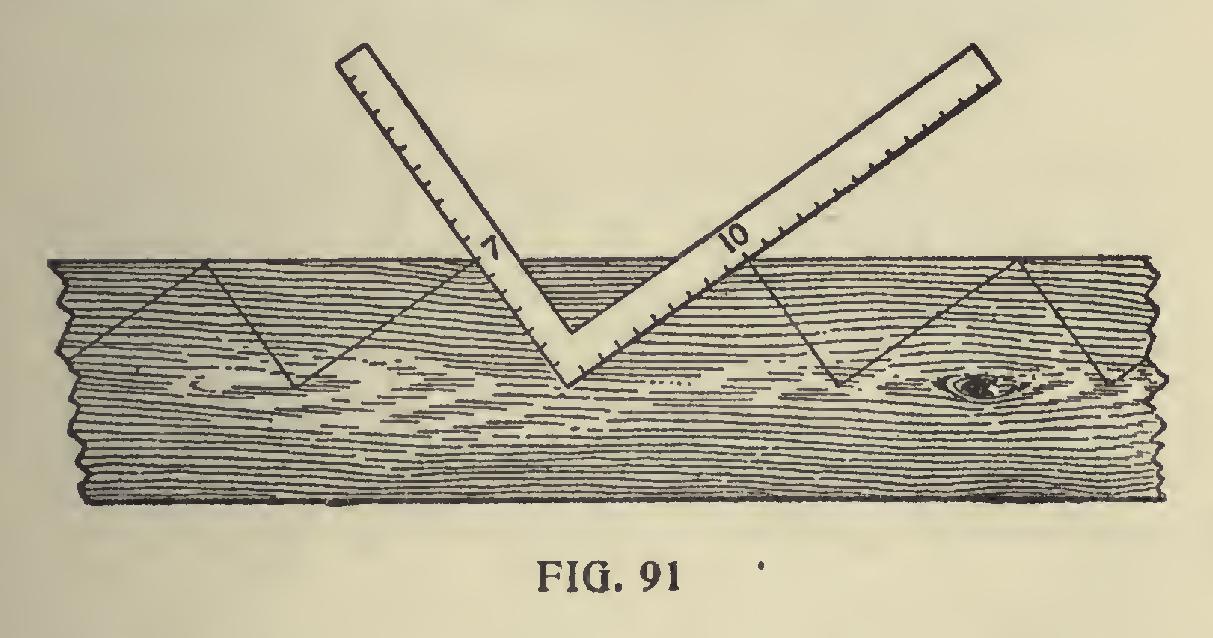
To cut a pitch-board, after the tread and rise have been determined, proceed as follows: Take a piece of thin, clear stuff, and lay the square on the face edge, as shown in the figure, and mark out the pitch-board with a sharp knife; then cut out with a fine saw and dress to knife marks, nail a piece on the largest edge of the pitch-board for a fence, and it is ready for use.
Illustrations of the Pitch-board.—The next thing to be considered is what is the manner of using the pitch-board? Before showing its use, however, we wish the learner to have a thorough conception of what the pitch-board is, and with that object we show and explain the following il lustrations. Fig. 92 shows the pitch-board pure and simple; it may be an inch thick, or if of hard wood, may be from a quarter to a half an inch thick.
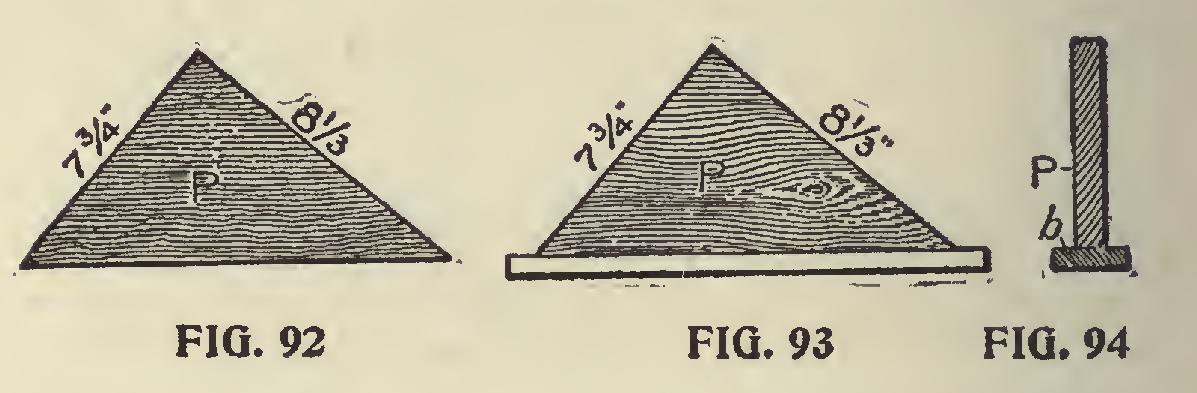
Fig. 93 shows the pitch-board after the gauge or fence is nailed on. This fence or gauge may be about one and one-half inches wide, and from to 4 of an inch thick. Fig. 94 shows a sectional view of the pitch-board with the fence nailed on as at bp, which shows the edge of the board.
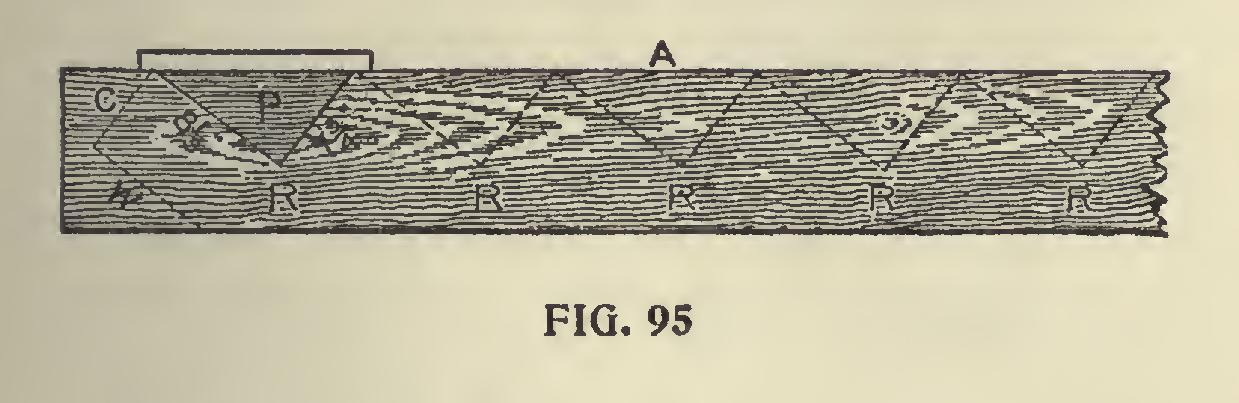
Manner of Using the Board.—Fig. 95 shows the manner of applying the board. R,R,R,R, is the string, and the line A shows the jointed or straight edge of the string. The pitch-board, p, is shown in position, the line 8i represents the step or tread, and the line 7i shows the line of the riser. These two lines are of course at right angles, or as the carpenter would say, "they are square." This string shows five complete cuts for treads, and six complete cuts for risers. The bottom of the string at W.is cut off at the line of the floor on which it is supposed to rest. The line C is the line of the first riser. This riser is narrower than any of the other risers, be cause the thickness of the first tread is always taken off it; thus, if the tread is 11 inches thick, the riser in this case would only require to be 6f inches wide, as 61 and 1i inches together make 74 inches. Another thing to be considered is the string, which must be cut so that the line at W will be only 61 inches from the line at 8*, and it must be parallel with it. The first riser and tread having been satisfactorily dealt with, the rest may be easily marked off by simply sliding the pitch-board along the line A until the line Si on the pitch-board strikes the line 7i on the string, when another tread and another riser are marked off in the same manner.