Roughing-In
waste, water and tank
In some cases where an attic tank is used for the storage of soft water, a ball-cock, similar to the one used for regulating the supply to the water-closet flush-tank is placed on the soft water supply to the tank, being set to limit the supply to a certain height of water in the tank. When any water is drawn from the tank, the lift will replace it, and the supply then be shut off by the action of the ball-cock.
Refrigerator wastes should never be con nected directly to any sewer or drain-pipe, but should discharge into a sink indirectly, as per Fig. 46; or into soil-pipe, as per Fig. 47. The use to which the refrigerator is put demands that unusual care be taken in disposing of the waste wNter. The piping should be provided with cleanouts wherever there is a possibility of a stoppage occurring from the sawdust, etc., used in packing the ice; and the pipe should be run in such a manner that it can be readily taken down and cleaned if a stoppage occurs which cannot be cleared from the cleanouts. It is not
usually necessary to vent refrigerator traps, since the water does not enter the piping, as it does from other fixtures, in a large volume, but only as the ice melts, and there is little possi bility of any siphonage occurring.
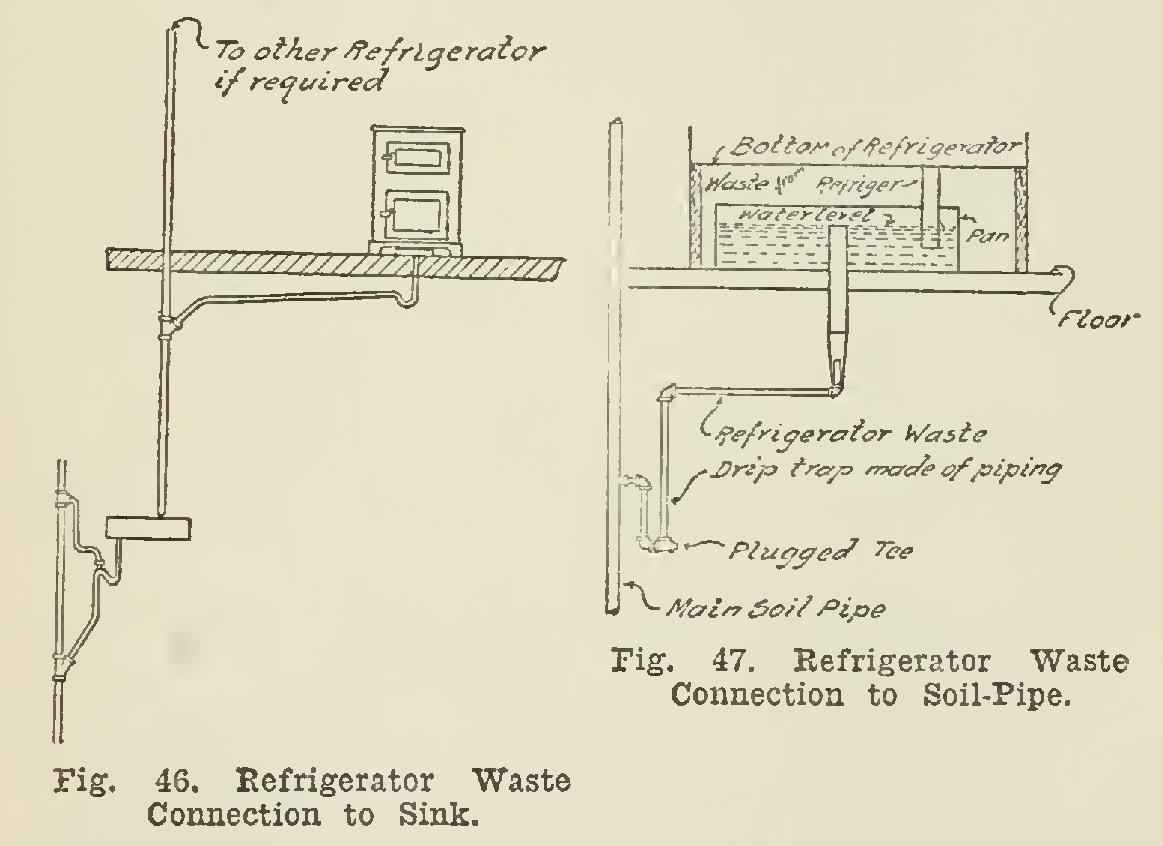
Waste pipes from refrigerators should be galvanized iron, with ends well reamed. The trap used at the soil-pipe in Fig. 47 may be made out of pipe and fittings. The end of the waste pipe from the refrigerator extends down into the pan (Fig. 47) ; and the waste to sewer con nected toward the top of the pan will leave a place for the dirty matter from the ice to collect, and this can be removed frequently, being thus prevented from entering the waste pipe. By making the trap seal at the soil-pipe about 6 to 8 inches in depth, there will be little danger of this trap being siphoned from the discharge of fixtures on the line above; and even if this did occur, the dripping from the ice would soon seal the trap again.