Steam Heating
ft, radiation, sq, feet, square, boilers and glass
For example, we shall consider a room 12x15 feet in size, with a 10-foot ceiling, containing two windows 3x6 feet in size, and having one side wall (10x12 feet) exposed.
Temperature desired in room 70° Outside temperature—zero 00 Difference 70° Temperature of steam in radiator at 1 lb pressure 215.5° 215.5°-70° (temperature of room) = 145.5° (Dif. in temperature) 145.5° .481 Glass in windows 3' x 6' x 2 = 36 sq. ft. Equivalent glass in wall 10' x 12' 9 =133 sq. ft.
Total equivalent glass sq. ft.
493x.481=23.7 sq. ft. of radiation required.
The result from the above calculation pro vides only for the exposures named, and not take into account the effect on the system from loose windows, poor building construction, or a degree of exposure excessive beyond that stated.
Mills Rule. The Mills rule, known also as the rule "2-20-200," is possibly more easily applied, and it is consequently the one generally adopted by heating men. Its explanation fol lows: Find the following three quantities in each room to he heated : (1) the cubic feet of contents, by multiplying together the length, width, and height ; (2) the square feet of exposed or outside wall (not deducting the space occupied by doors or windows) ; and (3) the square feet of glass (counting outside doors as glass). After obtain ing these results, proceed in figuring thus : For each 2 sq. ft. of glass, allow 1 sq. ft. of radiation; for each 20 sq. ft. of exposed wall, allow 1 sq. ft. of radiation; for each 200 en. ft. of contents, allow 1 sq. ft. of radiation.
The total of these different results will be the number of square feet of radiation required to heat the room to 70° with a pressure of 2 lbs. of steam, the outside temper ature being at zero.
For example, consider a corner room (two walls exposed) having three windows 3x6 feet in size. Dimensions of room, 15x20 feet, with a 10-foot ceiling.
3'X6'=18 sq. ft. X3=54 sq. ft. of glass 15'+20'=35 feet X10=350 sq. ft. of exposed wall cu. ft. of contents 54-4- 2=27 3504- 20=17.5 3,000--i-200=-15 Total, 59.5 sq. ft. of radiation required.
For all direct-indirect radiation used, add 25 per cent to the amount to obtain the equiva lent of direct radiation; and to the amount of all indirect radiation used, add 50 per cent to obtain its equivalent in direct radiation. The character and purpose of "direct-indirect" and "indirect" radiation are explained later under the heading "Radiating Surfaces."
Having determined the number of square feet of radiation necessary to heat the building in accordance with the above rules, we proceed to the selection of the boiler.
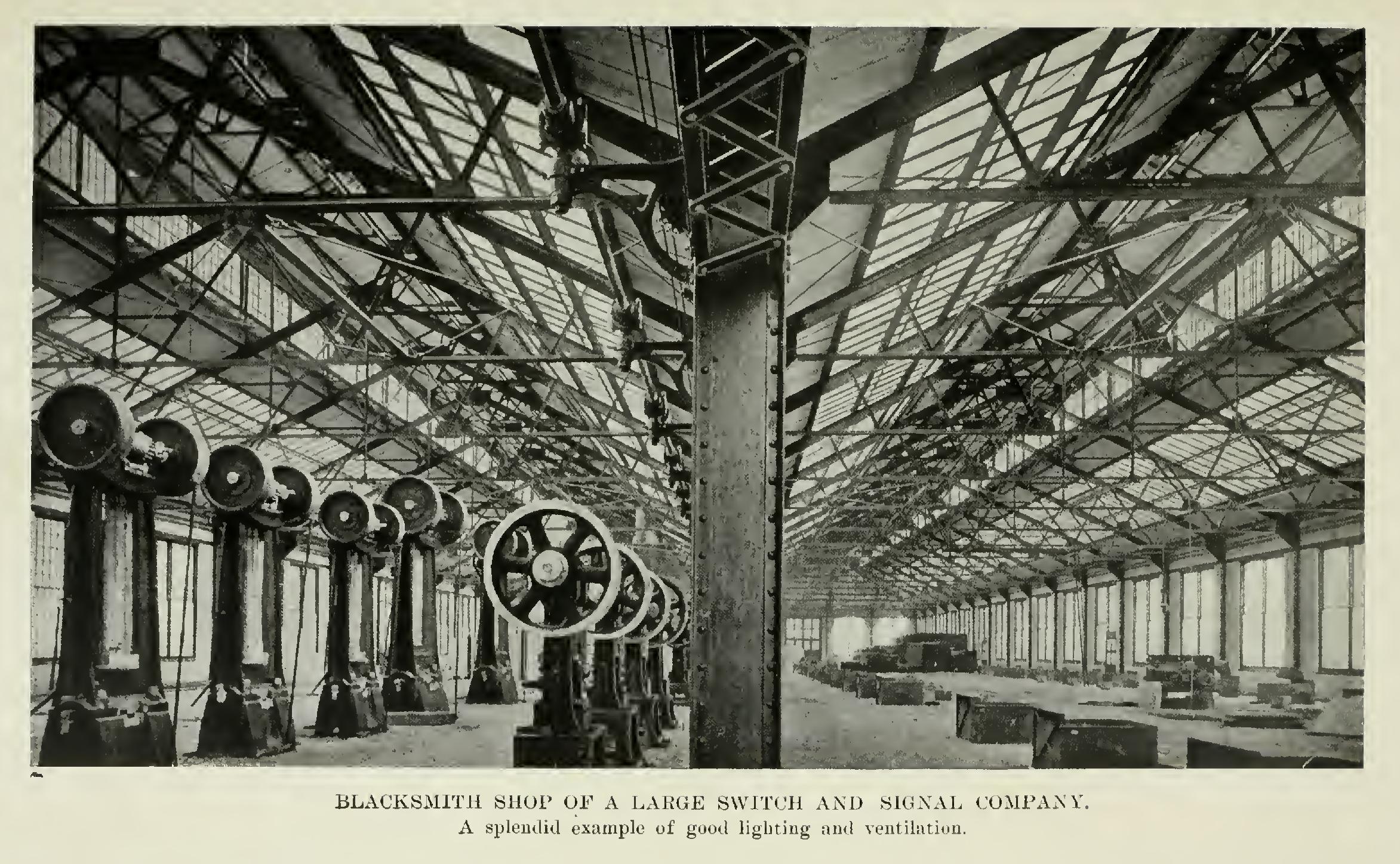
Selection of a Boiler. The selection of the proper size and character of boiler for any in stallation means much for the efficient and eco nomical operation of the entire job.
The catalogue ratings of all boilers for house heating, or "low-pressure" boilers, are gross ratings; that is, in the stated capacities, not only is the amount of radiation to be supplied con sidered, but all pipe, fittings, etc., on the work are counted as radiating surface, and allowance must be made for the same in accepting the printed ratings.
House-heating boilers are the opposite of power (tubular) boilers in so far as the matter of fuel consumption is concerned. With high pressure boilers used for power purposes, the point of greatest economy is reached by burning as much fuel as possible within a certain period for each square foot of grate surface; and this type, consequently, has a high rate of combus tion. With low-pressure boilers, on the con trary, the greatest economy is afforded by a low rate of combustion, and with a heating ap paratus we aim to burn as little fuel as possible per square foot of grate per hour.
House-heating boilers must be capable of run ning six or eight hours without attention, and be able during this period of operation to keep all radiating surfaces filled with steam.
Manufacturers' ratings, as a rule, are based upon evaporative tests; that is, that a certain number of pounds of condensation may be evap orated per pound of fuel per square foot of grate per hour. This amount varies from 7 to 10 pounds per hour, with an average of possibly pounds. A safe plan when using such ratings, is to make the following allowances: Actual sq. ft. of radiation in building 600 Add 25 per cent for uncovered mains and risers 150 750 Add 10 per cent for radiation in risers 75 825 To this result should be added an allowance of 10 or 15 per cent for friction or loss of heat between the boiler and radiators, the final result showing that for good service on the work the boiler selected should have a gross rating of approximately 900 square feet.