Steam Heating
fig, shown, radiator, return and connection
Reference to Fig. 28 will show that two valves are necessary for each radiator or unit of radiating surface—one on the supply end, and one on the return end; and these valves should be operated in unison; that is, when the valve on the supply is opened or closed, the valve on the return should he opened or closed accordingly.
For the purpose of simple illustration, the risers are shown connected directly to the main. In actual practice, however, these should be in every instance attached to the main with a swing or double-swing joint, the branches being taken from the main by either 45-degree or 90 degree elbow connections.
False Water-Line. It
is sometimes neces sary to place a job of this character in a build ing where a portion of the cellar is not exca vated; and in order to follow the advisable prin ciple of connecting the condensation into a wet return, it is essential to flood a return which would otherwise be dry. We call this arrange ment the establishing of a false water-line, and the method practiced in doing the work is clearly shown in Fig. 29. When the valve on the return (shown on sketch) is closed, the re turn will be flooded to, the height of the loop, as indicated by the upper dotted line, the por tion of the return pipe in the unexcavated sec tion of the building remaining full of water. When it is necessary to drain the system, all water is expelled by the opening of this valve.
Steam Radiator Connections. In order prop erly to install a steam-heating plant, it is neces sary to know what method of connecting radi ators is best to use according to varying circum stances surrounding the installation. The ordi
nary form of stiff radiator connection from a main is shown in Fig. 30; the same from a riser, in Fig. 31.

To allow for expansion, the radiator may be connected to the main by the style of branch shown in Fig. 32. When, in connecting a radi ator to a riser, it is desired to allow the pipe to expand in an upward or downward direction, the tee on the riser should be turned to the side, and a close nipple and elbow used in making the connection, as illustrated in Fig. 33.
A two-pipe method of radiator connection, of which there are several adaptations, is shown in Fig. 34. If the riser is to expand freely, the connection to the flow end of the radiator may be made as shown in Fig. 33.
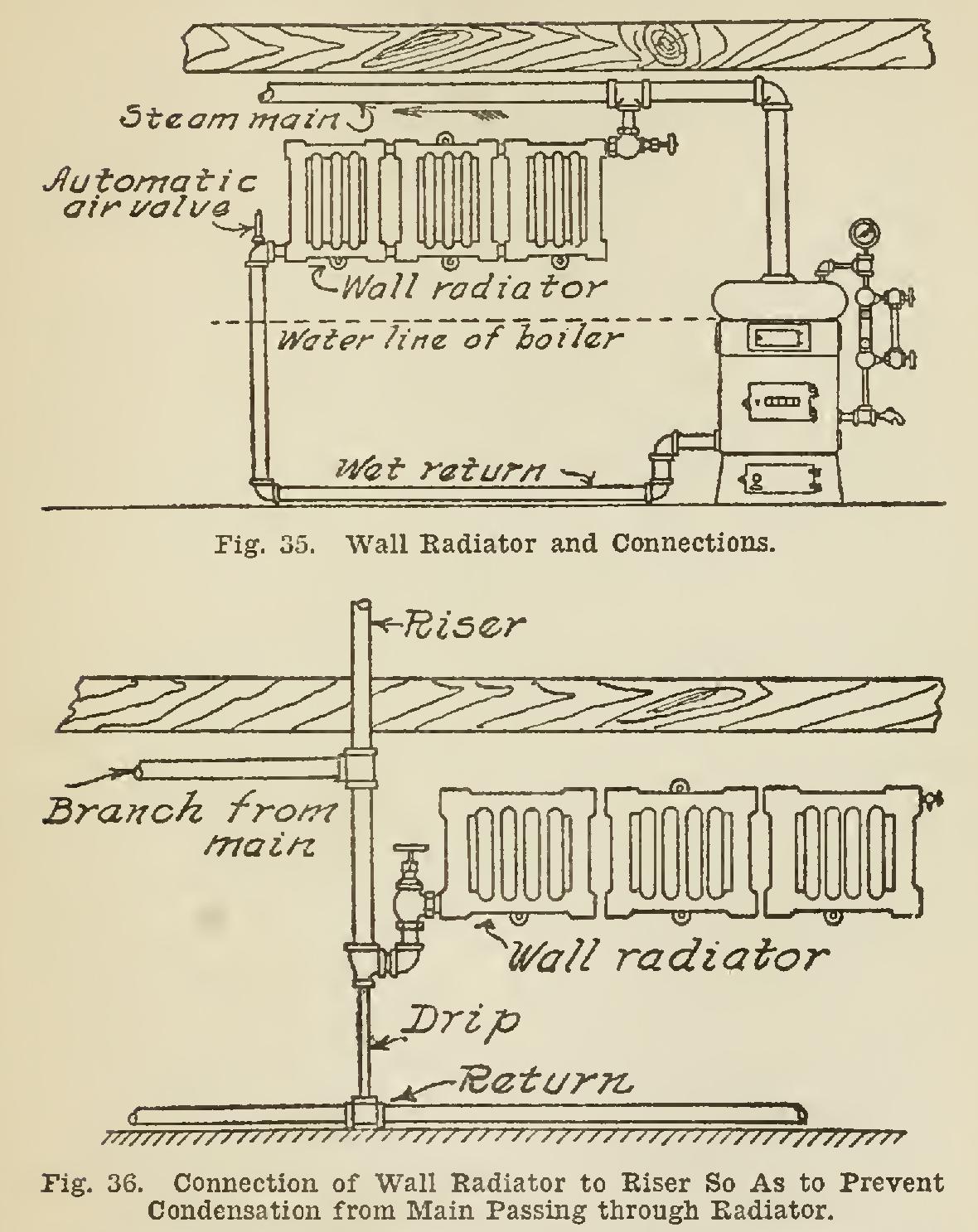
Radiators are sometimes placed on the wall of the basement below the main but above the water-line of the boiler; and for the purpose of such usage, a type constructed of flat panel shaped sections is employed. These forms are known as wall radiators, and the method of con necting them is shown in Fig. 35.

if it is desired to make this connection in such a manner that the condensation from the main will pass through the pipe feeding but without going through the radiator, it should be attached as shown in Fig. 36, the branch being connected from the side or bottom of the main.
A little care exercised in the proper con necting of the radiators will often ensure a per fect working job. On the other hand, imprac tical radiator connections on the system, even though the general piping plan of the job be good, will inevitably make a poor and unsatis factory job of steam heating.