Ii the Black Oak Group
II. THE BLACK OAK GROUP Acorns biennial; leaf lobes spiny tipped; bark dark.
KeY TO SPECIES A. Pacific coast species.
B. Leaves holly-like, evergreen.
C. Young growth golden tomentose; branchlets pen dulous. (Q. chrysolepis) MOUNTAIN LIVE OAK CC. Young growth hoary; branchlets erect.
D. Acorns elongated; leaves pubescent; fruit annual.
(Q. agrifolu2) CALIFORNIA LIVE OAK DD. Acorns ovate; leaves smooth.
(Q. Wislizen2) HIGHLAND OAK BB. Leaves not holly-like, deciduous.
(Q. Californica) KELLOGG'S OAK AA. Eastern species. Deciduous.
B. Leaves pinnately toothed and cleft by deep sinuses, petiole slender.
C. Acorn cup shallow, broader than high.
D. Tree pyramidal; branches with pin-like spurs.
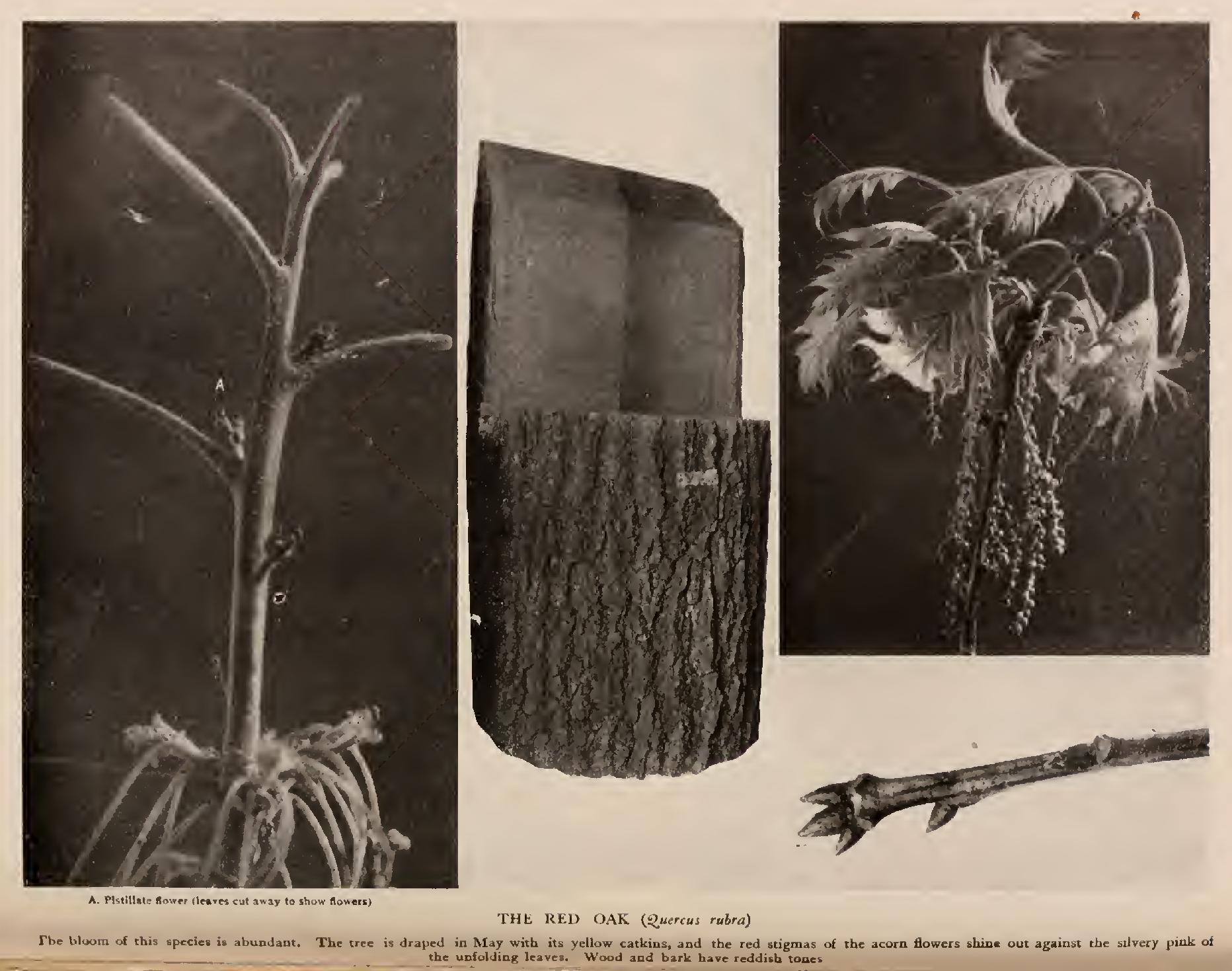
(Q. palustris) PIN OAK DD. Tree spreading; acorn large, in smooth, shallow saucer (Q. rubra) RED OAK DdD. Tree of oblong head; acorn cup greyish, downy.
(Q. Texana) TEXAN RED OAK CC. Acorn cup hemispherical, as high as broad.
D. Leaves thin, glabrous beneath; acorn cup drawn in at top. (Q. coccinea) SCARLET OAK DD. Leaves coarse, tufted with rusty hairs below; acorn cup not drawn in at top.
(Q. velutina) BLACK OAK DdD. Leaves firm, pale greyish downy beneath; acorn cup drawn in at top.
E. Lobes 5 to 7, lanceolate or sickle-like.
F. Leaves thin, 6 to 7 inches long; lobes entire (Q. digitata) SPANISH OAK FF. Leaves thick, 3 to 12 inches long; lobes toothed. (Q. Catesba2) TURKEY OAK EE. Lobes 3 to 5, broad, spiny tipped.
(Q. nana) BEAR OAK BB. Leaves 3 to 5-lobed at apex or nearly entire, on short petioles, becoming glossy.
C. Tree squat, contorted, spreading.
(Q. Marilandica) BLACK JACK CC. Tree slender, tall, graceful. (Q. nigra) WATER OAK BbB. Leaves entire, elongated, rarely toothed.
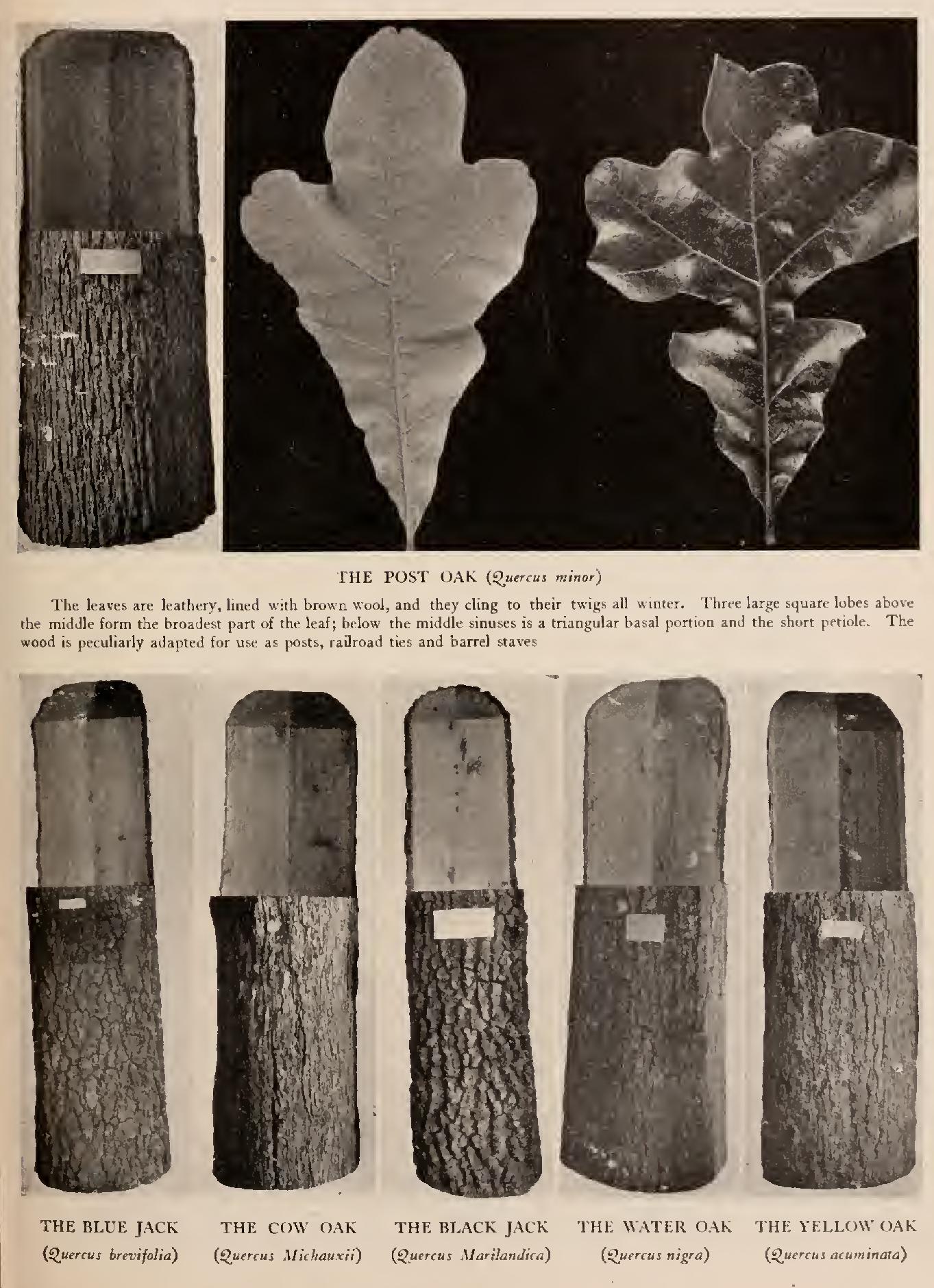
C. Foliage willow-like, shining. (Q. Phellos) WILLOW OAK CC. Foliage laurel-like, shining.
D. Tree pyramidal, pendulous.
(Q. imbricaria) SHINGLE OAK DD. Tree round, thick topped.
(Q. laurifolia) LAUREL OAK Mountain Live Oak, Maul Oak, Oak (Quer cus chrysolepis, Liebm.)—A low, broad tree, with drooping limbs, scrubby in high altitudes, 4o to 5o feet high, rarely loo feet, and too to 15o feet across; trunk 2 to 6 feet through. Bark pale grey or reddish brown, flaky. Wood pale brown, close grained, tough, strong, hard to work. Buds broadly ovate, small, scaly. Leaves evergreen, oblong, entire, acute, 1 to 2 inches long, bright green, shining above, yellowish pubescent below. Flowers, June; stami nate catkins profuse; pistillate, sessile, solitary or few in a cluster; scales golden tomentose. Fruits solitary, 4- to i inches long;
cups shallow, thick, of triangular scales, concealed by yellow tomentum. Preferred habitat, canon sides and rocky gulches. Distribution, southern Oregon to Lower California, on western slopes of Sierra Nevada and coast mountains, mountains in south ern Arizona and New Mexico. Uses: Most valuable timber oak of the Pacific coast. Used for wagons and farm implements.
The mountain live oak is not a horticultural tree, beautiful as it would be in the broad, rolling valleys of California. It is a wild thing, untamable as the mountain goat, loving the rocky canon sides and the high terraces on which earthquake and avalanche have left mighty indelible scars. Two thousand feet above sea level these trees begin to appear. On these heights they rear their sturdy, buttressed trunks which soon break into limbs that spread into broad, low domes. The width of these trees is often twice their height, and their resemblance to the live oak of the Southeastern States is striking. Instead of the Spanish moss that decks these Southern trees and gives them such a funereal look, here is nothing to droop but the tree's own long, flexible twigs clad in leaves all yellow-green and shining, which brighten the sun shine that sifts through them. They are lined all summer with yellow down, and the spring catkins and autumn acorn cups give an extra Midas touch to the tree at both ends of the growing season, There is a wonderful story of struggle and victory mutely eloquently told by this tree, as it contends with the adverse con ditions of soil and weather, grappling the rocky ground with its spreading roots and losing nothing in dignity and character as its size dwindles and it reaches its limit-5,000 feet. This low, knotty oak chaparral that the mountain climber grasps so thankfully as he faces toward the summit is fringed with yellow tassels in the spring and set in autumn with golden acorn cups, even as are its brethren, the gnarled giants he passed on the terraces 3,000 feet lower down. In the highest elevations, 8,000 to 9,o0o feet above the sea, this oak is reduced to a foot in height. This is the "huckle berry oak" of the Sierra Nevada range, variety vaccinifolia, of the parent species. Another dwarf variety, Palmeri, called the Pal mer oak, grcws on the boundary between California and the lower peninsula.