Ii the Black Oak Group
The range of the Spanish oak is from New Jersey to Florida and west to Missouri and Texas. It is most common in the South Atlantic and Gulf States, on the hills back from the coast.
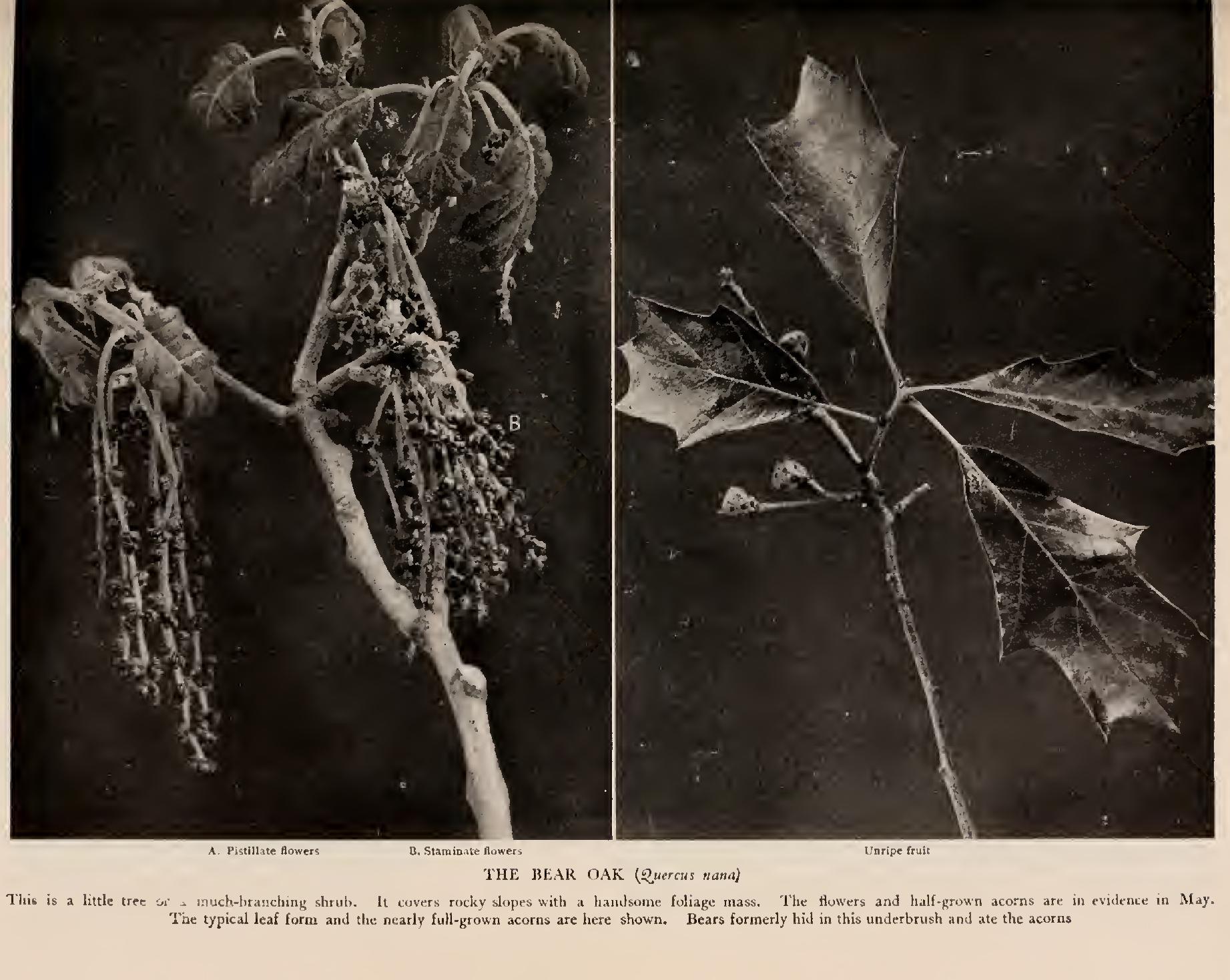
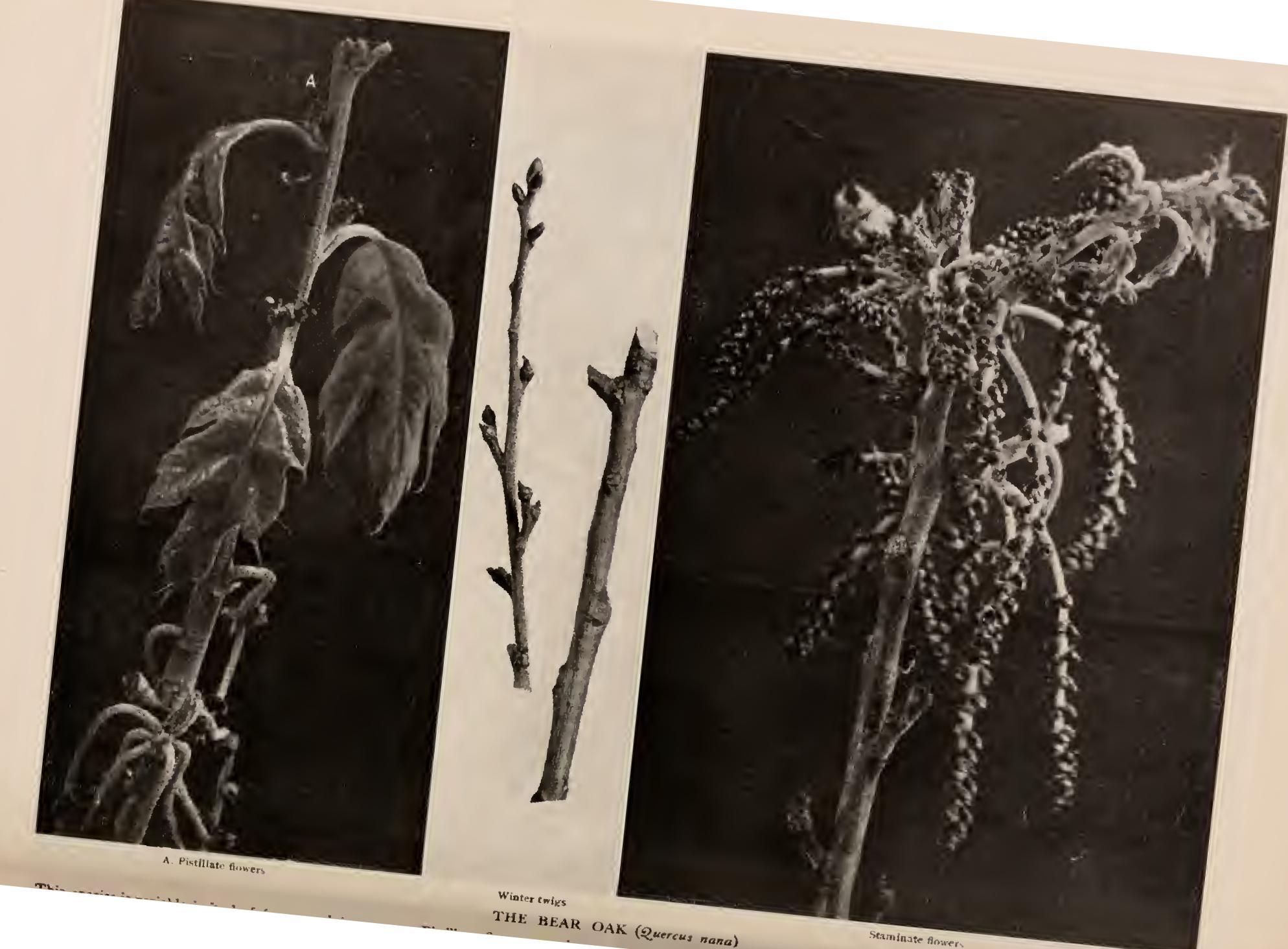
The Bear, or Scrub Oak (Q. nana, Sarg.), is a shrubby tree that creeps in thickets over rocky barren ledges from Maine to Virginia and Kentucky. Its downy-lined leaves vary greatly in their size and lobing. They are obovate, with the three largest lobes at apex, and tapering to the base, with at least one pair of lesser lobes below the broad middle sinuses. There is a resem blance between these and the leaves of the post oak, although the sharp, holly-like spines that tip each lobe and the two sizes of acorns each tree shows in summer prove this species to belong in the black-oak class. The little acorns, which are bitter and set in shallow saucers, are abundantly produced, and bears fatten on them. The species is often effectively planted to adorn rocky areas in parks.
The Black Jack, or Barren Oak (Q. Marilandica, Muench.), is a black-trunked, contorted, spreading shrub, or a tree reaching the height of 5o feet. Its leaves are leathery, with brown fuzzy linings, and the upper surfaces are set with rough, stellate hairs.
The leaf broadens to its apex and ends in three indistinct lobes of variable size and form, whose ribs protrude into the bristly points that characterise the black oak group. The obovate or pear-shaped outline is constant, however the lobing may vary.
The function of this ragged little tree is to clothe sterile ground from New York to Nebraska, and south to Florida and Texas. What it lacks in beauty it makes up for in a certain admirable ruggedness of character. The leaves are not as other oak leaves, and the tree's habit is as handsome as one could expect considering the worthless ground assigned it by Nature.
The Water Oak (Quercus nigra, Linn.) is a good-sized tree, with a leaf of somewhat similar outline, but thinner texture than those of the black jack. It is a favourite shade tree in the Southern States. It grows naturally along the borders of streams and swamps, but is easily transplanted, grows rapidly and thrives in cultivation. Its shining leaves, blue-green above, paler below,
vary from entire margins to lobing as deep as the average red oak shows. The acorn is a squat little nut in a shallow cup, set with fine scales.
Willow Oak (Quercus Phellos, Linn.)—A graceful, quick growing tree, 6o to 8o feet high, with slender branches that form a conical, round-topped head. Bark rather rough, reddish brown, with scaly surface; young trees, smooth. Wood pale, red-brown, coarse grained, strong, soft, heavy; sap wood lighter in colour. Buds small, acute, brown. Leaves alternate, leathery, short petioled, 2 to 5 inches long, linear like willow leaves, but obtuse at apex and base; upper surface bright green and glossy; lower pale green, dull, smooth; autumn colour yellow. Acorns biennial, not numerous, solitary or paired on short stalks; nut inch across, hemispherical, downy, yellowish brown, set in shallow saucer shaped cup; scales thin, ovate, dark reddish brown, hairy; kernel orange, bitter. Preferred habitat, low, wet borders of swamps. Distribution, New York to northeastern Florida (in the low maritime region just back from the coast); along the Gulf into Texas; north in low ground into Missouri, Kentucky and Tennessee. Uses: A fine shade and ornamental tree for Southern cities. Wood used in construction.
We think of oaks as being sturdy and rugged in their ex pression, leaving gface and delicacy to willows and birches, and such. Here is an oak whose leaves are willow-like in form, size and texture; and they hang on supple, pendant branches, like a willow's. The dainty acorns in their saucers are often needed to convince observers that the tree is truly an oak. But only the young trees are willowy in habit. The oak characters soon assert themselves.
Naturally, willow oaks grow on the margins of swamps, but they thrive as a street and shade tree, and are especially beautiful in the autumnal yellow of their foliage. A large tree grows in John Bartram's garden in Philadelphia; a small one seems to be holding its own without protection in the Arnold Arboretum at Boston, though its shoots are often nipped by frost.