Ii the Black Oak Group
The village of Flushing, Long Island, has proved through many years that the pin oak is an admirable street and shade tree. It is as easily transplanted as a box elder, so there is scarcely an excuse for not planting it. The flush on its opening leaves, the red flame that lights the tree in the autumn, and the dainty striped acorns in their scaly saucers—all combine to make an ornamental tree with scarcely a fault to set off its many horticultural virtues. The Europeans have cherished this tree for over a century. We Americans are just discovering it, and should make up for lost time.
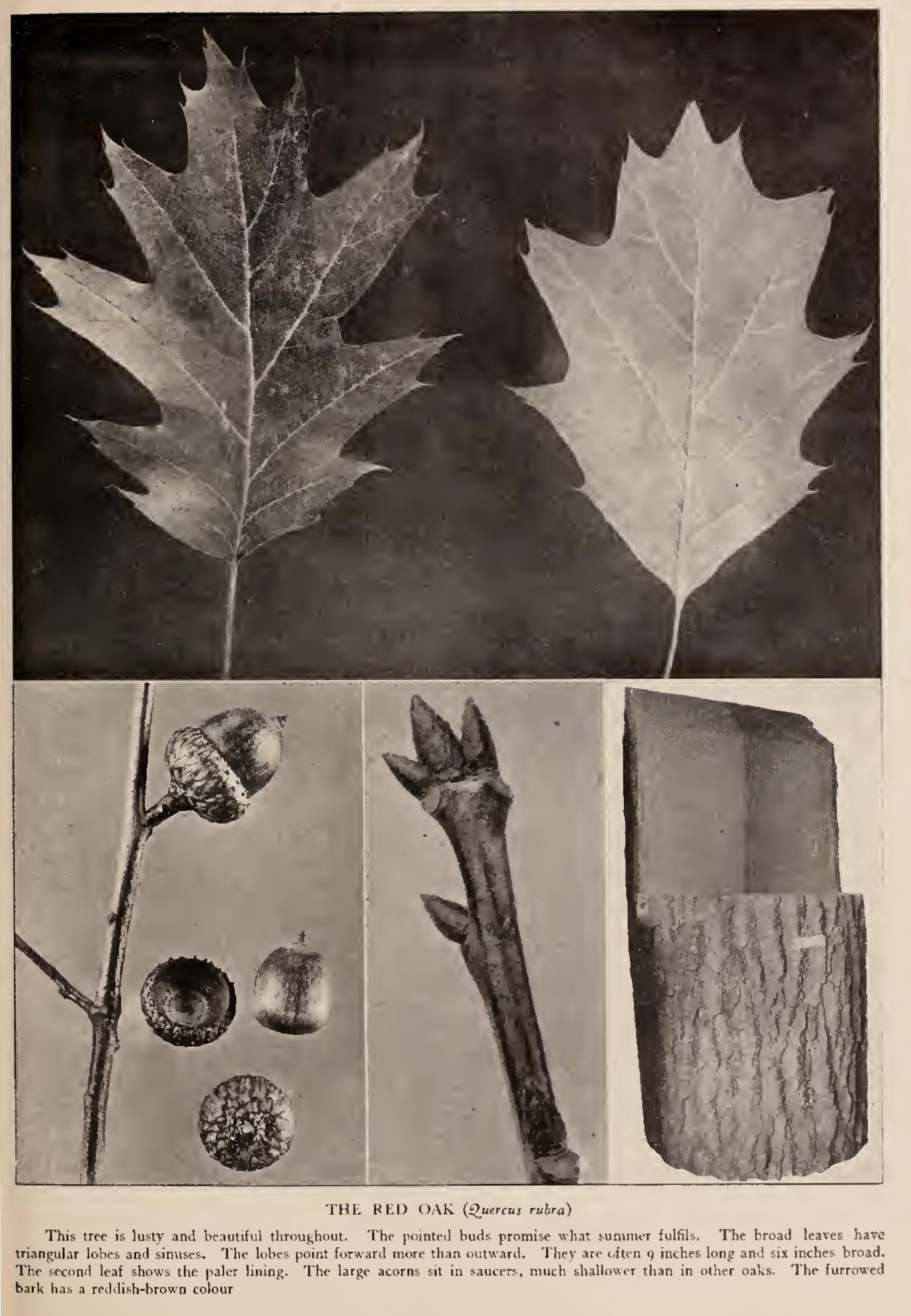
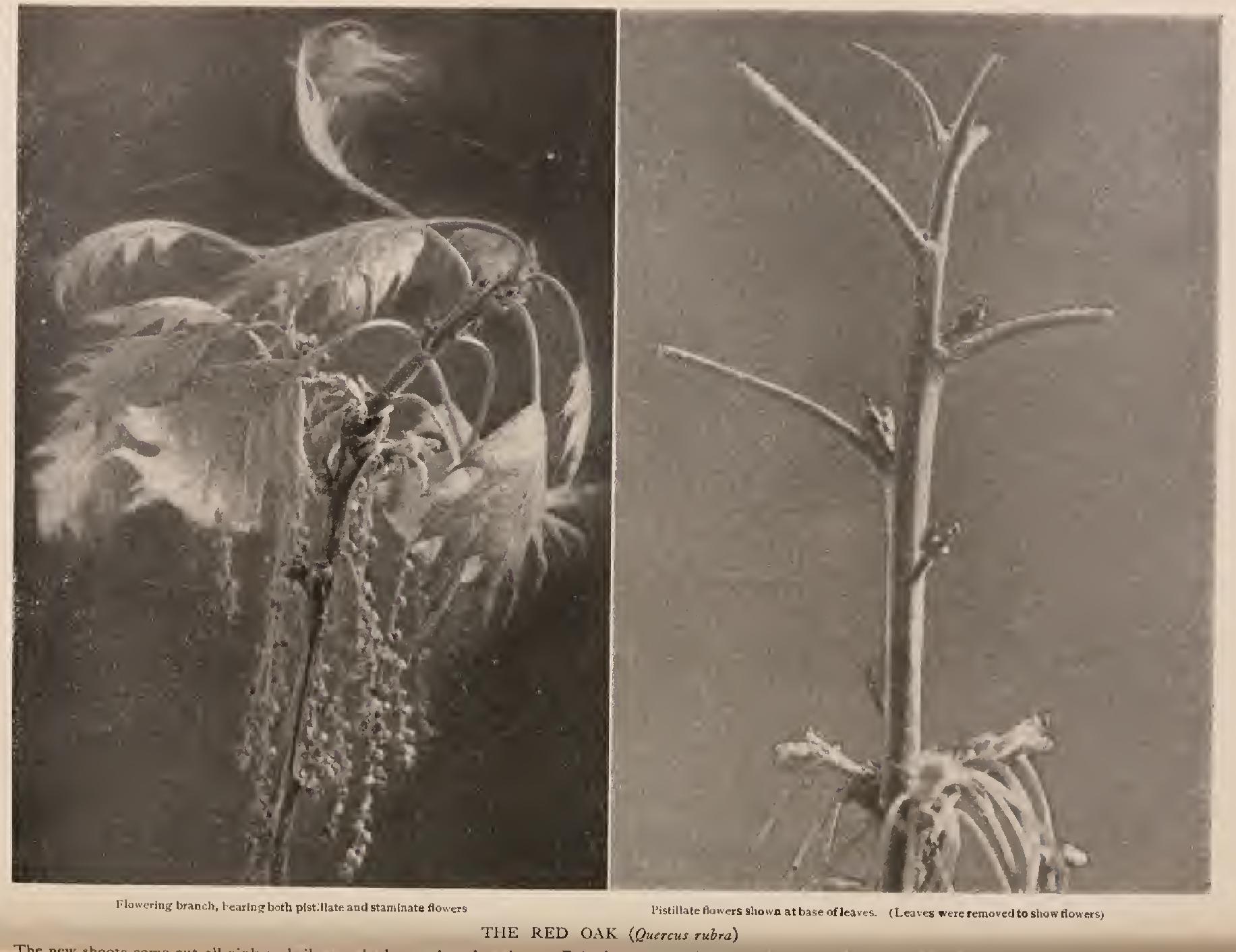
Red Oak (Quercus rubra, Linn.)—A large, stately tree, 5o to 15o feet high, with columnar trunk and round, symmetrical head of stout, spreading branches. Bark greyish brown with red tinge, with wide furrows between ridges; twigs reddish. Wood red brown, with darker sap wood, coarse grained, with well-marked annual rings and medullary rays; heavy, hard, strong. Buds reddish, pointed, inch long. Leaves alternate, 7 to 9-lobed, 5 to 9 inches long, 4 to 6 inches wide; lobes and sinuses both triangular in form; second pair from apex always largest; lobes irregularly toothed and bristly pointed; leaves variable in size and form; lining paler green, smooth at maturity; autumn colour deep red. Flowers, May, with half-grown leaves; staminate catkins, yellow, hairy, 4 to 5 inches long; pistillate, on short 2 to 3-flowered stems; stigmas, long, bright green. Acorns ripe second autumn; large, to 1t inches long; broad at base, in close scaled, shallow saucer; kernel white, extremely bitter, Preferred habitat, rich, well-drained stream borders. Distribution, Nova Scotia to Minnesota; south to Georgia, Tennessee and Kansas. Uses: A handsome, quick-growing shade and ornamental tree, easily transplanted and free from insect pests. Wood used in cooperage, cheap furniture, in construction and finish of buildings and for fuel. It is inferior to white oak. Bark rich in tannic acid, used in tanning leather.
There is no American oak more highly prized in Europe than the common red oak. It has been cultivated there for two cen turies, and splendid specimens are pointed out with pride, espe cially in Belgium, Germany and England. It is the "champion oak" which flames in English parks when the foliage of native species falls without a hint of the brilliant colouring which we always expect in autumn woods.
The red oak is so common in our Eastern forests that we have not realised its worthiness as a street and ornamental tree. Surely it is a stately tree in the forest, and as noble and benignant a figure as the white oak where it has ample room to develop its round dome. It grows faster than any other native oak and in a greater
variety of soils. It can be transplanted, even when 15 feet high, from the woods to a lawn, and not notice the change. After it becomes established a growth of a foot or more in height may be expected yearly, and an increase in diameter of an inch of wood in five years.
The shining leaves of red oak, though they are variable in form, are always cut oval and into triangular lobes which point forward, rather than outward. The sinuses are angled or rounded, but are not so broad as those of the black oak. These leaves are leathery and smooth, those of black oak are rougher. The bloom of red oak is more luxuriant than that of other oaks. The tree is fairly draped with its long yellow catkins, and the red stigmas shine out against the silvery pink of opening leaves.
The acorns of the red oak are unique. They are large, in pairs, on very short stalks, and the nut sits in a broad, shallow saucer covered with small, close-fitting scales. The acorn crop is two years in ripening, but the tree is so vigorous that there are usually nuts, or at least saucers, in evidence to identify the tree, if the leaves do not determine it with certainty. The under bark is red, while that of black oak is orange-yellow. This is another way to tell the two species apart at any time of year by the aid of a pocket knife.
Scarlet Oak (Quercus coccinea, Muench.)—Slender, sym metrical tree, 7o to i6o feet high, with graceful, curving branches and twigs, tapering trunk and round head. Bark brown or grey, rough, scaly, shallowly fissured; inner layers reddish; twigs green, scurfy, becoming red and smooth. Wood pale brownish red, hard, coarse grained, strong, heavy, of rapid growth. Buds pointed, hairy at tip, small, reddish. Leaves oval or obovate, thin, smooth, shining above, paler beneath, sometimes hairy tufted on veins, 3 to 6 inches long, 2 to 5 inches broad, with 5 to 7 spreading bristly pointed and subdivided lobes, with deep, rounded sinuses between; autumn colour scarlet; petioles slender, long. Flowers staminate catkins slender, reddish before maturity; pistillate with long stigmas bright red. Acorns biennial, to inch long, half covered by short-stalked cup, smooth, triangular, close-pressed scales, rounding in at the top; kernel white, moder ately bitter. Preferred habitat, dry, fertile loam. Distribution, Maine to Florida, west to Minnesota, Nebraska and Missouri. Best development in lower valley of Ohio River. Uses: A favourite ornamental oak in this country and in Europe. Lumber used for same purposes as that of Q. rubra.