Ii the Black Oak Group
The California Live Oak (Quercus agrifolia, Nee.), with holly-like leaves, is a ponderous tree with a low, wide dome, very common in California, extending to the coast and farther to the islands of the southern half of the state.
The wood of this species is of a hard, durable sort, but can be got out only in short boards, as the trunk is not tall. It is excellent for fuel.
The Highland Oak (Quercus A. DC.) is a large tree on the elevated foothills back from the coast in California. Its dark green, shining evergreen leaves resemble those of holly, Hex opaca, except that they are more finely toothed, and some times entire. The acorn is long and slender. The wood is of especial value in mechanical construction, being hard, tough, strong and durable. It is also valuable as fuel.
The Kellogg Oak, or California Black Oak (Quercus Cali fornica, Coop.), is large and beautiful, spreading wide its pictur esquely gnarled branches covered with smooth, bright green leaves, much like those of the Eastern red oak. It has also stout twigs and rough dark-coloured bark, and the reddish coarse grained wood strengthens still farther the resemblance of the two trees. The acorns of the Western tree, however, sit in deep cups that half conceal them; the red oak holds its nuts in shallow saucers.
The uplands only satisfy this Western black oak. It holds aloof from the plains and keeps back from the sea. Sunny open groves of it, mingled with white oaks, are common among conifers on mountain slopes and high valleys throughout California and north to the middle of Oregon.
The black bark of this oak is twice as rich in tannin as hem lock bark. The wood is rich in colour and wavy grained, but lumbermen dislike it. It dries very slowly, and is likely to be perforated with "pin knots," which mar and weaken it.
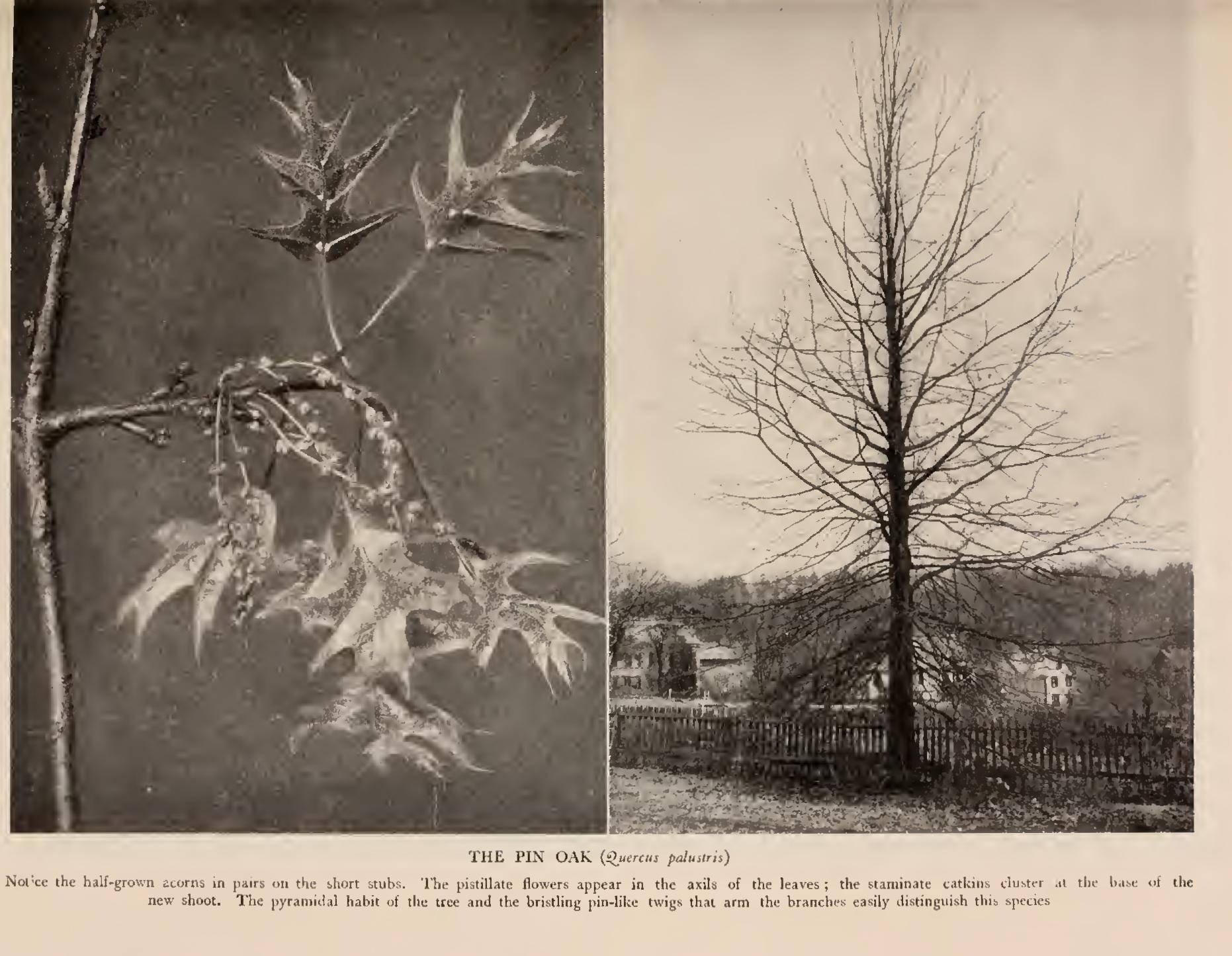
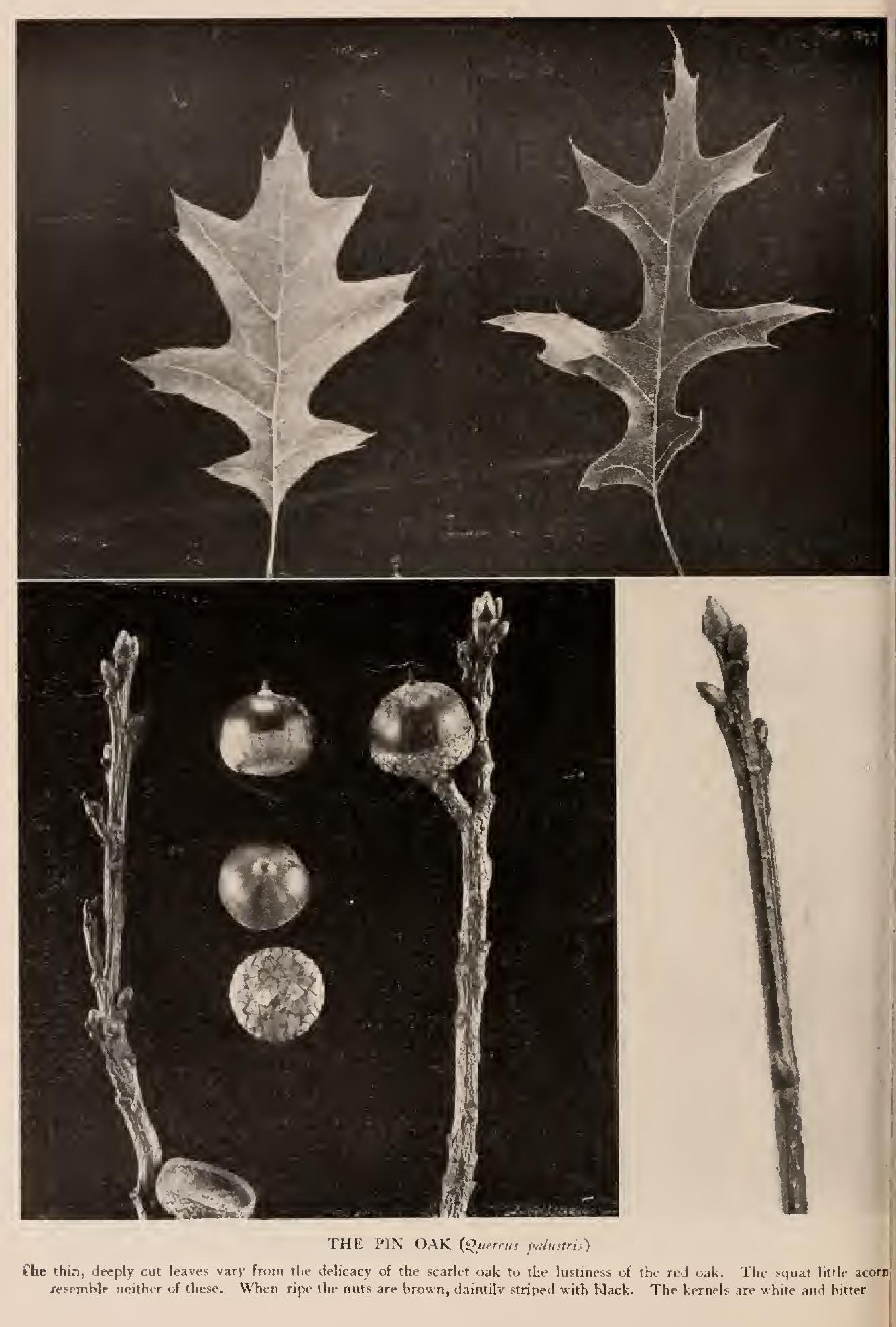
Pin Oak, Swamp Spanish Oak (Quercus palustris, Linn.) —A graceful, pyramidal tree when young, becoming oblong and irregular, at length; 5o to 12o feet high; branches horizontal, short. Bark grey-brown, shining, smooth, becoming scaly on trunk; twigs red, tomentose. Wood hard, tough, strong, heavy, coarse grained, light brown, variegated. Buds small, acute, brown. Leaves alternate, 4 to 6 inches long, deeply 5 to 7-lobed with wide sinuses almost to the midrib, shining above, dull and pale beneath, scarlet in autumn. Flowers in May, with half grown leaves; staminate, in hairy catkins, 2 to 3 inches long; pis tillate on short hairy peduncles, with bright red stigmas. Acorns
ripe in autumn of second year, to inch long, pale brown, streaked, broader than long and set in a shallow saucer-like cup, of close, reddish scales, which is lined with hair; kernel white, bitter. Preferred habitat, low, moist soil. Distribution, Massa chusetts to Delaware; west to Wisconsin and Arkansas. Uses: Handsome rapid-growing tree for avenues or lawns. It has fibrous roots and so transplants easily. Wood used in construc tion, cooperage, for interior finish of houses, and for shingles and clapboards.
The tourist who visits Washington and takes the trolley rides recommended by the guide book must have noted the superb avenues of native trees that give character and dignity to the whole city. For long stretches a single species holds uninterrupted sway, and the distinctive traits of the various kinds are thus impressed upon the observer, even as he flies by them on the car. I remember the beautiful pin oaks on the way from the capitol to the navy yard. Only a few years ago they were little striplings from the nurseries. Now they are goodly shade trees, and the beauty of youth is still upon them. Each tree is a glistening pyramid of leaves, that dance as the breeze plays among them; for the leaf stems and the twigs are slender and flexible, and the blades, catching the wind, keep the treetop in a continual flutter.
The leaves are deeply cut into five or seven spiny-toothed blades that point forwaid. The leaves of scarlet oak, cut with about the same "waste of cloth," point outward and have more rounded sinuses than those of the pin oak.
The leaf might confuse us, but the pin-oak tree tells its name before one is near enough to see the leaf distinctly. The tree has a broad pyramidal form, with slender branches stretched out hori zontally as far as they can reach. The spur-like little twigs that cluster on the branches throughout the treetop are choked to death by being crowded, but they remain, the "pins" that char acterise this species of oak. When it gets old the pin oak loses some of its symmetry and beauty. It holds on to its dead branches, but there is a dignity in its bearing that is admirable, even in its decline.