Ii the Black Oak Group
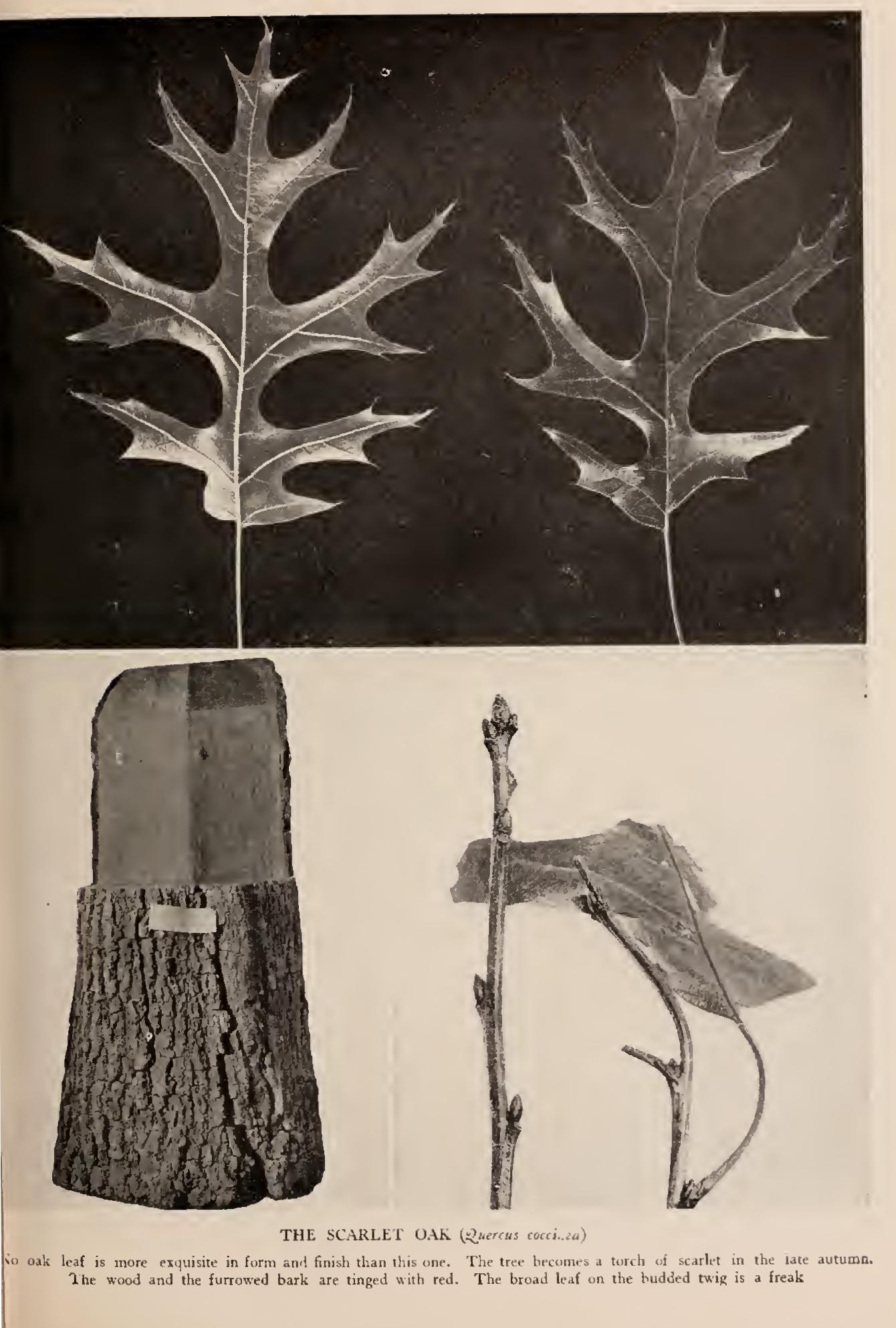
The splendour of our autumnal forests owes much to the foliage of the scarlet oak. The tree blazes like a torch against the duller reds and browns in the woods, and often keeps its brilliancy until after snow covers the ground.
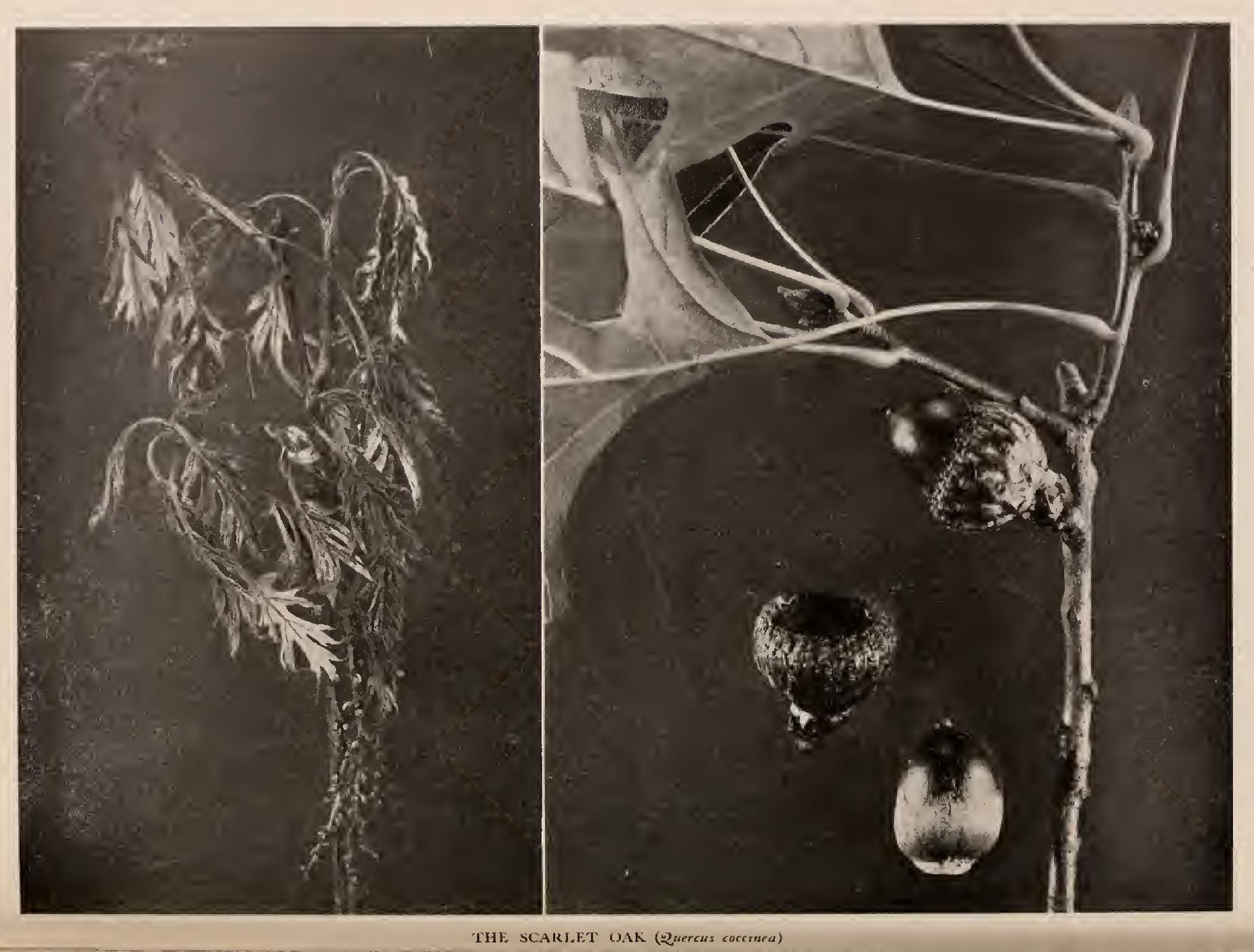
There is no reason for confusing the black, red and pin oaks with this species. They are all heavy and coarse beside it. Their leaves are leathery compared with the papery thinness of these. In summer the scarlet oak lifts its young shoots, delicately pink above the last year's growth, and waves them like long, tapering plumes, set with skeleton leaves. Break a twig, and the smoothness and delicacy of the leaves strike you. Just a pale trace of fuzziness remains along the veins on the under side. The wide, rounded sinuses are cut nearly to the midrib, and the leaf flutters airily on a long petiole. The acorn differs from the black oak's in having its cup drawn tightly in at the top.
Though we have planted this tree less often than the red oak and pin oak in this country, it is coming to be recognised as superior to both, while in hardiness and rapidity of growth it is the equal of either.
The Texan Red Oak (Quercus Texana, Buckl.), tallest of American oaks, and one of the handsomest, grows from Iowa to Indiana and south to Texas and Florida. It is closely related to the red and scarlet oaks, showing the characteristic acorns of the former and the leaves of the latter.
Possibly the giant red oak that stood on the borders of the Bayou St. Barb in Louisiana, fifty years ago, "44 feet in girth and tall according," was of this Texan species. Quercus rubra does not grow so far south.
Black Oak, Yellow Oak (Quercus velutina, Lam.)—A tree 7o to go feet, rarely 15o feet high, with narrow, open head of slender branches, occasionally wide spreading and short trunked. Bark usually very dark grey or brown, thick, with rough broken ridges and deep furrows; inner layers orange yellow, rich in tannin. Wood light reddish brown, coarse grained, with annual layers strongly marked and thin medullary rays, hard, strong, heavy, not tough. Buds large, pointed, angled, downy. Leaves alternate, 4 to to inches long, 2 to 6 inches wide, deeply cut into 7 to g broad, bristly toothed lobes with rounded sinuses, thick, almost leathery texture, lustrous, dark green above, smooth, or somewhat hairy, brownish beneath; petioles long, yellow, flattened; autumnal colour brownish yellow, rarely reddish. Flowers, May, with half
open leaves; hairy, reddish, stigmas bent back. Acorns biennial, solitary or in pairs, short stalked; nut ovoid, smooth, in cup of loose scales; rim fringed, not incurved; kernel yellow, bitter. Preferred habitat, rich, moist soil. Distribution, Maine to Florida; west to Minnesota, Kansas and eastern Texas. Uses: Rarely planted for ornament and shade. Wood used in cooperage, for furniture and in general construction; bark in tanning and dyeing.
Since early spring I have been watching life kindle and glow in the top of a grim old black oak. I knew the tree then by its black bark and its large, downy winter buds, and the velvety scurf on its young shoots. Still another sign, constant the year round, proclaimed this tree a black oak beyond question. Under the rough outer bark is an orange-yellow inner layer, easily reached by a little digging in one of the furrows. No other oak need be confused with this species if the observer carries a pocket knife.
This tree, though it was late March, was still holding some of its old leaves. On twigs destitute of leaves I found a leaf stem, here and there, frayed into many threads, showing how tough its are.
My black oak leans up against a bluff, and thrusts its giant arms out over the wide roadway. One sided as the situation compelled it to grow, it is yet a majestic tree, "framed in the prodigality of Nature." From the path below I can just touch its lower limb with the ten-foot pruning shears; but by climbing the bluff I walk right into the treetop. Here I go to see things happen in the spring days.
The buds open and the shoots set with leaves push rapidly out. The whole treetop flushes crimson in the morning sunshine, and there is a "pale moonbeam's light" gleaming through it. Can it be dewdrops pearling the young leaves? I ask the question, and the tree answers it as soon as I get near enough to examine a spray. The red glow is from crinkly, half-awake, baby leaves, and their brilliance is softened by a silky covering of white hairs. This is especially thick on the under side, but the silvery mist over the treetop lasts only a day, or until the leaves are grown large and self-reliant enough to get on without such protection. Then the fuzz is suddenly shed from the upper sides of the leaves, but the under surfaces are more or less coated throughout the summer with a dull scurfy down.