Blinds Fittings for Doors
door, butt, hinge, butts, type, spring and hinges
but
ts are the cheapest type of butt hinges, and are constructed on the prin ciple already mentioned in connection with the old-fashioned strap hinge. One half of the hinge bears the pin, and the other half the sleeve which fits over the pin. This construction necessarily makes them non-reversible. The wear in this type of butt comes all on one surface. The door may be removed, when this form of hinge is used, by simply opening it clear of the casing and lift ing it away from the pins. Care should be taken to notice whether right-hand or left-hand butts are needed, when using this type.
Fast joint-butts are similar to the loose-pin butt, with the exception that the pin is riveted firmly in place. This type is not often used on doors of any considerable size, on account of the difficulty met in removing a door. This style of butt has its advantage when horizontally placed butts are needed, since the pin cannot fall out, as might be the case if a loose-pin butt were used.
Ordinary butts used in building are square when open. When special forms are designated in catalogues—as a 3 by for instance—it means that the butt is 3 inches high by inches wide when open. The first figure indi cates height. The common sizes for interior doors are the 4 to 5-inch sizes; while for heavier doors or entrance doors, the 5 to 6-inch sizes are used. In some cases where a light hinge would be sufficient to carry a door, but where the finish around the door prevents it from swinging clear back against the wall, it may be necessary to use a larger butt in order to allow the knuckles to project out far enough so that the door when opened may not strike. The rule is to allow the knuckles to project a little more than one-half the distance from the surface of the hanging stile, where the hinge is attached, to the surface of the finish on the casing on the knuckle side of the door.
While it is common practice to place only one pair of butts (two hinges) on an ordinary light door, the use of one and one-half pairs will give better results both in wearing qualities and in rigidity. The middle hinge prevents the door from springing. Large or heavy doors, or doors over seven feet high or four feet wide, should always have three hinges.
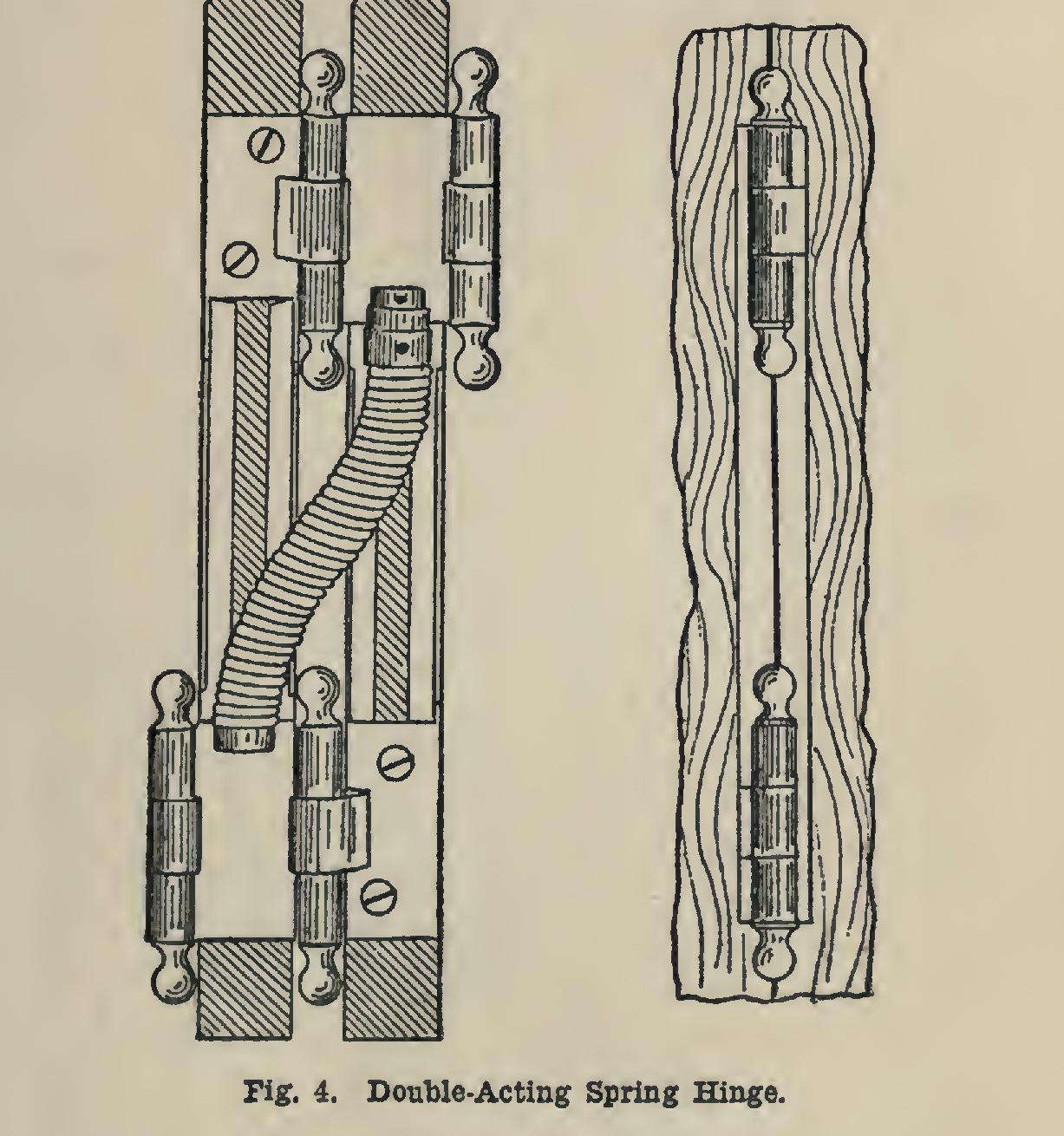
Fig. 3 shows a type of spring butt which is used on doors that are to be self-closing. This butt is useful for screen doors, or, in a heavier form, for light entrance doors. The constant
slamming of doors fitted with such hinges is liable to rack and loosen the parts of the door. The tension in the spring of these hinges is adjustable for either slow or quick closing.
This form of butt is also doubled with an other of the same kind by a connecting plate be tween the two spring cases, forming what is known as a double-action spring butt or hinge. These are used on doors which must swing in either direction, and yet remain closed when still. Pantry doors and doors between kitchen and dining room, often have this type of hinge.
Fig. 4 shows a type of double-acting spring hinge for use on heavy entrance doors. This same form of hinge is finished without the spring, if desired. Double-acting hinges—espe cially of the spring type—are both heavy and expensive. The largest size of the kind shown in the figure weigh thirty pounds per pair and are listed at from $7.50 to $12.00 per pair.
Right and Left Hand.
We have spoken in the preceding pages of right-hand and left-hand butts, and, as these terms will be used again in connection with locks, a few words of explana tion will be in place.
Fig. 5 shows a floor-plan of a house, with the doors marked R. H. for right hand, and L. H. for left hand, as the case may be. The rules which govern the marking of this diagram are as follows: The hand of a door is determined from the outside, this being the street side in case of an entrance door; the hall or corridor side, for a room door; and the room side, for a closet or clothes-press door.
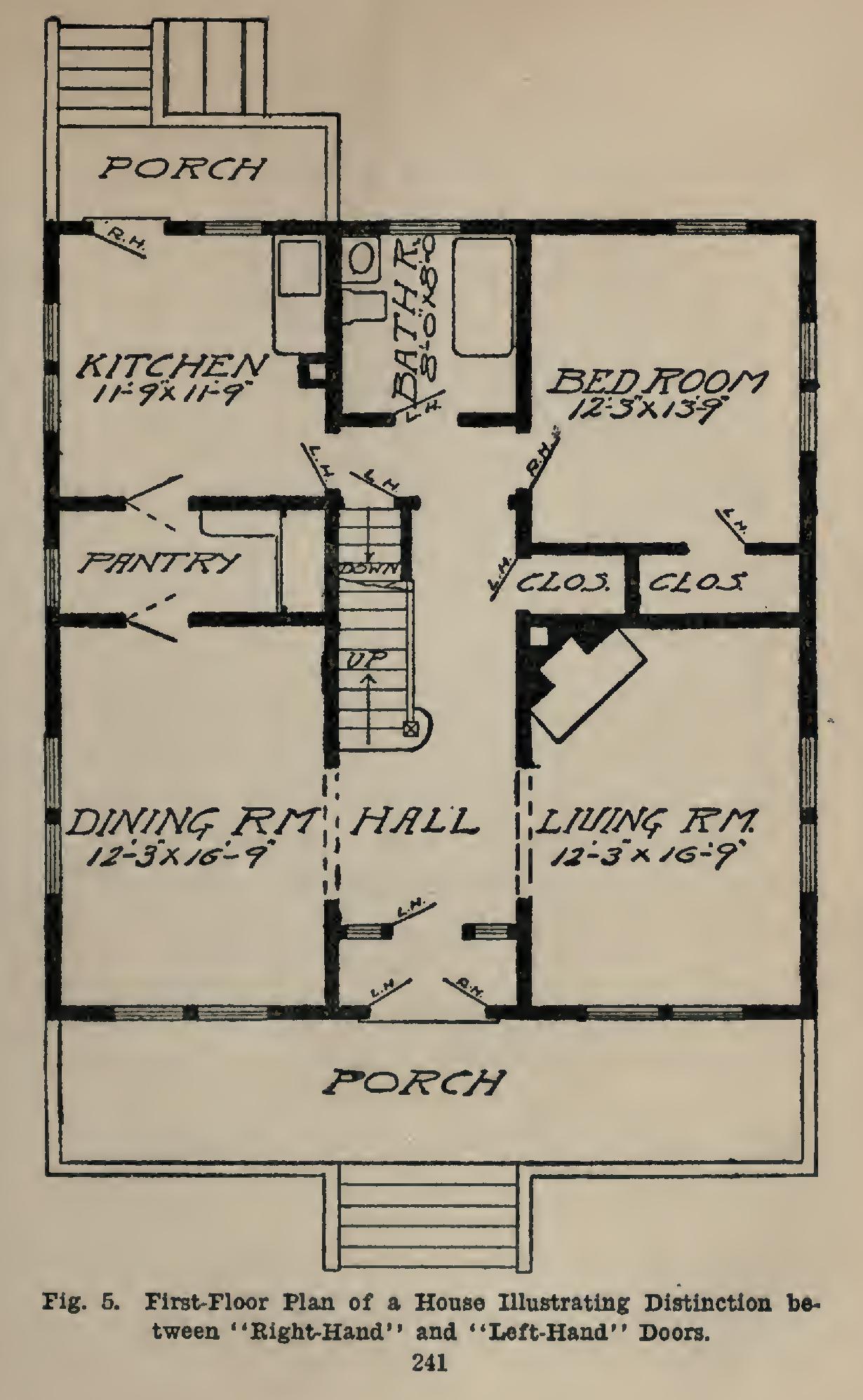
In the case of a door between two communi cating rooms, the outside is the side from which the butts are not visible when the door is closed.
If, when standing outside a door as explained above, the hinges or butts are on the right-hand side, it is a right-hand door; if on the left side, it is a left-hand door.
Latches and Locks.
Now that we have our doors hung in place with the proper forms of hinges, the next step is to provide latches and locks to hold them closed.
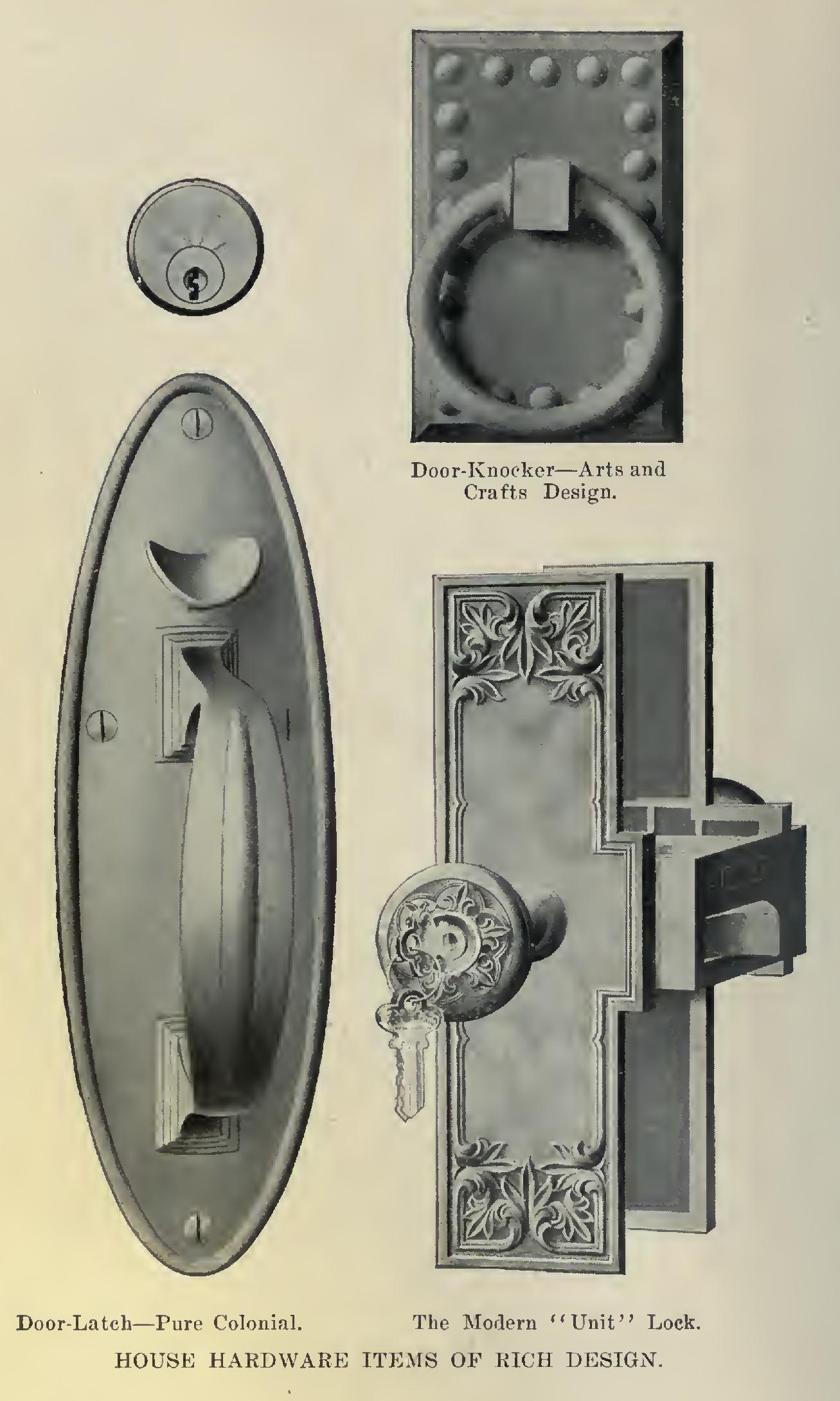
Latches and locks are divided into two gen eral types—either rim or mortise. Rim latches and locks are those which are screwed directly onto the stile of the door; while the mortise type are set into a cavity mortised into the stile and closed by the front plate of the lock or latch.