Blinds Fittings for Doors
knob, spindle, door, fig, bar, inside, knobs and latch
Spindles which connect the knobs with the latch or lock, are of two general types: the straight bar spindle, and the swivel spindle. The bar spindle is made either as a bar with small tapped holes near each end for the insertion of a small screw in the shank of each knob, or by the placing of three parallel bars together so that they form a square bar, the middle bar act ing as a wedge against the other two. The solid bar spindle has the defect of seldom having the screw-holes occur just where they are needed for a proper adjustment of the knobs. Small washers are inserted along the bar to make up for this inequality of spacing. The result is that the knob is either too tight to work as it should, or so loose that it rattles.
The bar built of three parts is more satisfac tory in that the knob can be adjusted in any position by means of a set screw, and the friction resulting from the wedge-like action of the parts will hold it securely after it is once set in place.
Another advantage of this form of spindle is that if the set screw loosens at all, it is noticed from the slipping of the knob; while in the solid spindle, the set screw generally drops out and is lost before the knob actually comes off.
The swivel spindle is similar to the ordinary spindle, with the exception of a swivel-joint lo cated in the middle of its length. This spindle used on locks where stop work changes the latch into a lock. The outside knob cannot be turned, while the inside can still be turned at will.
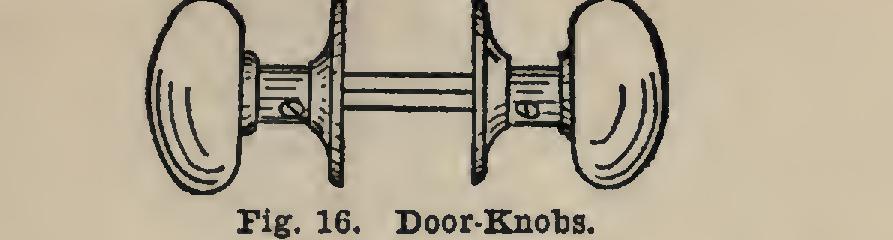
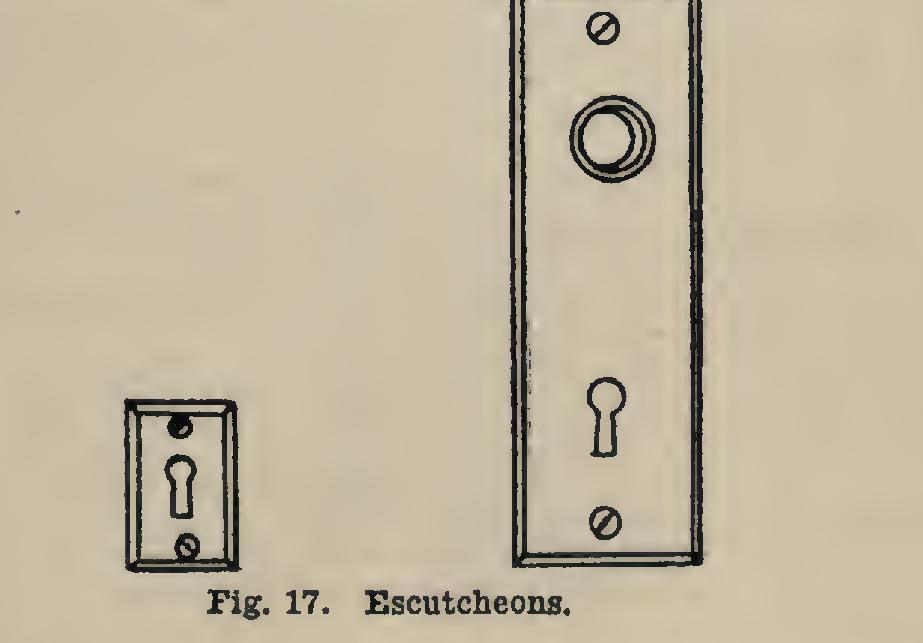
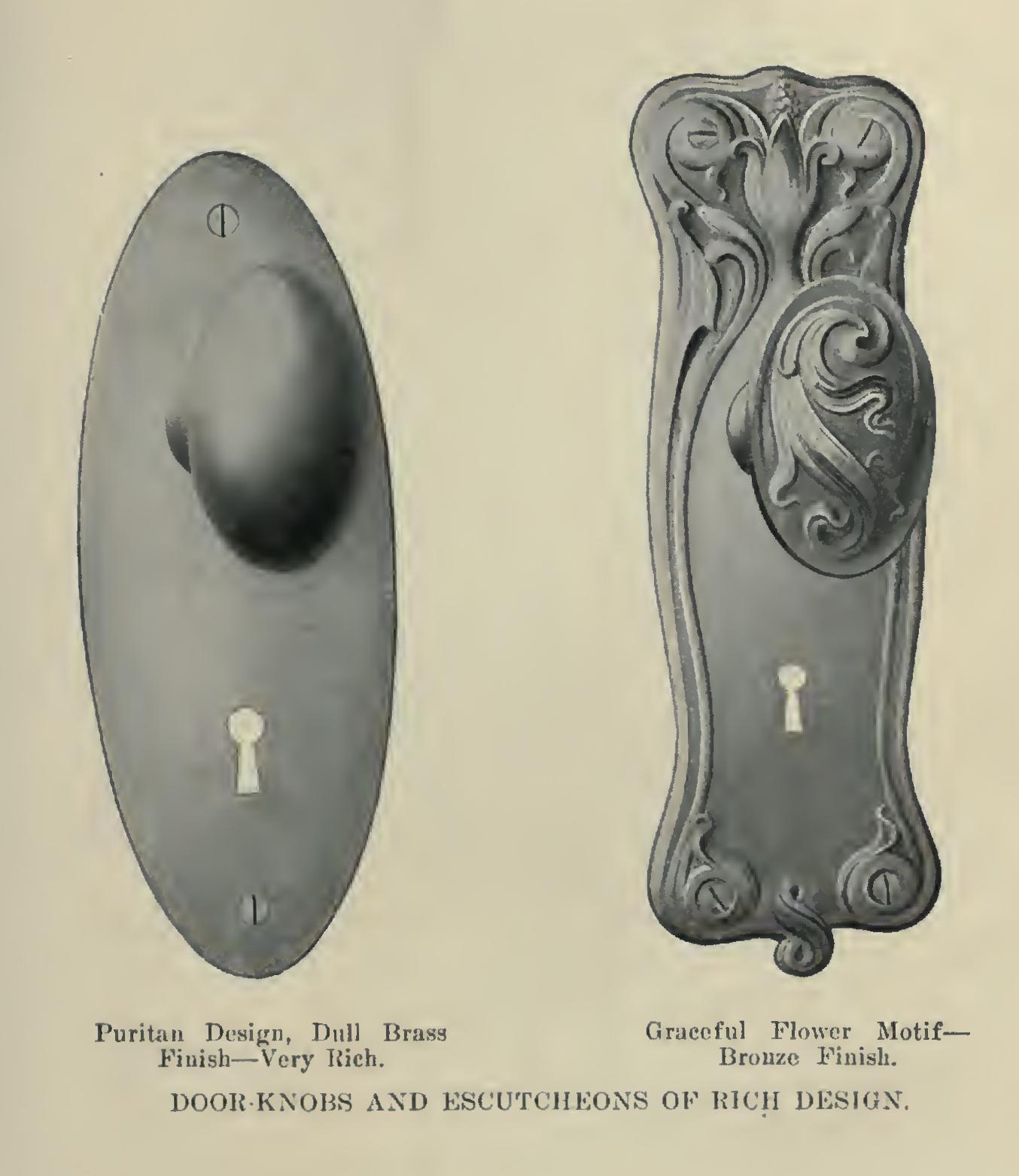
Fig 16 shows a pair of ordinary door knobs with spindle and roses for use when no escutch eon plate is used. The roses are omitted when knobs are used with regular escutcheons as shown in Fig. •17.
In some of the heavier and more ornamental lock and latch sets, forms of lever handles and T-handles take the place of knobs. These are not common in general residence work, except in the case of very light catches and fastenings for cupboards, etc.
Fig. 17 shows two forms of escutcheons, one for a keyhole alone, and the other a combina tion for keyhole and knob. When the combi nation type is used, care should be taken to see that the projecting rim shown in Fig. 17 around the hole for the knob shank and spindle is at least of an inch long, and that the knob shank fits it closely. This allows for a good stable bearing surface for the knob shank and pre vents a loose and sagging knob. Care should
also be taken that the plate is of sufficient length so that the screws which hold it in place will clear the mortised cavity in the door stile. Otherwise they would have but slight holding power.
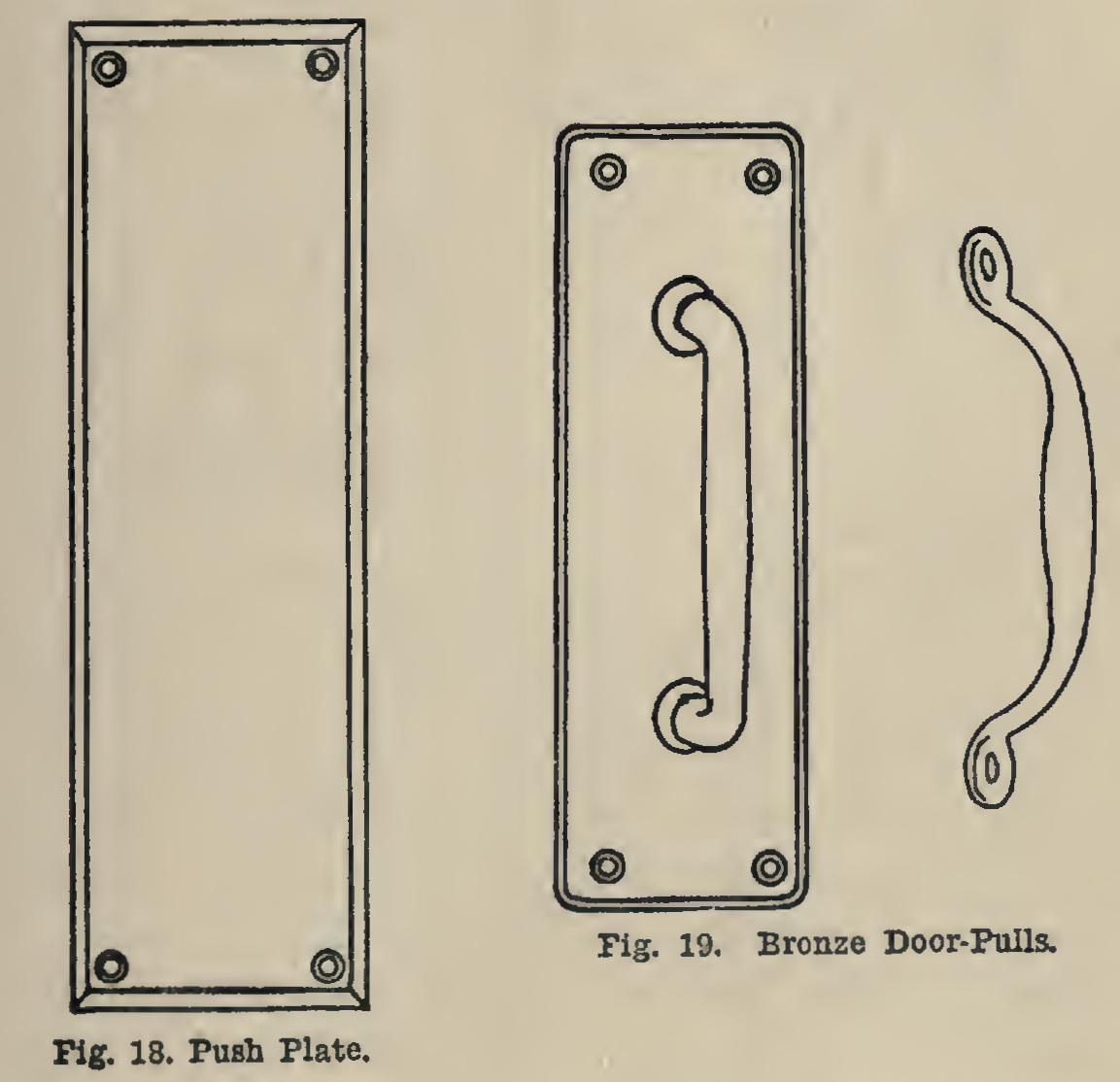
Push plates and kick plates are another form of trim used on doors which are either of con siderable weight or subjected to frequent and hurried use. Fig. 18 shows an ordinary plain form of push plate. The use of such plates gives protection to those parts of the stile and bottom rail which are most subjected to wear.
Figs. 19 and 20 show two forms of door-pulls for use on heavy doors or on doors which are not provided with latch and knob. Fig. 19 repre sents a high-grade form of pull made from wrought bronze; while Fig. 20 shows a cheap iron type which is used on barns and rougher work.
An old form of door latch which is often used now on unimportant doors and where appearance is not of great importance, is a type of thumb lift-latch. This consists of a thumb lever pass ing through a slot in the top part of an iron or brass handle similar to Fig. 20. The raising or depressing of this thumb lever from the inside or outside of the door lifts a flat bar, pivoted at one end, from a catch (fastened to the casing) in which the other end rests.
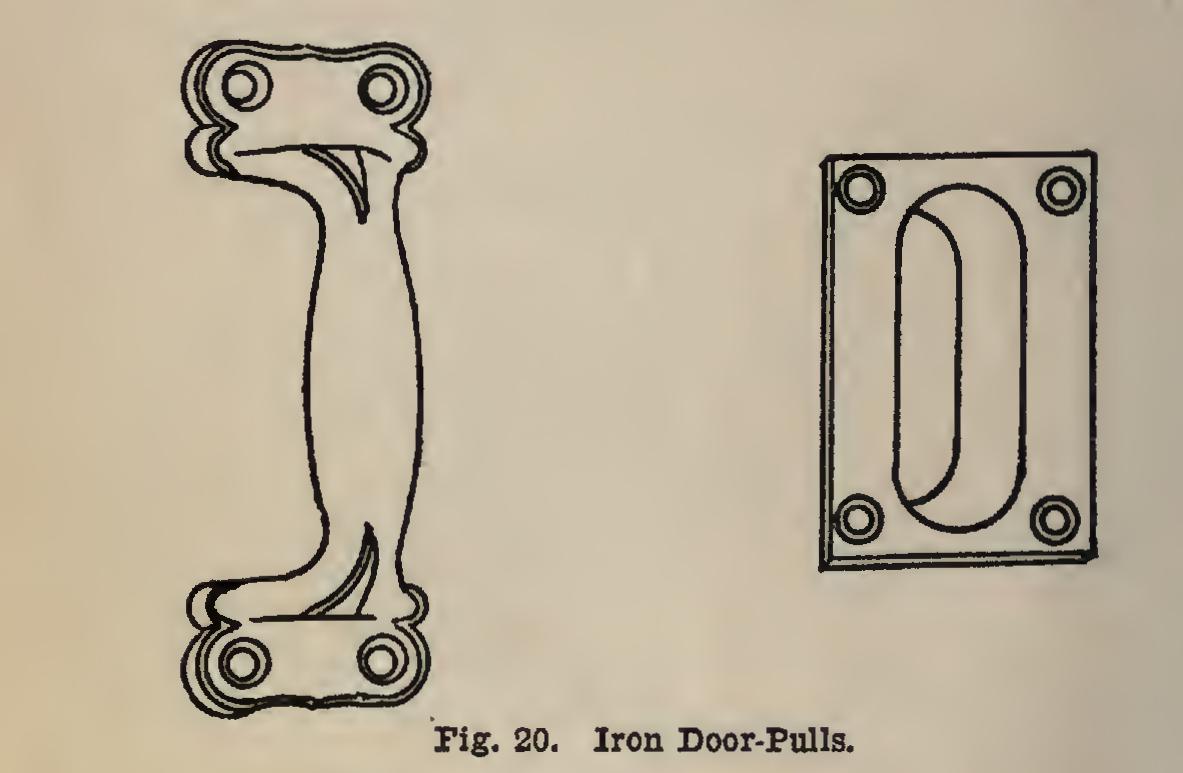
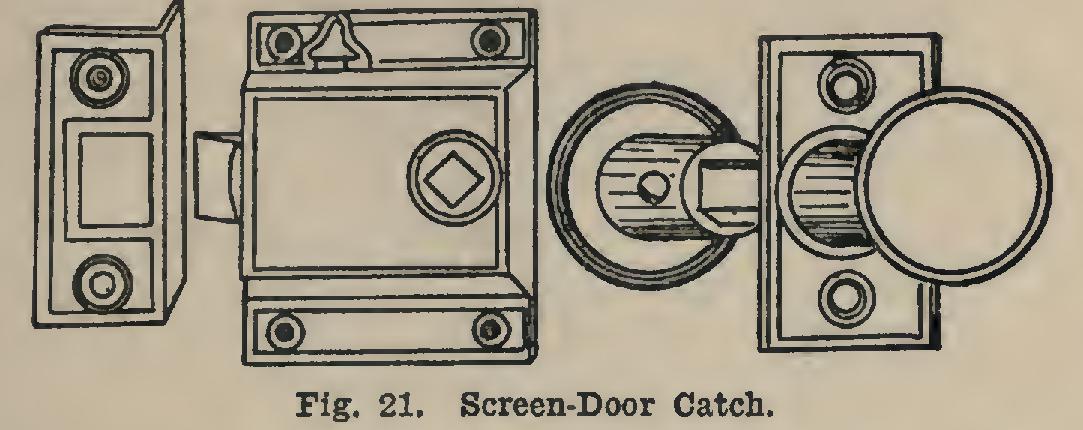
Fig. 21 illustrates an ordinary type of screen door catch which is fastened directly to the rim of the door. Other more expensive types do away with the inside knob, substituting a lever handle in its place. Mortise types of this catch can also be obtained.
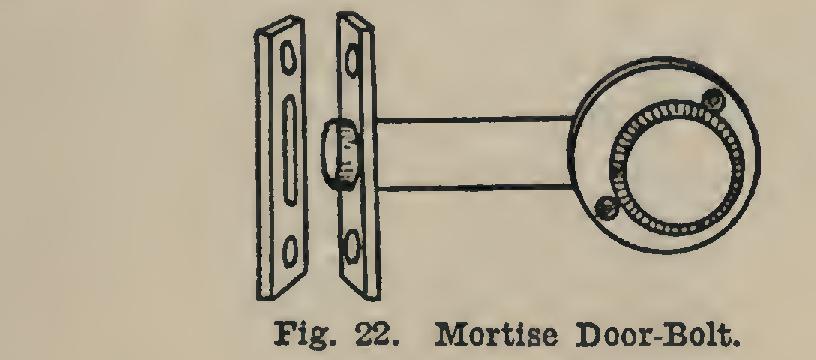
As a means of protection from the inside, mortise door-bolts are frequently employed. As seen in Fig. 22, these consist of a stout bolt en closed in a case and mortised into the stile of the door, the front plate fitting flush with the edge of the door, with a corresponding flat strike sunk into the casing. The bolt is moved by a cog movement through a distance of about of an inch by turning the knob shown. This knob, with its rose, is placed on the inside of the door.
Foot-bolts and chain bolts are used with double doors to secure one half of the door in place while the other is free to open. As the name implies, the foot-bolt is used on the bottom rail, while the chain-bolt with its chain hanging down within reach is fastened to the top rail. These bolts, of course, are for inside use.