Miscellaneous Framing
air, chord, angle, chords, span, ice and lower
As the top chord is a compression member, it is not necessary to clamp it; but all joints should fit close so as to make compression even throughout.
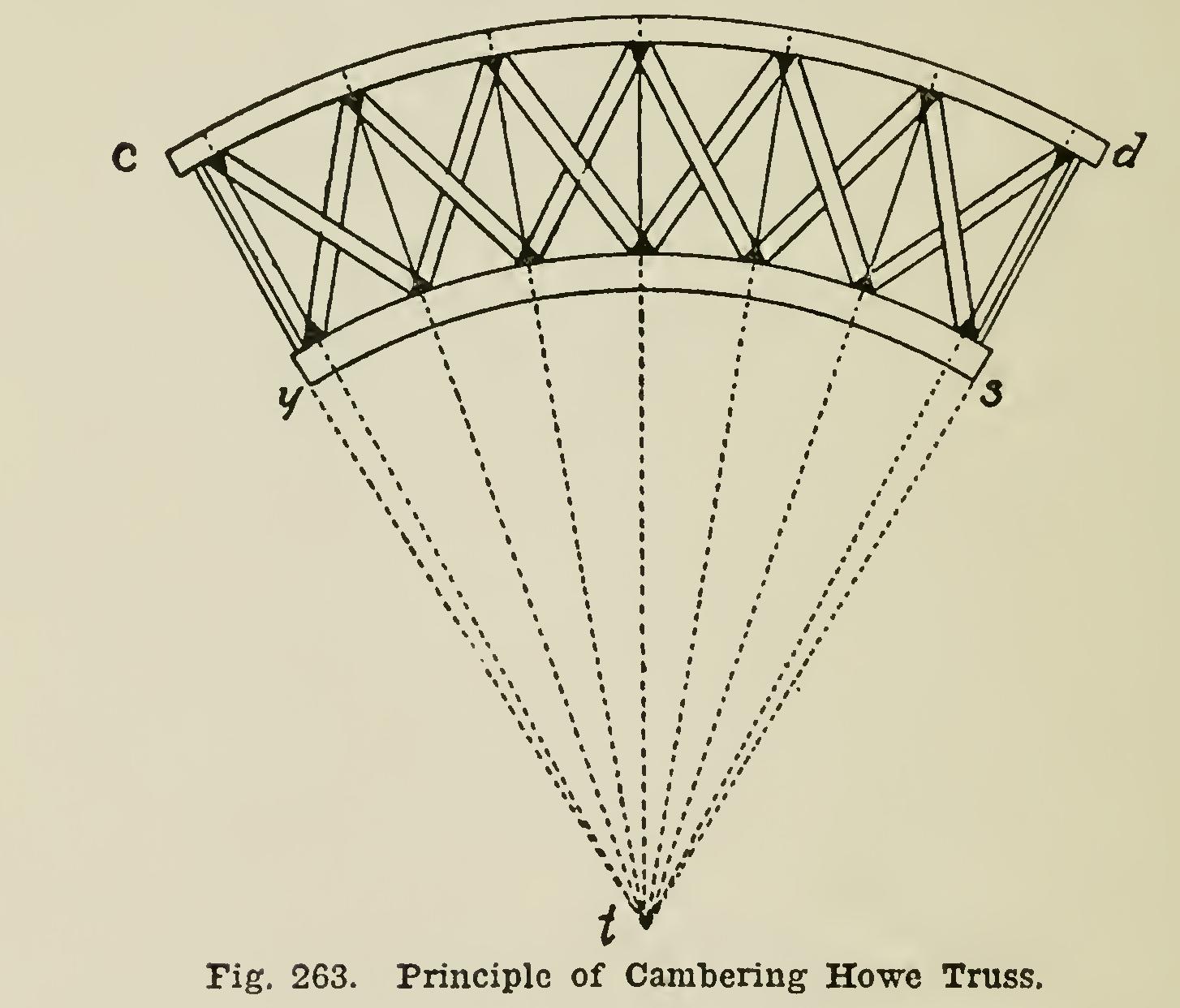
In practice, the members of the upper and lower chords of bridges are not placed perfectly in line, but so that the chords curve slightly with the convex side upward. This curve is called the camber. Its object is to prevent the truss from bending- down below a horizontal line when heavily loaded; when the chords are cambered (see y s and c d, Fig. 263), they become approxi mately concentric arcs of two large circles, of which the center is at t; the upper one plainly becomes longer than the lower one. The verti cals, instead of remaining truly vertical, become portions of radii of the arcs mentioned; and, although their lengths remain unchanged, their tops are farther apart than their feet, and this renders it necessary to lengthen the diagonals.
If we divide the span in feet by 50, the quotient will be ordinarily a sufficient camber in inches; this amounts to one in 600; the cam ber to be used is, however, usually stipulated in the specifications.
A well-built bridge of good design should not, under its greatest load, deflect more than about one inch for each 100 feet of its span; in fact, the deflection is frequently much less than this. The excess of length of the upper chord over that of the lower one will be: 8>
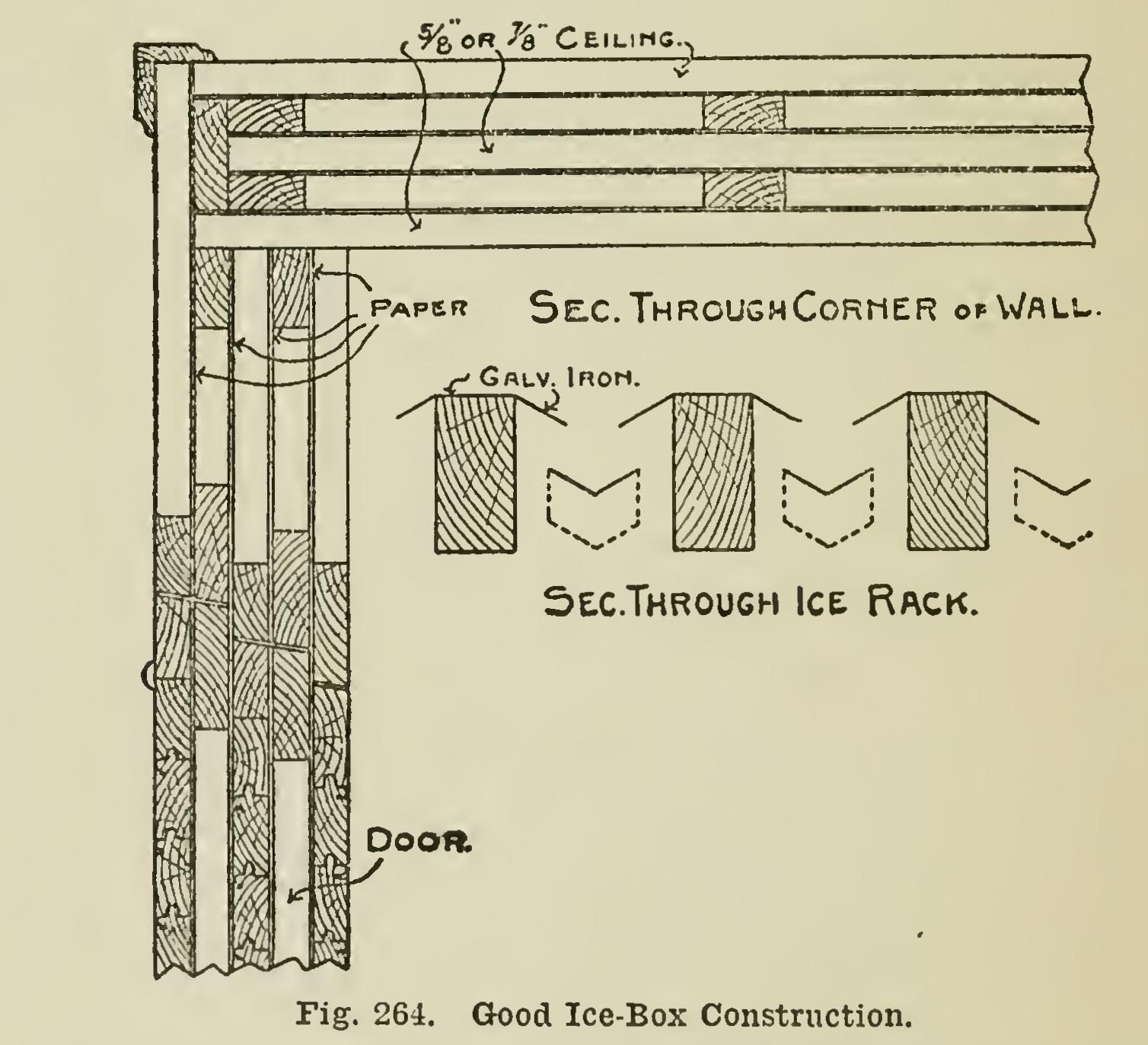
How to Build a Refrigerator. In construct ing a refrigerator, there is no necessity of char coal or any filling whatever. Simply construct, as in Fig. 264, two or more perfectly air-tight walls, with dead air chambers between them; this makes the best possible insulation, as air which is absolutely confined is the best insulator. Three air-tight walls, with space be tween them, will make a good room for refrig erating purposes.
A cheap way to obtain this would be to build the outer wall, and cover with good two-ply red rosin sized building paper. This should then have a coat of linseed oil to make it air-tight and durable; then strip this with strips, coil again, and cover with paper as before, being sure that all joints are stripped down and air tight. Next cover the strips with paper as before (this may be oiled and dried before applying), and finish with the inner wall of ceil ing, which can be best coated with shellac. To make a job which will economize ice, this should be the construction of floor and ceiling as well.
Now, as to the ice shelf. All that is neces sary is to form a rack, which will support the ice wanted, and at the same time give free pass age of the air down through and around it, and at the same time carry the water off perfectly. This may be secured by taking 2 by 4 inch, arranged side by side on edge, 4 inches apart. Cover them with galvanized iron so that it will project inches on each side of the 2 by 4's, and bend down at an angle of about 30 degrees; then place a series of troughs between the 2 by 4's to carry off the water into another trough at the ends of these; and connect with a drain pipe, which should be trapped so that the air cannot pass back through it into the cool ing room. It goes with out saying that the ice rack should be at the top of the room, as the cold air descends, keep ing up a circulation. The doors should be con structed with air-cham bers, same as the walls.