Miscellaneous Framing
floor, inches, pieces, matched, battens, twine and 1-inch
The site chosen should be slightly elevated, so as to allow of good drainage; and must be prepared by laying a good bed of sand, about six inches deep, well packed down and leveled, and rather larger than the plan of the building. In this sand, four pieces of 6-by-6 are imbedded to form the bearing for the floors. Sills for the frame are formed of 2-by-8 pieces, doubled and lapped, and spiked at the angles.
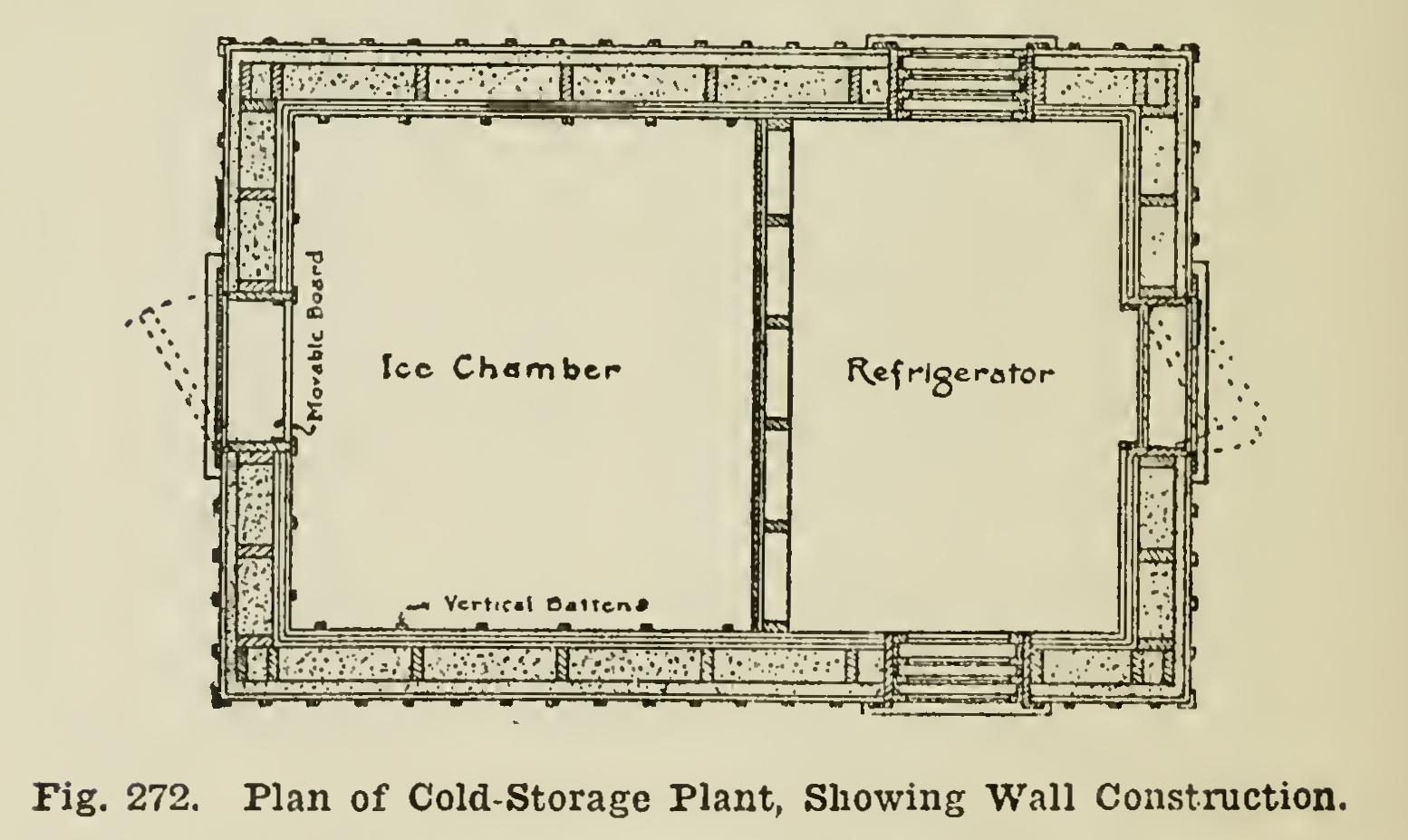
The size of house recommended for the aver age small plant would call for an oblong formed of 2-by-8 pieces, 11 feet 6 inches the short way, and 17 feet 6 inches the long way. On this, 2-by-8 studs are erected, and spiked into posi tion at the foot. The studs for the ice chamber are 18 feet long, and for the refrigerating room 9 feet, and are spaced as shown in the plan (Fig. 272).
The ceiling joists, 2-by-4, are spiked to the sides of the studs, so that the bottom edge of the joists will be 12 inches below the top of the stud. The joists extend far enough over the sides to allow the rafters to be spiked to them, thus forming a good support for the latter. The ceiling is formed of matched boarding, nailed to the under side of the joists, and cov ered with 14 or 15 inches of well-packed, dry sawdust. All spaces between the studding arc also packed with sawdust, well pressed down into every nook and cranny.
On the outside of the studs, 2-by-2 straps are nailed horizontally at 18-inch centers; and on these, vertical matched boarding 10 inches wide is well nailed, the joints being afterwards cov ered with a 2-by-1 chamfered fillet, nailed closely over them.
The paper should be the heaviest building paper obtainable, and is tacked on in an in genious way. The specification for this is as follows: The inside of studding to be first sheeted with 1-inch matched boards, then with paper on walls and around corners. In fasten ing paper on walls with tacks about inch long, do not drive the tacks home, but let them project half their length. Then take a ball of twine (No. 8 cotton, if procurable, or something simi lar, such as thick yarn, not too hard) ; run this twine over the heads of the tacks, which must be placed so as to have a line of twine directly under the 2 by 1-inch battens to be put on.
When the twine is on, drive tacks home; on the paper, and over the twine, place vertically 2 by 1-inch dressed battens at about 18-inch cen ters. Between these battens, fix similar ones horizontally, over the twine and about 36 inches apart. These horizontal battens must be cut true on the ends, and fitted tightly between the upright pieces. Over these battens, lay another layer of paper and twine put on as before; then sheet with matched lumber fixed vertically. Over this inside sheeting, place 2-by-1 battens, fixed vertically from floor to ceiling at about 18-inch centers. (These battens are not required in food chamber.) The floor of the ice chamber is built up on the 6-by-6 sills referred to before, and consists of alternate layers of matched boarding and quartering. The floor must have a fall of at least one inch towards the central gutter. As may be seen in the cross-section, the first layer con sists of pieces of on flat, well spiked to the 6-inch sills, 1 foot apart, and thoroughly packed round with sand. On these is laid the first floor of 1-inch planed matched boards. On this, and directly over the 2-by-4 pieces, are laid pieces of 2-by-3 to support another floor of 1-inch planed matched boards. A reference to the longitudinal section (Fig. 203) will show in this floor an opening 12 inches wide and extend ing the full width of ice chamber, and a nar rower one at the end. On this upper floor is laid another set of 2-by-4 on edge over the under-bearers; across these are placed 2-by-4 on flat, 3 inches apart, to receive the blocks of ice. The two layers of boarding form a set of cold air flues, through which the air passes to the food chamber.
The floor of the food or refrigerating cham ber is formed of 1-inch matched boarding laid on pieces of 2-by-4, spiked on two 6-by-6 sills, and with a fall towards the gutter. Pieces of 2-by-4 on edge are then laid on top of the 1-inch boarding at 15 inch centers; and across these, 11/4 by 2-inch battens, 1 inch apart, are firmly nailed. This lattice floor should be in two or three sections, so as to allow of its being readily lifted for cleaning.