Miscellaneous Framing
logs, log, wall, boards, door, house and hold
A Non-Freezing Storage House. Such a storage house for pota toes or other perishable goods may be construct ed as in Fig. 265. The studs will be 2 by S set on 16-inch centers. On the outside are first placed one-inch boards horizontally with the studs, and over this are one-inch boards placed perpendicularly, with building paper between them; and the cracks are covered with buttons.
There are two courses of black plaster as shown, making three dead air spaces in the width of the wall. The inside of the wall is lathed and plas tered; and over this, boards are placed for the protection of the plastered walls. The maiii object is to keep the frost out.
The three dead air spaces will act as a non conductor of frost sufficiently to protect the interior from freezing, in most sections of the country where potatoes are raised. If more pro tection is needed, two or three thicknesses of paper should be put between the outer boards, with tarred felt for the last layer.
How to Build a Log House.
In certain localities, it is necessary to erect barns and out houses, and even temporary dwellings, of logs. There are several ways to proceed.
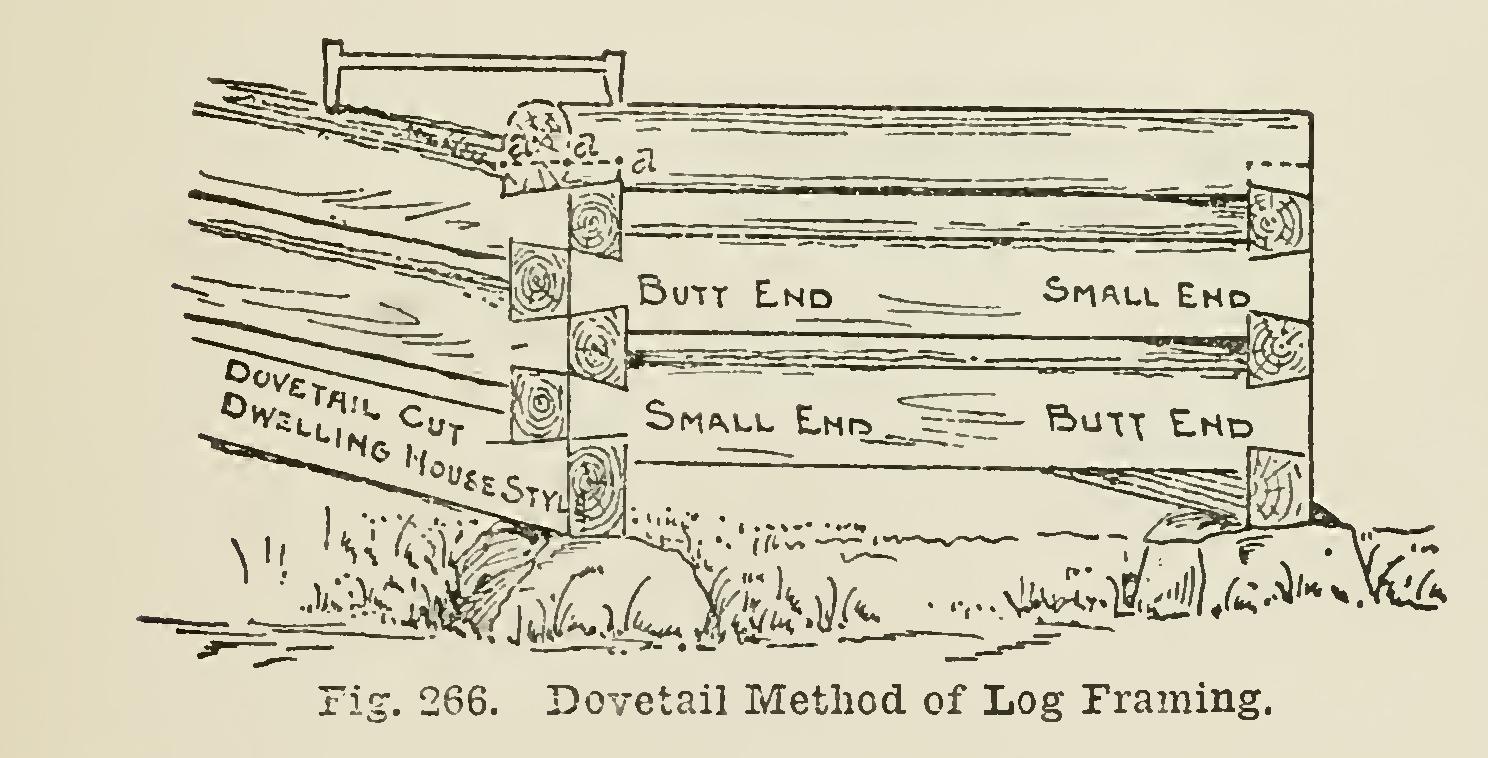
The dovetail cut is chiefly used for dwellings, as it has a tendency to hold corners together better than the straight cut, and then the cor ners may be made straight and even, to allow the nailing on of wide corner boards to cover the end wood of logs, as the latter usually crack, take in water, and rot.
It does not pay to put siding on a to house. Siding protects the logs from the weather, but makes the building colder, because when the plastering loosens—as it always does—you cannot get at it to plaster again, and then there is only the siding to keep out the cold, except what is on the inside of the logs; this you can get at until you wainscot or plaster on lath over it. The reason plastering loosens is that a log house never gets through settling—never; so the mortar is pressed away from the logs. For keeping out the rain, the round log is best. If logs are hewn, or sawed flat, the rain drives through easily.
Cuts a, a, a, Fig. 266, show how to measure bevel of dovetail cut on a round log. Use a divider, and measure at a a a all same height, at both ends of log, so as to get the drop the same at each end. It is well to use butt and small ends of logs alternately, unless the logs are very even in thickness at both ends. When
crooked—and they often are—turn the crook up when possible, unless log will fit the under one better by turning crook down. If too crooked, a log can be straightened somewhat by sawing up into it, which will let it down some.
Do not turn bends of logs out and in, as this makes a crooked wall and one which is much more likely to spring out of shape. Some use logs in the gable, whether roof is to be shingled or not; others use boards, nailed up and down outside of rafters and logs.
In places where shingles are not to be had, a roof of flat pitch is used. Run a log or two parallel with ridge and side wall; counting ridge as one log, and one or two on each side between ridge and wall, we have three to five logs, according to width of building, to carry the roof. This is made of poles laid up and down, with a cross-piece fastened on top of these at the bottom ends to hold against the sod, which covers the slough grass or birch bark coat. After sod is put on, it is covered with clay to keep out the water. These roofs will hold out an ordinary shower; but when they do leak, they may keep on letting in water for a day or two after the rain is over.
In Fig. 267, b shows one way to fasten logs at door and window openings by putting in a short dovetailed block between them, fitted to lower log and hollowed out to receive the next upper one. This way is just as easy as to bore holes, as at c, for or 2-inch oak dowels.
Another way is to make an oak strip like a 2-inch square continuous dowel, fitted at e, the bottom log; also at f, the one above door or win dow. This involves a little more work, because you have to make a sort of open-end mortise through each log, and slip the logs onto the oak strip; but you get a straight wall.
In making jambs, do not have them as tall as the door opening, because the log above the door will keep sagging and cause the jamb to spring crooked. Use 2 by 6-inch for door jambs. In chinking, or filling cracks between logs, do not drive chinks too tight; better use an 8-penny nail here and there. The log-hook, or dog, to hold log from turning, is made of iron, about 18 inches long, with flattened ends, one in line with bend, the other across.