Battle of Jutland
fleet, forces, enemy, british, coast and admiral
The Grand Fleet.—Immediately prior to the battle of Jut land the distribution and composition of the British forces which took part in the action was as in table on p. 218.
At Harwich were five light cruisers and about 20 torpedo craft under Commodore Tyrwhitt, and at Sheerness was the 3rd Battle Squadron consisting of the "King Edward" and the "Dread nought" flying the flag of Admiral Bradford. These two com mands, however, took no part in the battle.
The High Seas Fleet.—The main German forces, in prepara tion for Admiral Scheer's project, had been concentrated in the Jade Basin. They were organized as in Table II.
Attached to the High Seas Fleet were sixteen U boats and ten "L" class airships, but these took no part in the action.
The Table on p. 220 is a summary of the principal armaments of the capital ships of the rival fleets.
An order issued to the High Seas Fleet on May 18 ran as follows:— The bombardment of Sunderland by our cruisers is intended to compel the enemy to send out forces against us. For the attack on the advancing enemy the High Seas Fleet forces to be south of the Dogger Bank, and the U boats to be stationed for attack off the East Coast of England. The enemy's ports of sortie will be closed by mines.
This order may be taken as defining the strategy of the enemy on the above date.
In preparation for the execution of this scheme the U boats had already set out in order to be in their appointed stations by May 23, while some six or eight Flanders submarines had gone north to reconnoitre between Norway and the Firth of Forth. From that date to June I was the period during which it was intended to bring off the bombardment. But the weather continued to be unfavourable for airship reconnaissance. Scheer would not risk an advance on the English coast without ample warning of the approach of the British fleet; meanwhile the limit of endur ance of his submarines was nearly spent.
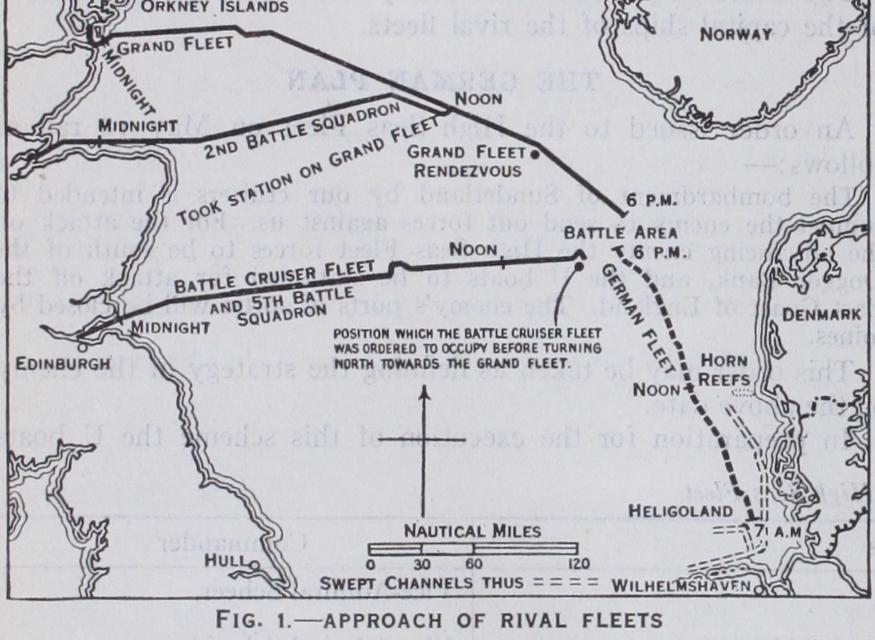
On May 3o, when he could wait no longer, he abandoned the bombarding plan and ordered Hipper, with the scouting force to sail next day and to demonstrate off the southwest coast of Norway. This he anticipated would soon be known to the British
Admiralty, and he hoped, by following the scouting force with the battle fleet, but keeping out of sight until the enemy appeared, that he might fall on a detached portion of the Grand Fleet, which would probably be sent out to protect the cruiser patrol and ship ping to the northward. But events turned out otherwise.
The Grand Fleet Sails.
The British Naval Intelligence Dept. was already aware both of the movement of German sub marines and that there was a "certain liveliness" in the Jade Roads, and Jellicoe was warned that a large operation on the part of the enemy appeared to be imminent. At 5:4o P.M. on May 3o the commander-in-chief and the admiral commanding the Battle Cruiser Fleet were sent orders to proceed to the pre determined rendezvous eastward of the Long Forties (about 6o m. east of the Scottish coast) in readiness for eventualities. A warn ing was also sent to the Harwich Forces and 3rd Battle Squadron at the Nore. By 10.3o P.M. the three sections of the Grand Fleet had left their respective bases at Scapa Flow, Invergordon and Rosyth and were heading out across the North Sea. The main battle fleet made for a rendezvous in lat. 45' N. long. 4° 15' E. where the forces under Admiral Jerram from Invergordon would meet him at 2 P.M. next day. Beatty, with the Rosyth force, was making for a point 69 m. S.S.E. of the battle fleet's position (see fig. I). These dispositions would enable the battle fleet to intercept an enemy trying to attack the loth Cruiser Squadron on the northern patrol, while the Rosyth force would guard against a raid.
When the British fleet put to sea 13 hostile submarines were lying off the coast; also U-67 was south of the Dogger Bank; and U-75, having laid the mines, which afterward sank the "Hamp shire" with Kitchener on board, was on her way home. The Ger man submarines made a few ineffective attacks; but in the main the under-water craft, as usual, proved unable to prevent free movement of the fleet.