Battle of Jutland
cruisers, british, beatty, fleet, enemy, german and sighted
To Jellicoe the position was by no means clear when he set out. The evidence pointed to another cruiser raid being afoot, but a misleading telegram sent from the Admiralty during the forenoon of May 31 informed him that directional wireless signals placed the German fleet flagship in the Jade river, thereby leaving him with the impression that there was no reason for undue haste; he, therefore, regulated his speed so as to economise his destroyers' fuel consumption.
First Contact.
Hipper, with the scouting force left the Jade at 2 A.M. on May 31 and steamed northward, keeping well out of sight on the Danish coast. Scheer followed so m. astern with the battle fleet. During the early morning the German commander-in chief received wireless reports from his U boats, but these proved vague and misleading, so much so that far from gleaning that a combined advance was being made by the British forces, he alludes to "our hope of meeting with separate enemy divisions," as being "likely to be fulfilled." (See Germany's High Seas Fleet in the World War, Scheer.) At 2 P.M. Beatty, having arrived at his rendezvous, prepared to turn north in accordance with his instructions. Then followed one of those seemingly trivial events which are sometimes destined to have momentous issues. A stray merchant steamer attracted the attention of Commodore Alexander-Sinclair in the "Galatea," on the eastern wing of the light cruiser screen. He stood on to the E.S.E. to examine her. Simultaneously the "Elbing," on the west ern wing of the German scouting force, sighted the same steamer and detached a destroyer to investigate. Another instant and the rival warships had seen each other. At 2.20, just as Beatty had turned to the northward, "Galatea" hoisted the signal "enemy in sight." (See fig. 2.) The result was to hasten a meeting which otherwise would, most probably, have occurred farther North and therefore nearer the British battle fleet. Beatty at once set out to cut off the line of retreat of the enemy's light cruisers towards Horn Reefs, but finding that they were apparently following the "Gala tea" to the northwest, he hauled round more to the northward. He had been steering northeast for some io minutes when the heavy smoke of Hipper's five battle cruisers was sighted on his starboard bow, whereupon he turned back to the east.
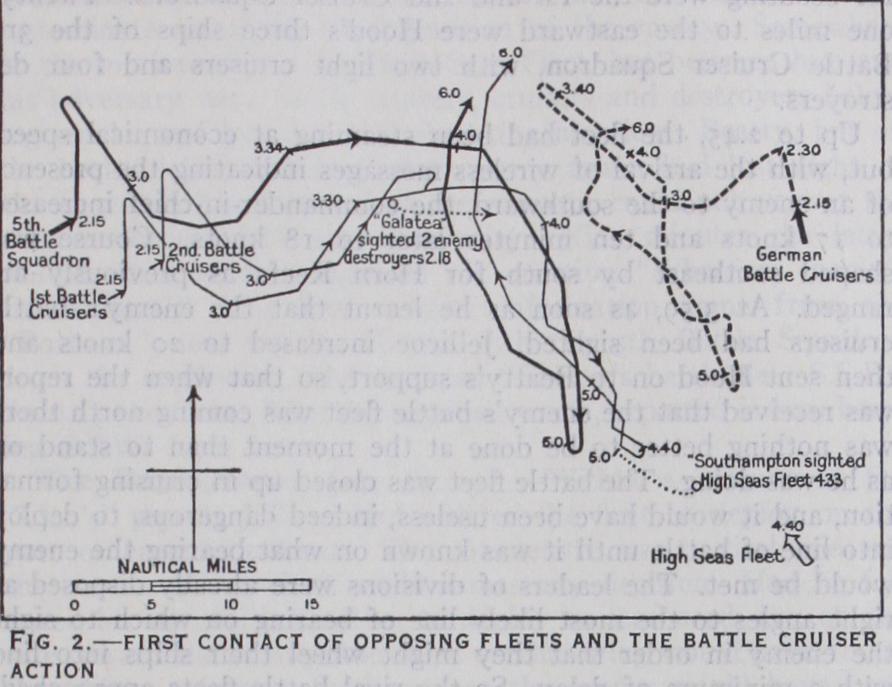
Owing to the greater visibility to the westward, Hipper had already sighted the six British battle cruisers, and now realised that they were heading to cross his stern and cut off his line of retreat, and that he must hasten to fall back on the battle fleet. Beatty, knowing nothing of the greater forces to the south, could only regard this as a golden opportunity for getting to grips with the enemy. There followed a hot running fight to the southward between the opposing battle cruisers (see fig. 2). The 5th Battle Squadron under Rear-Adm. Evan-Thomas had, unfortunately, been stationed by Beatty 5 miles on the opposite bearing to that on which the enemy was sighted. A further delay in bringing this powerful force into action was caused through ineffective signalling in the "Lion." The result of this division of forces was that the British battle cruisers suffered heavily instead of the German squadron being annihilated.
At 3.34 P.M. Beatty formed the battle cruisers into single line, increased to 25 knots and made for the enemy. About this time the "Engadine" sent up a seaplane which reported Hipper's course south. This is noteworthy as being the only occasion on which a British aircraft was used throughout the operations, and the report failed to reach the battle cruiser's flagship. At 3.45 however, the enemy could be made out distinctly from the "Lion," and Beatty formed his ships on a line bearing north-west to clear the smoke and bring their guns to bear, while he turned to E.S.E. At about 3.48 fire was opened almost simultaneously on both sides at a range of approximately 16,000 yards.
The British battle cruisers were at considerable disadvantage, for they showed up well against the western sky, while visibility to the eastward was poor for observing their fire. German ac counts agree that the British firing during this part of the action was somewhat ragged, while they pay high tribute to that of the 5th Battle Squadron as it eventually got into range. The better protection of the enemy's battle cruisers and the better shell with which the heavy guns of his fleet generally were provided stood him in good stead, while confusion in the interpretation of the "Lion's" signals for distribution of fire added to the disadvantages of the British battle cruisers.