Battle of Jutland
fleet, cruisers, squadron, enemy, fire, british, scouting, destroyers and line
At 5.4o the Battle Cruiser Fleet converging on the 1st Scout ing Group, from the westward, saw the "Liitzow" and her con sorts emerging from the mist. Fire was opened at a range of about 14,00o yards. This apparently disconcerted Hipper, who turned away to the eastward. Hardly had he done so before he heard the guns of the 3rd Battle Cruiser Squadron engaging his and Scouting Group. The trap was closing in on him, but as yet he was unaware of the far greater menace to the northward; but he seems to have sensed danger and at 6.34, hotly pursued by Beatty, he turned southeast only to see his light cruisers being attacked by four British destroyers. These latter he took to be the forerunners of the British Battle Fleet and, now thoroughly alarmed, he doubled right back to southwest to seek the cover of his own battleships. In fact what he had seen were Hood's light forces. These had been hotly engaged with Boedicker's and Scouting Group. In the initial skirmish the "Chester" was badly mauled by the German light cruisers, but they in turn sud denly found themselves overwhelmed by the fire of the three "Invincibles." The "Wiesbaden" was reduced to a wreck and the "Pillau" and "Frankfurt" were badly damaged and only escaped by using their torpedoes, which forced Hood to turn away and break off the pursuit.
The destroyers which Hipper
had seen were part of the 4th flotilla. Led by the "Shark," they gallantly went for the "Re gensburg" and nine or ten enemy torpedo craft which seemed to be preparing to attack the 3rd Battle-Cruiser Squadron. In the course of this encounter the "Shark" was severely battered and eventually sank, fighting to the last under her mortally wounded captain, Commander Loftus Jones. Hood avoided this attack by turning his squadron sharply to starboard ; and almost at the same instant he sighted the "Lion" racing up from the west ward. He turned to meet her and then swung his squadron into station ahead of the Battle Cruiser Fleet and led the line on a south-easterly course. Jellicoe was left in doubt until the very last minute as to the exact position of the enemy. Somewhere to the southward was the High Seas Fleet, but between him and his adversary were battle cruisers, cruisers and destroyers belch ing smoke and gun fire and obscuring his view. Beatty, hot on the heels of his own particular quarry again, had lost sight of the enemy battle fleet and at the moment could not answer the commander-in-chief's urgent enquiry. Nine minutes the latter waited, then at 6.10 repeated his question "Where is enemy's battle fleet?" The first definite information came from the "Barham," now rapidly closing with the 5th Battle Squadron from the southwest. She reported "Enemy's battle fleet S.S.E." At 6.14 the "Lion," having regained touch, reported it too, bear ing S.S.W. from her.
The Deployment
(see fig. 3.).—Within a minute of the "Lion's" report, Jellicoe had ordered the fleet to deploy on the port or easterly column. The manoeuvre was a vital one andthe commander-in-chief made a masterly decision. Had he f ol lowed his natural inclination to deploy to starboard, i.e., on the side toward the enemy, the ships on that wing would have found themselves at grave disadvantage ; the enemy would have been able to concentrate his fire on them while they would have been masking the other columns until each could turn up in rear in succession. Moreover, the head of the British line would have had to make a sharp turn to port at once to prevent the enemy crossing the "T." It is not too much to say that had Jellicoe made a wrong decision at this moment irretrievable disaster might have followed. As it was the Grand Fleet was placed at the outset in a position of overwhelming tactical advantage.
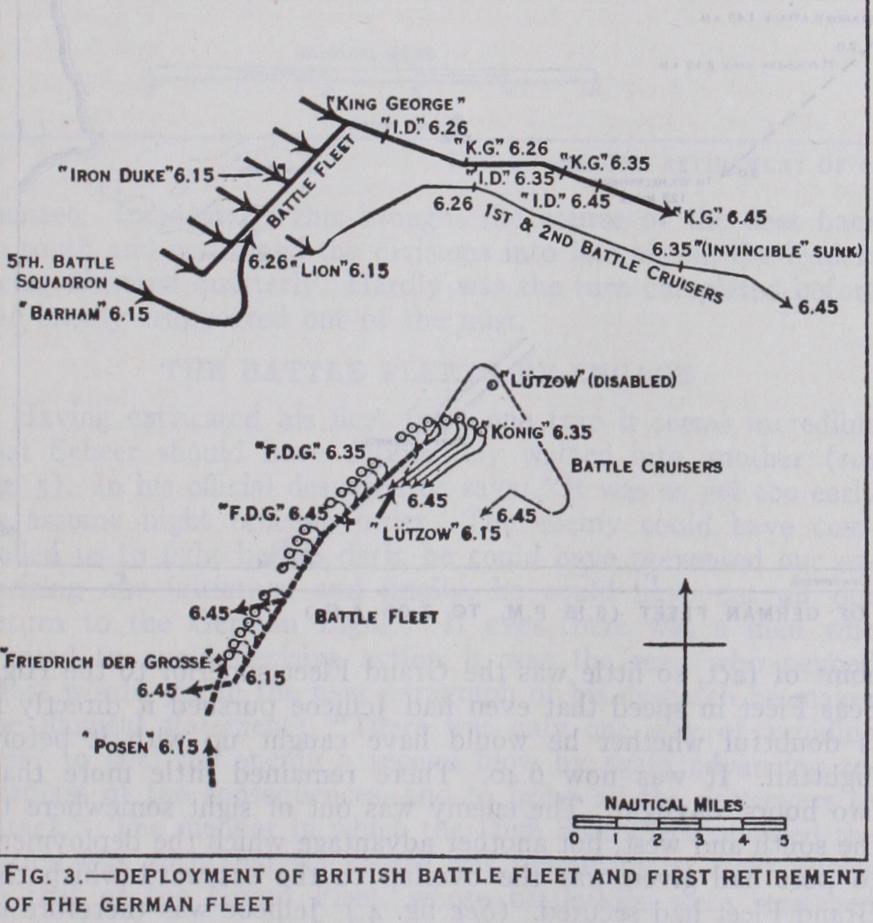
The deployment, it will be seen, developed in the form of an obtuse-angled "L," one arm of which steadily lengthened to envelop the head of the enemy's line, while, during the process, the British ships could give each other the maximum of support. The battle cruisers hurried to their station at the head of the line, the 5th Battle Squadron slipped into place astern, cruisers and destroyers automatically took up their pre-arranged posi tions. The whole was a magnificent piece of fleet work, the cul mination of fine organization and training and a clear indication of a high standard of leadership on the part of the flag officers commanding the several divisions and squadrons.
But now a tragedy occurred in the foreground of this impres sive scene. Up to the moment of deployment Rear-Admiral Ar buthnot in the "Defence" with his 1st Cruiser Squadron had been scouting ahead of the battle fleet, but on contact being made, it became his duty to engage the enemy's cruisers. Boe dicker's 2nd Scouting Group was faintly visible to the south ward and, followed by the "Warrior," Arbuthnot turned to pur sue them. He was about to deliver a coup de grace to the now blazing and disabled "Wiesbaden," when out of the mist came both the British and German battle cruisers hotly engaged. Hold ing on tenaciously, close across the bows of the "Lion," the two cruisers soon found themselves in a hurricane of fire as Hipper endeavoured to cover the stricken "Wiesbaden." Two great sal voes hit the "Defence" in quick succession and at 6.19 Arbuthnot and his flagship disappeared in a sheet of flame. The "Warrior" limped away, and was only saved for the time being by the bat tleship "Warspite" performing an involuntary circle round her, owing to the sudden jamming of the latter's steering gear. Clear of the fighting, the sea-plane carrier "Engadine" made a brave effort to tow her home, but the "Warrior" had to be abandoned at 7 A.M. the following morning and eventually sank.