Lamellibranchia
usually, gills, foot, passes, protobranchia, blood, ventricle and gastropoda
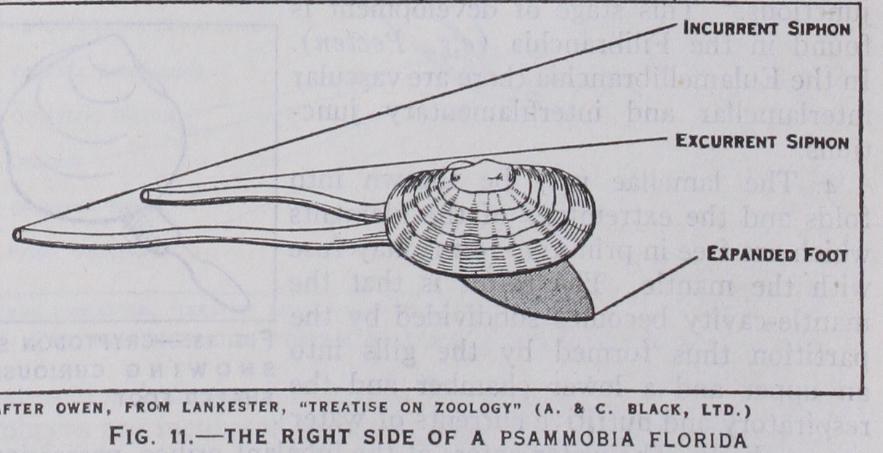
The gills, which are an even more distinctive feature of Lamelli branch organization, are described under "Respiratory System." The foot is usually very muscular and in some primitive forms (Yoldia, Solenomya) among the Protobranchia it has a flat sole which allows of a creeping mode of locomotion. This is, however, of rare occurrence and in Nucula (an otherwise primitively organ ized Protobranch), Hirasaka has recently shown that the foot is, as in most other Lamellibranchia, a burrowing organ. The foot of certain more specialized genera (Lepton, species of Erycina) has a creeping surface. Usually, however, it is laterally compressed and its lower edge is keeled so that the whole foot is somewhat like the blade of an axe—hence the name Pelecypoda (axe-foot; Gr. TiXeKvs, axe), which is sometimes given to the class.
In the middle line of the surface of the foot is an orifice cor responding with the ventral pedal pore of the Gastropoda. This leads into a cavity in which is secreted a mass of a hard substance, conchyolin (which constitutes the organic matrix in the shell) in the form of long bristles or hairs. This mass is gradually pushed to the exterior where it hardens on contact with water and serves to attach the animal to rocks, stones and masses of sand. This structure, the byssus, is of considerable importance to forms which live on open beaches (see section "Bionomics"). It is imperfectly developed in the Protobranchia and is large and highly efficient in Anornia (in which it is calcified and passes through a hole in the right valve), Arca, Mytilus, Pecten, etc.
Alimentary System.
The situation of the mouth has already been described. It leads through a short oesophagus directly into the stomach. In the Nuculidae (Protobranchia) alone is there any special expansion of a pharyngeal nature. In the embryo of Cardium Loven observed a small protuberance in the stomodaeal wall which may be a vestige of a radular coecum. This observation has never been recorded in other Lamellibranchia and in no adult representative of this class is there a radula (the rasping tongue characteristic of the rest of the Mollusca). The stomach is thin walled and lined with hard cuticle. It has a well-marked pyloric coecum which in some forms communicates with the initial part of the intestine by a longitudinal slit as in certain Gastropoda. This coecum secretes the crystalline style, a gelatinous rod which contains a digestive enzyme. The physiological action of the stylehas been recently studied by several workers. In Mya Yonge shows that its ferment reduces starch and glycogen. The liver is bilobed and usually communicates with the stomach by several ori fices. It contains (e.g., in Mya) amylolytic, proteolytic and lipo lytic enzymes and is the principal organ of digestion. It seems also to have an absorptive function. The intestine is usually long and provided with a typhlosole. It traverses the ventricle of the heart (as in the Rhipidoglossate Gastropoda) in most cases; but in Nucula and some Filibranchia it passes below the ventricle.
It should be mentioned here that the tracts of cilia on the gills and palps are an important adjunct to the alimentary system. By their vibration the food particles which are drawn into the mantle cavity, when water is taken in, are sorted out into appropriate sizes and driven towards the palps from which they are passed to the mouth.
Circulatory System.
The blood is usually colourless ; but haemoglobin is found in it in sundry forms which live in sand and mud (Arcidae, Solen, etc.) and haemocy anin in some others (species of Venus and Cardium). The blood is contained in ves sels which are usually capacious cavities (sinuses). The heart is situated on the dorsal side of the body and consists of a medium ventricle and two lateral auricles. In most Lamellibranchia there are two aortae (anterior and posterior). In the ramifications of these the blood is carried to the tissues. It is ultimately collected into certain large sinuses and passes thence to the gills in afferent vessels. After oxy genation it is carried from the gills in effer ent vessels to the auricle's of the heart.