Lamellibranchia
larva, water, development, shell, cells, incubation, eggs and formed
Breeding Habits: Oviposition.
Marine Lamellibranchia usually discharge their eggs into the water, fertilization is external and the embryo develops as a free-swimming larva. In a few marine forms and in freshwater groups the eggs are retained within the maternal body or shell where they are fertilized and in cubated. Incubation is a distinctive feature of freshwater La mellibranchs and attains a far greater development in this class than in any other molluscan group. In incubatory forms the eggs are retained as a rule after fertilization in the spaces between the gill-lamellae, which are often modified to serve as brood-chambers (Onio, Anodonta, Pisidium, Cyclas, etc.). It has been more than once observed that the embryos eat the epithelial cells of the maternal gills during incubation. In certain species of Ostraea the embryos are incubated in the mantle-cavity outside the gills.
There is not much doubt but that marine Lamellibranchs which live in cold seas are more prone to adopt some form of incubation than those inhabiting warm or temperate seas.
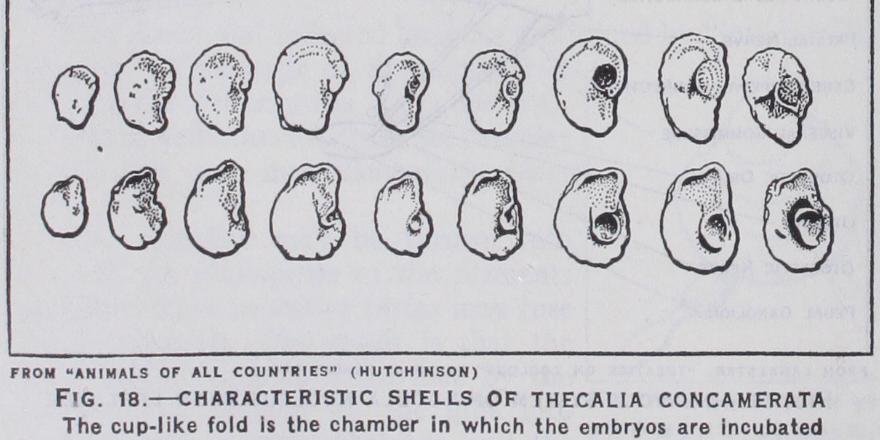
One of the most curious devices for tending the young is found in Thecalia concamerata, the shell-valves of which are modified to form a kind of inner chamber in which the eggs are lodged.
Development.
The development of the Lamellibranchia is best known from Meisenheimer's study of the freshwater mussel Dreissensia polymorplia. With two important exceptions the course of development in such other forms as have been studied is more or less similar.
In Dreissensia the first two cleavage divisions produce four macromeres of which one is very much larger than the rest. Suc cessive divisions of the macromeres yield "quartettes" of micro meres and these are also divided until the micromeres form a cap overlying the macromeres. This type of cleavage is spiral, i.e., like that found in Gastropoda, but the radial symmetry resulting from cleavage is modified very early in development.
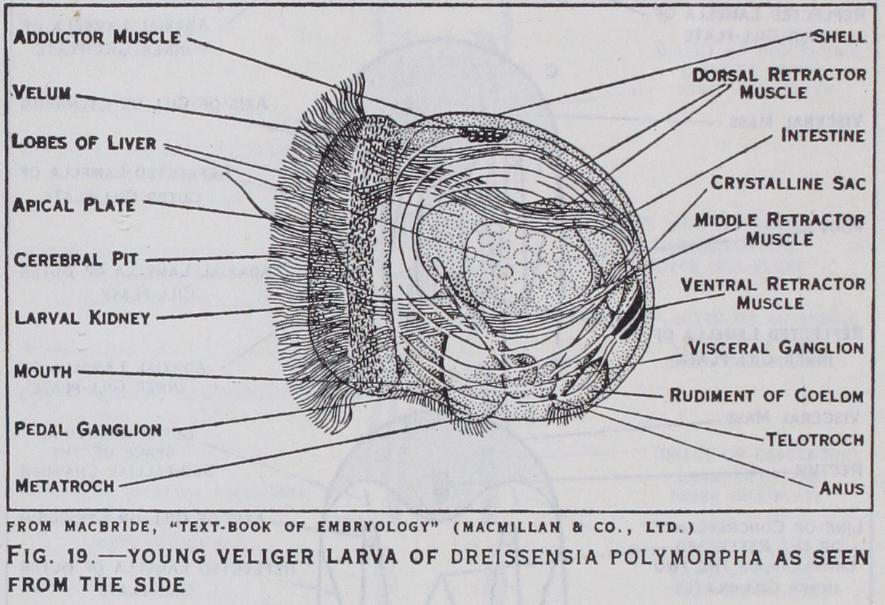
Of the mass of cells thus formed those which subsequently give rise to the mid-gut and the mesoderm are invaginated in the course of development. The larval stomach is developed and is joined by two invaginations, the stomodaeum and the proctodaeum, which form the mouth and anus respectively. At about this time the shell-gland appears and gives rise to a horny plate, the rudi ment of the shell. A girdle of cells bearing long cilia is formed around the larva (the prototroch) and a tuft of long cilia appears at the apex of the larva. The embryo has now assumed the char
acteristic form of the molluscan larva known as the trochophore and starts its free-swimming life. The prototroch eventually enlarges to form the velum (veliger stage) and the original horny plate of the larval shell is converted into the two-valved shell. Before this stage the rudiments of the coelom and the kidneys are recognizable. During the veliger stage the nervous system, musculature, otocysts, gills and foot of the adult are laid down. The larva metamorphoses into the adult with great rapidity. The cells of the velum are cast off, the larval musculature disintegrates and the area of the larval mouth shrinks to the proportion char acteristic of the adult.
One of the most notable modifications of this developmental history occurs in the Protobranchia in which the veliger has an enormous velum consisting of rows of large ciliated cells con ferring on the larva a barrel-shaped appearance. In the fresh water incubatory forms such as Cyclas and Unio there is no free swimming stage and neither prototroch nor velum is developed.
The development of the Unionidae is remarkable in that part of the embryonic life is parasitic. The embryo is ejected after incubation as a larva of a special type known as the glochidium. The bivalved shell is furnished with hooks and if, on entering the water, the glochidium comes into contact with a fish, it may suc ceed in fixing itself to the latter by means of these hooks. Once lodged on the fish a cyst is formed round the larva which then lives parasitically in the tissues of the fish. During this phase it develops into the adult and subsequently escapes from its host by the rupture of the cyst.
Distribution.
The Lamellibranchia are essentially a group of aquatic animals. No authentic record of a permanent terrestrial habitat is known among them. A small South American fresh water mussel Eupera is occasionally found out of water. This appears, however, to be a fortuitous occurrence due to the drying up of the ponds in which the mollusc lives, and may, in fact, occur to many small tropical bivalves. Nevertheless the author is in formed by Mr. G. S. Carter, who has collected Eupera in Uruguay, that on one occasion the circumstances suggested that it lives out of water for a considerable time. Mr. J. R. Tomlin has collected specimens of Pisidium living out of water upon damp moss.