Architectural Drawings
kitchen, provide, bathroom, doors, closet, table, window and pantry
It will be necessary to have a serving pantry between the dining room and kitchen. There should be double-acting doors. This greatly facilitates the carrying of dishes from one room to another. In this pantry should be a wide shelf or counter which will be used in the prep aration of the meal. Above are shelves with sliding doors, and below are drawers for differ ent articles of food. Provide always plenty of drawers and shelf room. In a small room, sliding doors will be found much more con venient than swing doors, as they are much more easily handled and take up much less room in opening and closing. If possible, there should be built in this room a refrigerator. If not here, place it in the kitchen. This refrigerator should be provided with an outside door through which the ice may be replenished from the outside, thereby doing away with the ice man coming in at all hours and in bad weather tracking mud into the house.
The kitchen, while in the rear of the house, requires careful thought. The housekeeper usually spends the greater part of the morning here; therefore give this room, if possible, an east exposure. Make the windows low enough so that a person sitting can see out. For the kitchen table and sink, have a window near. This will not only be an aid to better light, but will give the housekeeper a chance to see out through the window. Place a sink as near the pantry and dining room as possible; also, as mentioned above, so as to be near outside light. In the kitchen will be found a cooking range or gas stove, or both. Place these, if possible, where they will get a cross-draft; in other words, place them between a door and a window, or between windows, so that the odor during the preparation of a meal will be carried away. Of course there is necessary a flue for the range, and there should also be one for the gas stove to carry off the odors of the gas and the ovens. The kitchen table should be convenient to the stoves. There should be built-in shelves and cupboards for the kitchen-ware and the pots and kettles. Either in the serving pantry or some where in the kitchen, provide a tilting bin for the flour. This can be very easily done by making the bin pivoted at the outside corners, to allow the bin to tilt out. Hooks or pivots for swinging a barrel of sugar would also be a great convenience. Do not make the kitchen large; make it small, compact, and convenient, to save the housekeeper all unnecessary steps. There will also be necessary rear stairs, one to the basement and one to the attic. These stairs should be about 3 feet 6 inches wide, as boxes, furniture, etc., are all taken up or down these
stairs; so do not make them too small.
Having decided upon a satisfactory arrange ment of the lower floor, we now consider the upper floors. These are devoted to the bed rooms and other rooms where more privacy is desired, such as the sewing room, the study, or the nursery. As has been said, the first-floor plan determines the outline of the second-floor plan. The number of bedrooms is determined by the size of the family. There will be required also a guest room and a servant's room.
As to the requirements of a bedroom, make ample-sized rooms. The usual articles of furni ture will be the bed, a dresser, a chiffonier, a small table, and sometimes a writing desk or an additional table of some sort. Provide plenty of closet room, with a window, if possible, in it. In the closet should be a number of shelves, a hook strip around the three sides. The closet should be finished, so far as plaster and inside finish are concerned, as well as the other rooms. The question of closets is important; therefore, consider them an essential part of every house.
On the second floor provide a bathroom con venient to all rooms, yet far enough away from the main hall to be private. The bathroom is usually crowded into any remaining space that may be left after bedrooms have been consid Fig. 6. Layout of a Very Small Bathroom.
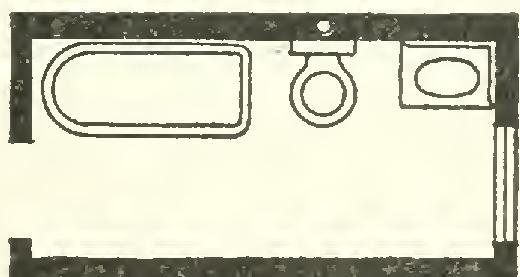
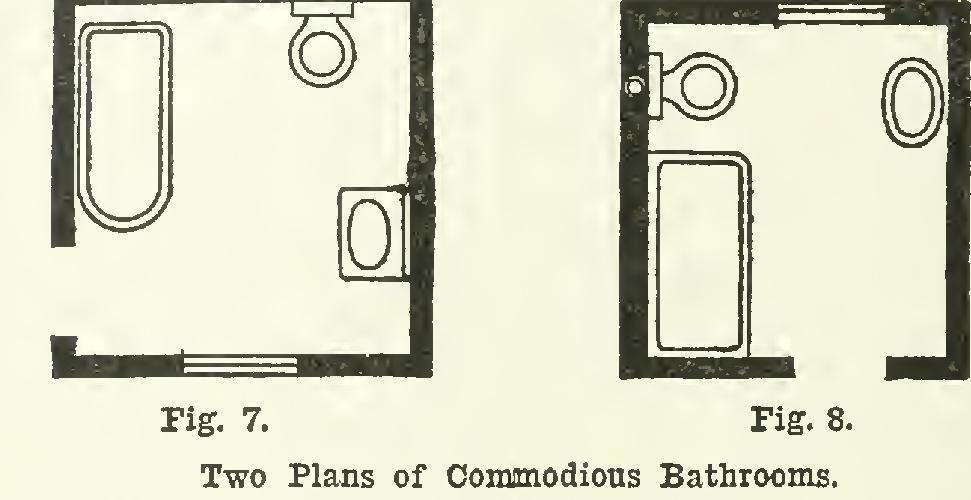
ered. This, however, is not a satisfactory way of doing, since the bathroom should be as con venient in arrangement as any other room. In the bathroom the usual necessary fixtures are a bathtub, a lavatory or wash-bowl, and a water closet. In more expensive homes a foot-bath and a sitz bath are provided; sometimes a shower bath also. There should be ample room for the placing of these fixtures, with plenty of room around them. In Fig. 6 is shown the smallest room that can accommodate the neces sary fixtures. While this will serve in the cheapest houses, yet the arrangements shown in Figs. 7 and 8 are much better.
Should more fixtures be added, the room should also be made larger to accommodate them. There will also be required a medicine chest, usually built into the wall directly above the lavatory, or these can be bought at furniture stores, ready to hang on the wall. There should always be a mirror in the door of this chest. Provide a built-in closet with swing doors for the upper half and drawers for the lower half. The finish of this room, as well as the shape of the mouldings, should be such that the dust will not easily settle on them, and that they may be frequently washed to remove any accumulation of dust.