Architectural Drawings
building, buildings, usually, elevation, windows, lines, height and class
In the modern office building we see the lower stories marked by a projecting stone course; below this, the walls are of stone, and usually present a solid, substantial base upon which rests the upper part of the building. The, column is in dicated either by pilasters or column-like projec tions from the main face of the building, or by a three-quarter column fastened to the building. The upper stories, depending upon the height of the building, are placed in the entablature.
It is worth while to study this feature in all classes of building, in order to design intelli gently.
Thus we see that the Orders of Architecture are really the basis for all our designs. This same applies to any type of building, being more marked in some classes of buildings than others. The Colonial residence or Colonial Architecture adheres strictly to this basis of ornament. If de tached or free columns are used for porch con struction, then we see the component parts of the Order carried out exactly. Therefore, in any building, use the Order to start the general ele vations, and elaborate or suit the elevation to the class of building.
Characteristics of Types of Buildings Let us now consider the general types of buildings for different purposes. The residence, for instance, usually has the appearance of a quiet, restful place. The types of doors, win dows, and roof lines are in general similar, there being large windows and plenty of them. Resi dences thus constitute a class marked by well known and easily distinguishable general char acteristics.
Consider a library. We see here a closer ad herence to the Orders than in many other types of structure. Usually there is a pillared entrance of some form or other; the windows are all large and dignified. The roof is covered with tile or some other more expensive covering. In general, libraries are a dignified class of buildings, easily distinguished as such, and usually quite costly.
In schoolhouses we see a class of buildings with large areas devoted to windows, not usually of very great height, and with a tower of some outline. There may be large, blank walls, which make this class of buildings all the more distinct.
The office building generally has numerous windows, not usually grouped but placed one above the other, and is rather plain in treatment except at the cornice.
The warehouse forms another excellent ex ample of the exterior indicating the purpose of the building. In this type, we see small windows,
some barred, with heavy doors, showing it to be a building of great strength and fire-resistance.
Thus endeavor, in designing any building, to make it indicative of the purpose for which it is designed. Study carefully from examples or from pictures these characteristics, and apply these principles to designs you may submit.
General Composition of a Building or Treat ment of Elevations. A few words about the gen eral composition or elevation of a building might be said. There are a few principles involved that will be an aid in deciding upon the charac ter of the elevation.
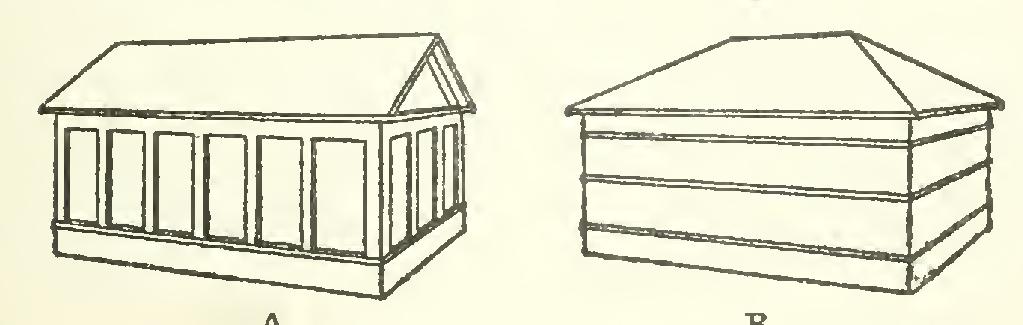
Fig. 10. Illustrating Method of Treating Elevations. In A, vertical lines are emphasized, adding to the appearance of height; in B, emphasis is laid on the horizontal lines, adding to breadth and length of structure.
The adjoining buildings will sometimes have a certain influence upon the treatment of the elevation. Should the new building be placed between two buildings taller and larger in every way, then some means to increase the general must be used. Should there be plenty of room and the buildings on either side be far enough away so that they will not be seen or in cluded in the general view of the new building, then the design may be anything in keeping with good design. If the present buildings are large and massive, covering a good deal of ground, then we shall treat the new elevation correspond ingly. In Fig. 10 are shown the results, on the same building, of different treatments of eleva tion. In A we see vertical lines emphasized, as they tend to increase the height. Such a treat ment of the elevation should be used if the loca tion were between two taller buildings. In B on the other hand, the horizontal lines are empha sized. There is the sill course or water-table at the first-floor line; then a belt course about the second-floor line, and a course at the attic line. These tend to lengthen the general appearance, and would be in keeping as mentioned above for the third condition. In A, we see that the cor nice is made smaller; while in B, the eaves are given a greater projection, thereby giving an other horizontal line. A and B are exactly the same size in plan and also in height to the cave tine; yet there is no mistaking which appears the taller.