Architectural Drawings
basement, column, building, coal, pedestal, base, house and kitchen
In most homes, the two main floors are all that are required for living rooms. The attic is usually low, and can be fitted up with store rooms. The construction of the roof should be such that soot and dirt cannot come through. This is ordinarily accomplished by using build ing paper under the shingles or roof covering. There should be an attic stairs, convenient and easy of ascent.
For the basement, the furnace will require a part of the space, together with a coal room. This coal room should be built dust-tight, and have a window convenient to a driveway for the unloading of coal. The size of coal room for different classes of coal, is indicated below under the heading "Dimensions." There should be a laundry with laundry tubs, or a room where the family washing may be done. The remaining space in the basement may be divided to suit the owner's wishes; sometimes a work-room, a store-room, a drying room, a shop, may be placed here.
It is very essential to have a concrete floor over the entire basement. This will do away with a great deal of dirt and dust that otherwise would be carried from the basement all over the house. There should be an outside entrance, as well as an entrance from the kitchen or serving room.
Thus we see the usual requirements for the different rooms of the house. The essential rooms have been considered. In addition to these, if the price will warrant it, there may be other rooms and conveniences, such as a den or study, additional store-rooms, an extra guest room, a nursery, a pantry off the kitchen for storing the supplies of the kitchen. A clothes chute would be very convenient also. This chute is a vertical shaft connecting the bathroom with the laundry in the basement. There is a door into this chute at the bathroom, and one on the first floor. It should be lined with wood, with the pieces placed vertically to offer no obstruc tions to the passage of clothes. The purpose is evident, being a means of conveying the soiled linen from the second and first floors to the base ment, and thereby saving carrying them from all over the house in a basket to the basement.
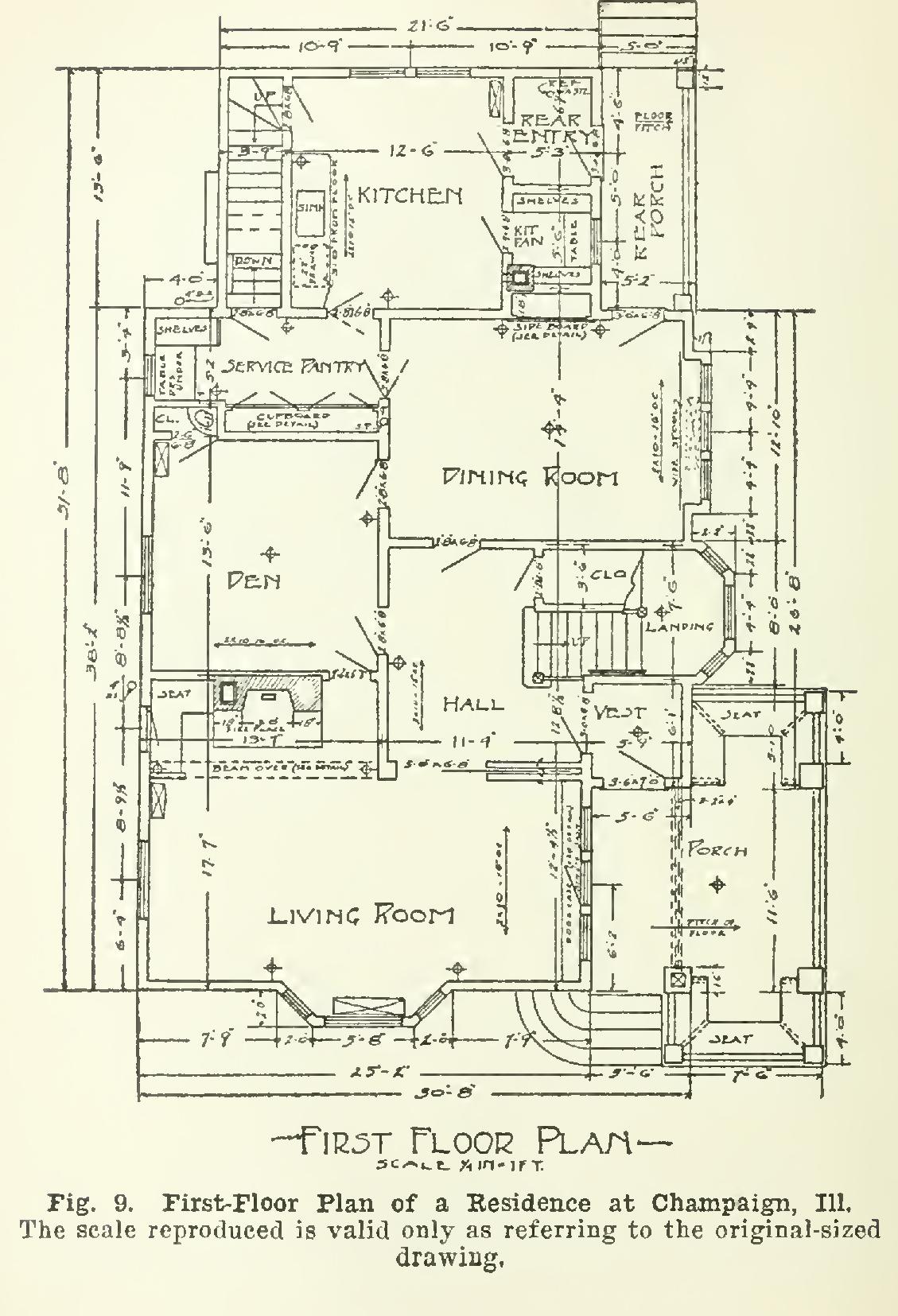
In summing up this portion of the work, let the draftsman put in all conveniences in the way of cupboards, shelves, and drawers wherever there is a space, corner, or portion of a wall. In this way you make a favorable impression upon the housekeeper, and if this is done, the "battle is more than half won." Fig. 9 is a first-floor plan, showing the arrangement, the dimensions, and all necessary information to give the builder a complete understanding of the work.
The Elevation. Having considered briefly the general methods used in the drawing of architectural plans, we shall now consider the elevations. By elevations we mean the different "views" of the building. These should show exactly the appearance of the building when completed.
Use of the Orders. It will be assumed that the reader is familiar with the Orders of Archi tecture (see below under heading "Orders of Architecture"), and that he knows the names of the various parts of an Order.
From a study of the Orders, we see that each one has three main divisions, the entablature, the column, and the pedestal. These are in turn divided into parts, the entablature consisting of the cornice, the frieze, and the architrave; the column has a capital, a shaft, and a base or plinth; and the pedestal, a cap, a die, and a base. Generally speaking, an elevation—especially the principal one—shows these component parts of an Order. They may not be classically correct in proportions, but the parts are more or less prominent, and should be used as a basis for design of all classes of work.
Let us take a residence for an example. Study an elevation of a good type of this class of building. We see that the basement wall up to the first-floor line corresponds to the pedestal of the column, a strong, massive part to support the building above. This pedestal is usually capped by a projecting course we call a water is, a board or strip projecting from the face of a wall to turn the water from the side of the building away from the foundation. This corresponds to the base or plinth of the column. Above the water-table, the part of the house extending to above the top story windows corresponds to the shaft of the column. Very often this column effect is emphasized by means of corner boards at the corners of the building. At the head of the top windows, or in that vicin ity, we see a horizontal board or moulding, mark ing the division between the column and the en tablature. Sometimes this entablature is divided by another moulded course, indicating the frieze and the architrave. There is always a cor nice of some sort, very often corresponding to the cornice of the Order; this may vary from the true profile to a small projection, such as a few projecting courses of brick.