Miscellaneous Rules
square, mark, inches and line
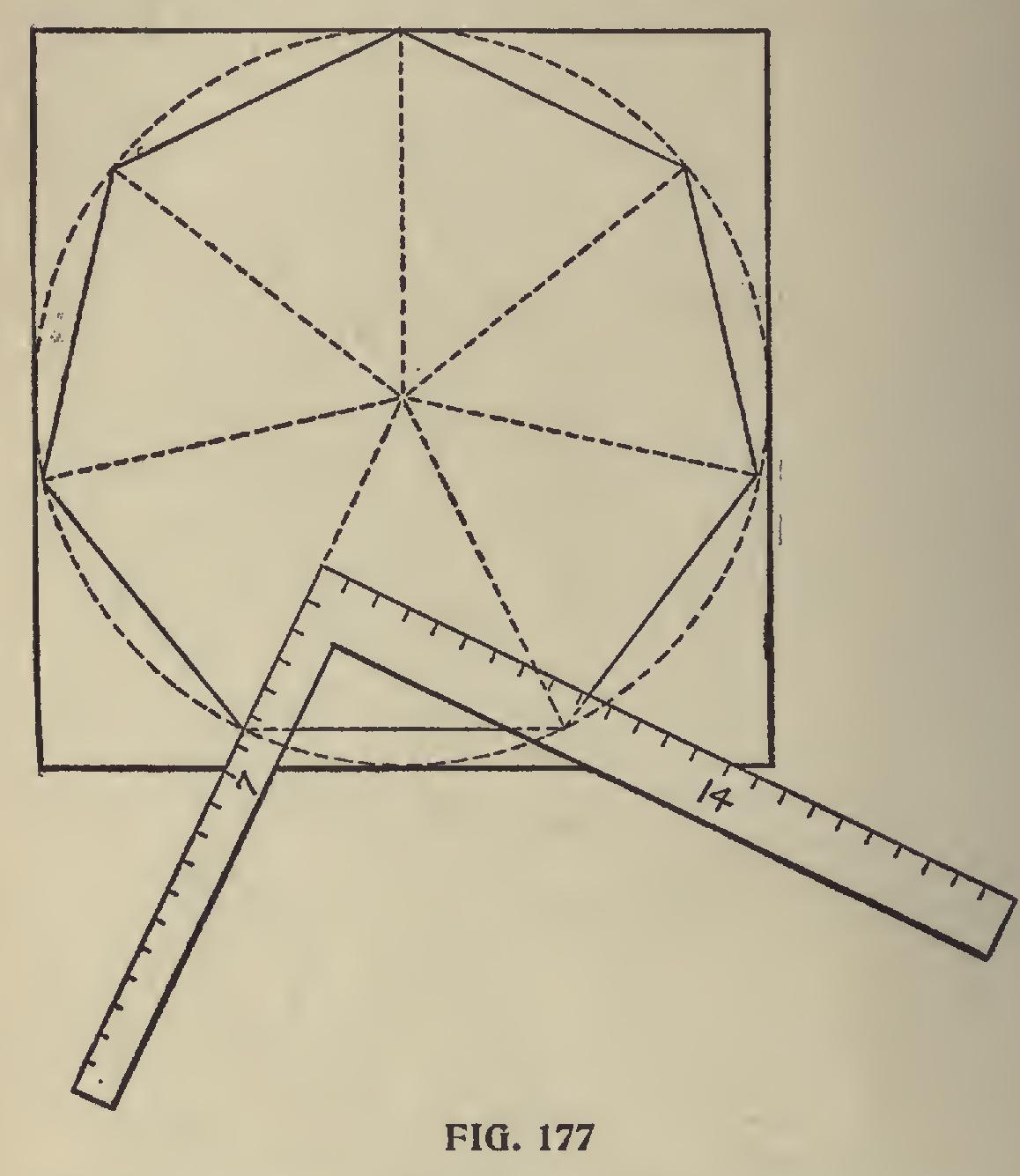
To Obtain a Heptagon.—Fig. 177 shows a heptagon, or seven-sided figure, and the manner in which it is obtained. To get the angle as shown, form a square in accordance with dimensions re quired; then inscribe a circle as shown; then place the square as represented, using the base line of the outside figure having the tongue miming in a line with the center, keeping the 7 inch mark on the base line; then on the blade the 14 inch mark will be over the base line. Hence, 7 inches on the tongue and 14 inches on the blade gives the figures for finding the lines for a heptagon.
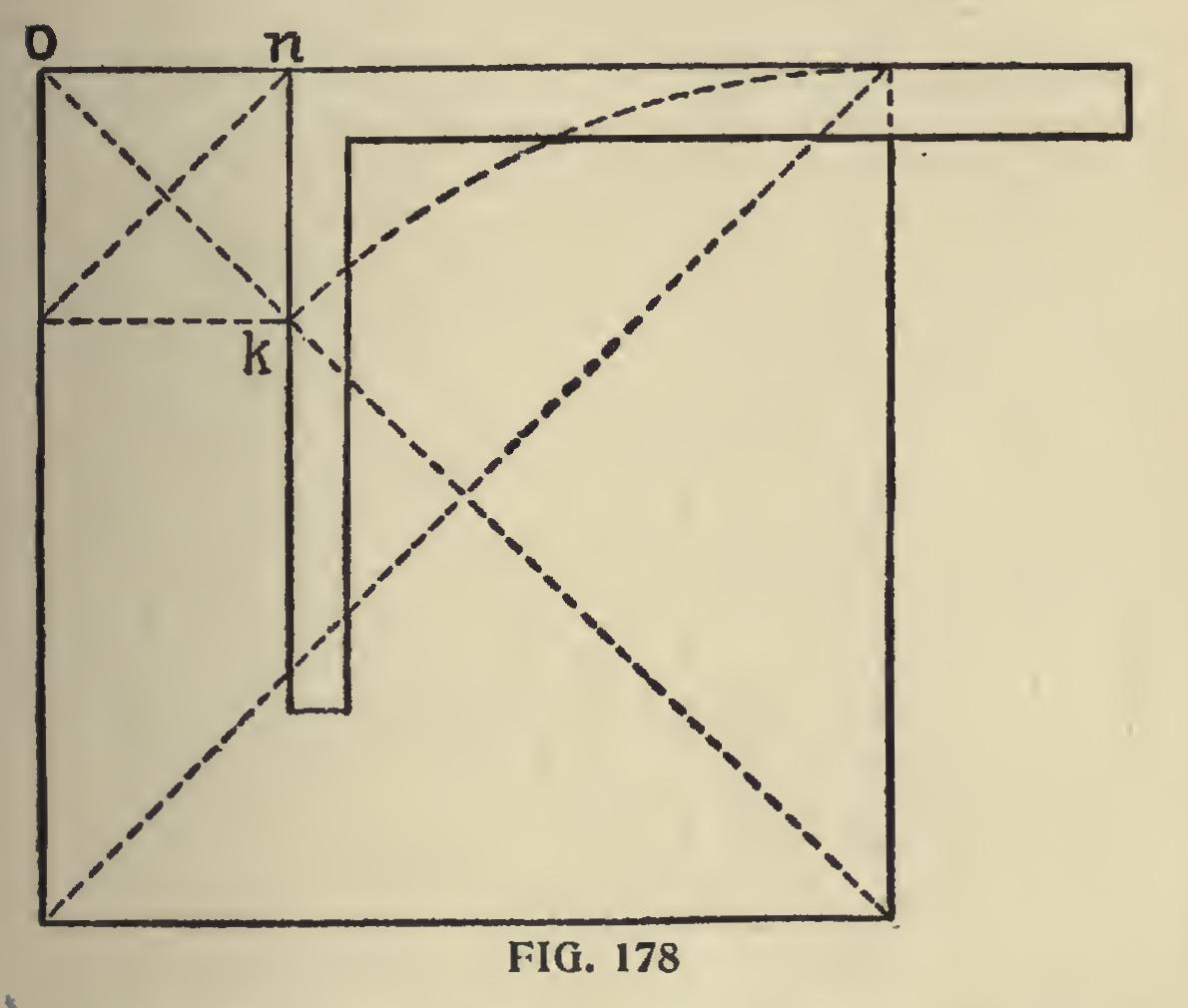
To Lay Off an Octagon in a Square.—In Fig. 178, measure off the side of the square on its diag onal k. Square from a side to the point thus found on the diagonal, and n o is the distance to be gauged from each corner, to mark the corners of the octagon.
When the Side of the Octagon is Given to Find the Square Width.—Suppose the side of the octagon is to be 16 feet; take half this or 96 inches for the square, 16 inches on both tongue and blade taken 6 times, giving 11 feet 3-1 inches, which, being doubled and added to the side of the octagon, gives the square width.
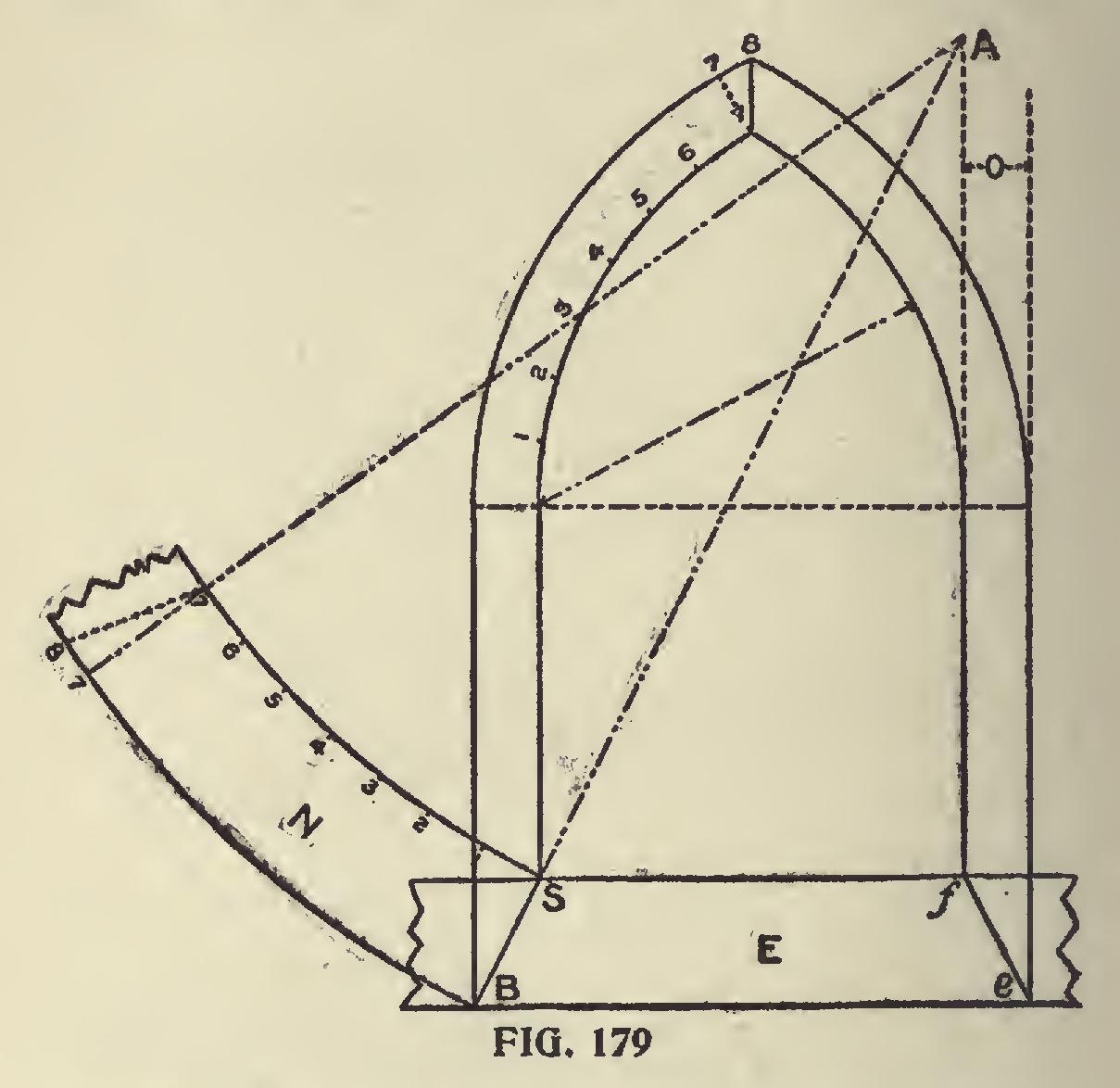
To Obtain Correct Shape of a Veneer.—Fig. 179 shows a method of obtaining the correct shape of a veneer for covering the splayed head of a gothic jamb. E shows the horizontal sill of the splay, fA the line of the inside of jamb, o the difference between front and back edges of jamb, BA the line of splay. At the point of junction of the lines
BA, fA, set one point of the compasses, and with the radius AB draw the outside curve of N ; then with the radius AS draw the inside curve, and N will be the veneer required. This will give the required shape for either side of the head. Its length may be found by spacing off the head as shown by 1,2,3, etc., and space off like amounts on the inner edge of piece N.
Proportional Scales
may be readily enlarged by the use of the Steel Square as shown in Fig.180.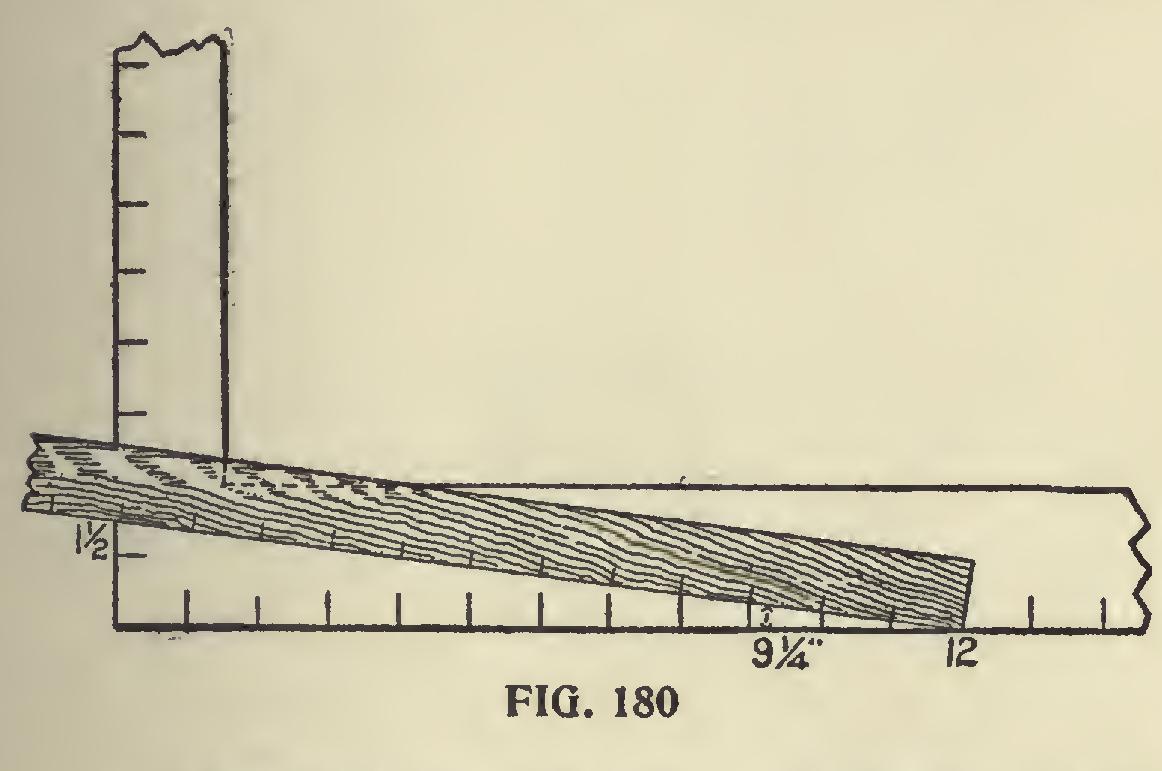
To Reduce from One Scale to a person is drawing a machine on a scale of 1i inches to the foot, he may simply lay a common rule over the square, touching the 12-inch mark on the blade, and the 1i-inch mark on the tongue; he then possesses a contrivance by which he may easily reduce from one scale to the other. For instance, if a piece of stick 2i inches square is to go into the construction, the draughtsman finds the 9k-inch mark on the blade, that is 2i inches back from the 12-inch mark, and measures square out to the rule. This distance is the reduced section of the stick. A straight mark, drawn on a table or a drawing board, serves as well as a rule.