Elements of House Framing
joist, shown, space, sill, cold, lower, bearing and construction
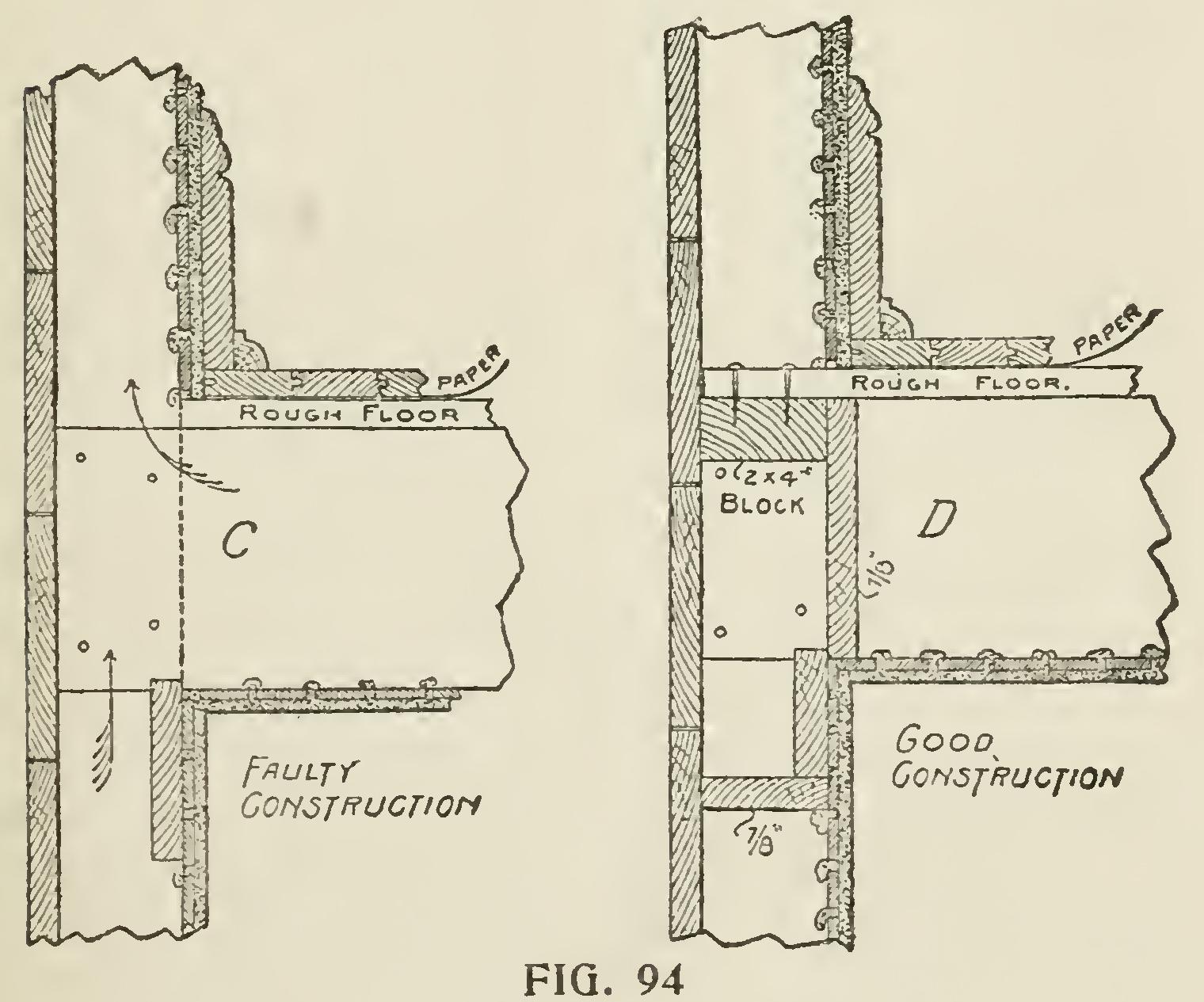
In Fig. 94 are shown two forms of construction at the bearing of the second floor joist. The con struction shown at C is the usual way most two story houses are built. No attempt being made to cut off the space between either studding or joist. At D is shown what should be done. Two by four-inch pieces are set in between the studding on a level with the top of the joist. The rough flooring should be laid diagonally with the joist and extend over on to these pieces and nailed. This forms a good tie and makes a closed job and by cutting in finch boards between the joist, letting the lower edge lap over the bearing board will cut off the space between the joist. If back plastering is desired a third piece should be cut in between the studding just beneath the bearing board for the back plaster to stop against same.
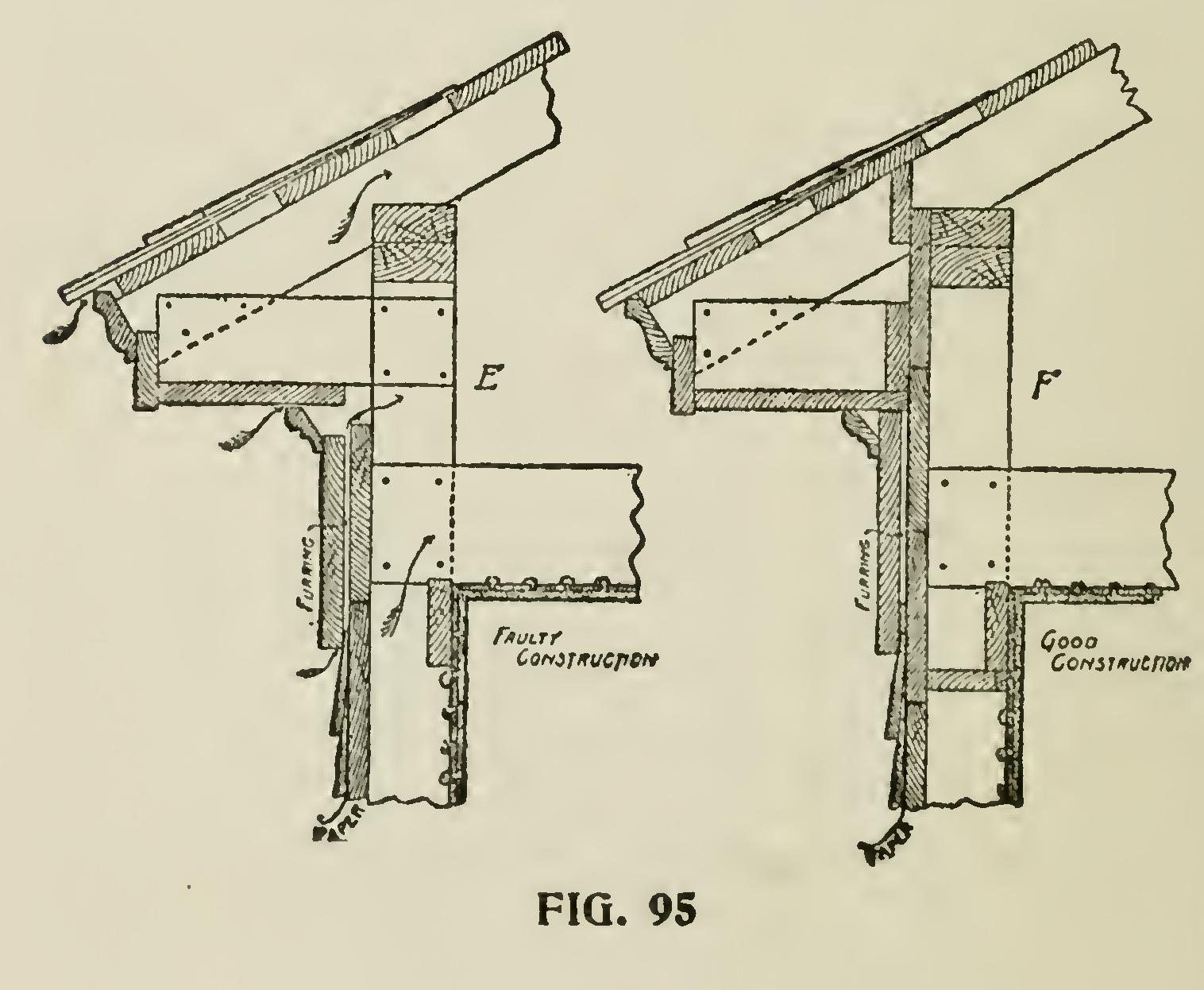
In Fig. 95 are shown faulty and good construc tion of cornice and bearing of the ceiling joist. At E is the usual way of construction for cottages where the ceiling is lower than the plate. The space between the studding is left open and is otherwise built on a refrigerator plan. Great open cracks are left between the frieze and plan cier with the idea of covering with the bed mould. After the natural shrinkage of the different mem bers, small crevices are open up to huge propor tion and the frosts and cold winds find their way in to compete with the burning coals for suprem acy. As the heat rises and warms the attic, the cold air seeks the lower level, and if by faulty con struction, as before mentioned, in the lower parts of the house, it has a perfect current of cold air sweeping through these spaces and the result is a cold house. At F is shown how these defects could have easily been remedied at a very little extra expense. But it does not stop here, for there are many other parts in and about the house that are constructed on the same principle. Gable studdings are oftentimes continuous from sill to the rafter instead of the plate across the end, thereby leaving an open space the whole way down. The pockets for the sliding doors are often not closed from the surrounding openings. In case of fire getting started every opening is a ready flue to fan on the flames. On the other hand, with these flues cut off, fire is not nearly so apt to get started and if it does it will take much longer time to consume the building, and the chances are much better for saving the house. The builders are not so much to blame for this kind of work, but rather the architect who should show these things in the plans and specifications and see that it is done.
Otherwise, in these days of close competition, the contractor must figure close, and unless these things are clearly shown and described he cannot reason ably be expected to do it unless all are required to do the same.
Constructing Box Sills.
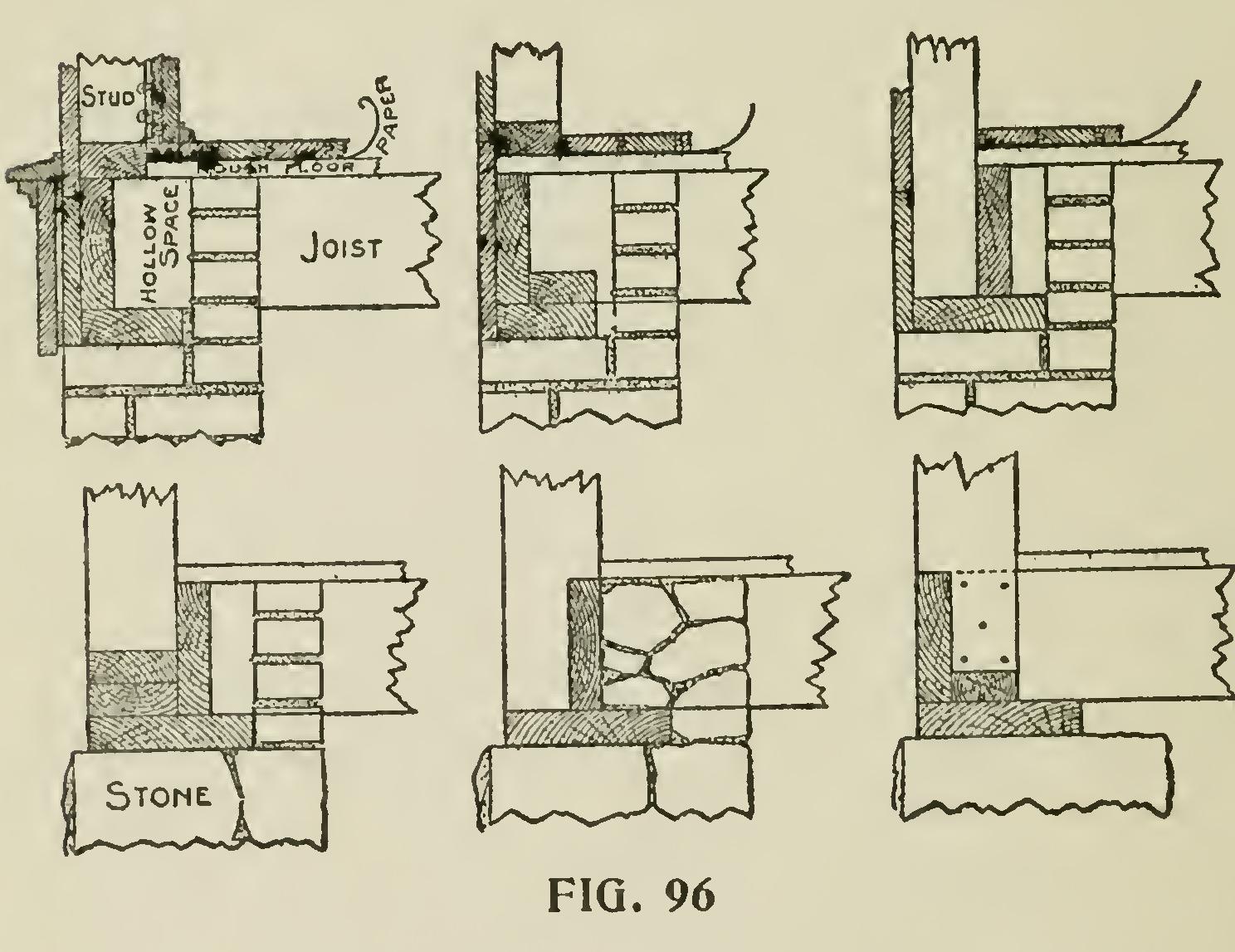
Fig. 96 shows several ways of constructing box sills, commonly called balloon framing. The first one shown at the upper left-hand corner is the same as that shown in the previous illustration for good construction, and what is said in its favor is not necessary to repeat here. However, the section here shown is that resting at right angles to the joist. The side sec tion should have an extra joist with finch set in between for the plate or shoe to rest on, so as to form a projection to receive the ends of the flooring. In long spans there should also be cross-pieces set in between the sill and the adja cent joist, as a further precaution to keep the sill from springing outward. The other types here shown are good forms of construction for general residence work, and are here given to meet the requirements that may arise. It is quite fre quently necessary to change, so as to make the lumber at hand work to the best advantage to give desired heights, etc. But whatever style is used, there should be great care taken to break the joints of the different members; that is, do not let two joints come at the same place, but equalize them as much as possible. Another point should not be overlooked, and that is the beam filling. This is done principally to keep out the cold. It is quite the custom to fill in the space between the joist with broken stone or bats, slushed with coarse mortar, which, of course, makes a tight job; but the experience of the writer has been that it is not a good one for several reasons, which are as follows : First—unless the sill is built water-proof, after forms as previously illustrated, it is only a ques tion of a few years until the sill is rotted out. Then, again, if is is built perfectly tight dry rot is liable to make quite as quick destruction; besides the joist are sure to shrink more or less, so something has to give, and it is usually a bulged floor, as the result. The better method is to fill in with brick, leaving an air chamber back of same and make allowance for the shrinkage by not filling flush with the top edge of the joist at first ; then after a time, if a tighter job is wanted, it can be pointed.