Elements of House Framing
timbers, building, time, sill, little and joist
ELEMENTS OF HOUSE FRAMING Use of the Steel Square.—In house construc tion, as in every other branch of the carpen ter's work, a knowledge of the steel square and its many capabilities is an absolute necessity. No other single tool displays such versatility of useful application.
The subject of the Steel Square and its mani fold uses is one of such magnitude ancl impor tance that its full detailed treatment is given elsewhere in a special volume.
Framing a House.
Some thirty-five or forty years ago when lumber was more plentiful, it was the common practice to build frame houses, great and small, with solid timbers. The sills, plates, and corner posts were often hewn from the round timber with broad ax and adz, it often taking months to prepare these for the "new house." After the timbers were hewn to desired size, then came the work of laying out the mortise and tenons for joining the different parts together. No nails or spikes were used for this work. The corner posts were usually made out of timbers six or eight inches square, with the inner corner hewn out to receive the lath and plaster. This carries us back to the time of the building of our old home, more than forty years ago. Though only a lad, we remember 62 the time the trees were being felled in the forest and after a long wait for the timbers to be squared, they were hauled to the building site, and after a time for them to season, the carpenters came, and as though but yesterday, we see them under the old apple trees astride the timbers with auger, chisel and mallet working away from morn till night. It was just so with all of the work con nected with the building. The mill work was gotten out by hand, even to the sash and doors. How well they built their works remains as a silent witness ; suffice it to say the latter day workmen could gain some good pointers in con struction from these old timers. Neither short hours, long hours, strikes nor lockouts worried them. Those were days of toil, days of content ment and peace. How different it is now ! When the new house is decided upon, within sixty or ninety days it is ready to move into. The workis divided up into different classes and done by different workmen. The solid timbers are no longer used for the frame work. In its stead the sills and other timbers are built up with joists and studding commonly known as balloon fram ing, and everything is rushed from start to finish, and in the hurry many things that should be done are overlooked to the detriment of the house. Some of these things may require but little or no extra expense, if attended to at the proper time, but if neglected prove a serious detriment to the building. It is to this phase of the question that we desire most to call attention.
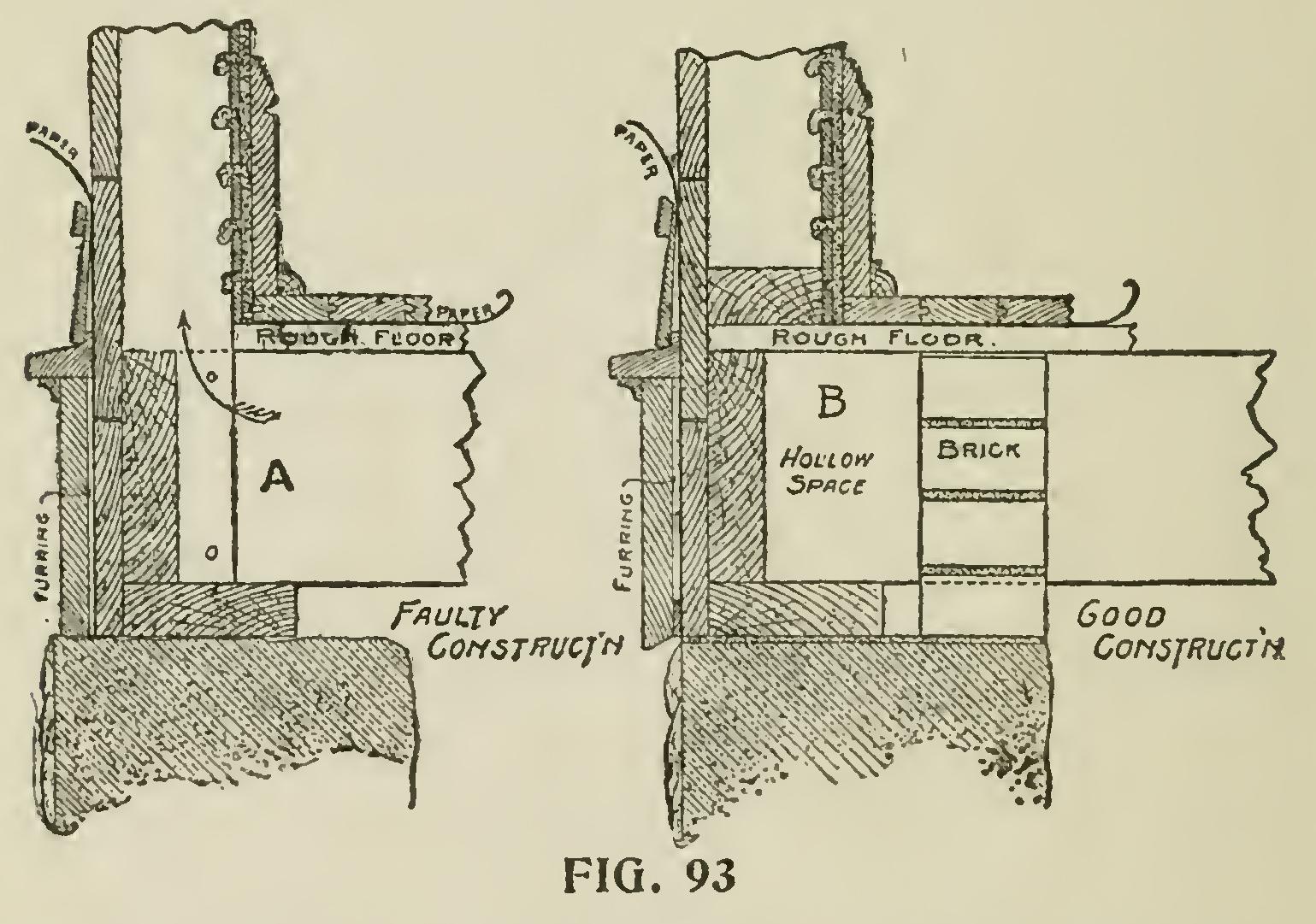
Good and Faulty Construction.—In Fig. 93 are shown two ways of constructing the sill; however, there are several ways, but these will serve our purpose. The one shown at A is marked "faulty," and that at B is marked "good construction." At A the masonry projects a little beyond the base board and the sill is laid without being bedded in mortar. The water follows the wood work and runs or beats under the sill, the in equalities of the stone holding the water and in a few years the sillis rotted out,I to say nothing of the cold that the open crevices will let in. The stud ding are halved to allow nailing space to the sides of the joists, but in doing this a space between the studding is left open, allowing free circulation, as shown by the course of the arrow. In the con struction at B the sheathing is flush with the mason work, and the base sets clear and a little below the top edge of the stone. The back edge of the base is beveled so as to form a drip. The sills are bedded in mortar and the spaces between the joist and studding are cut off. Bricks are used to fill in between the joist but in this allowance should be made for shrinkage of the timbers by leaving the masonry work a little below the top edge of the joist. The building paper extends from sill to plate and under window and door frames.