Elements of House Framing
cut, door, studding, openings, inches, double and measurement
It is much better to construct a gutter and give it all the fall you think necessary, and then add an inch more rather than make it an inch less. Give all gutters plenty of fall and you will not only be pleased, but the owner of the building will be also. These gutters are sometimes put on top of the shingles. It makes a more lasting job, but is far from ornamental, or convenient, either, when it comes to re-shingling.
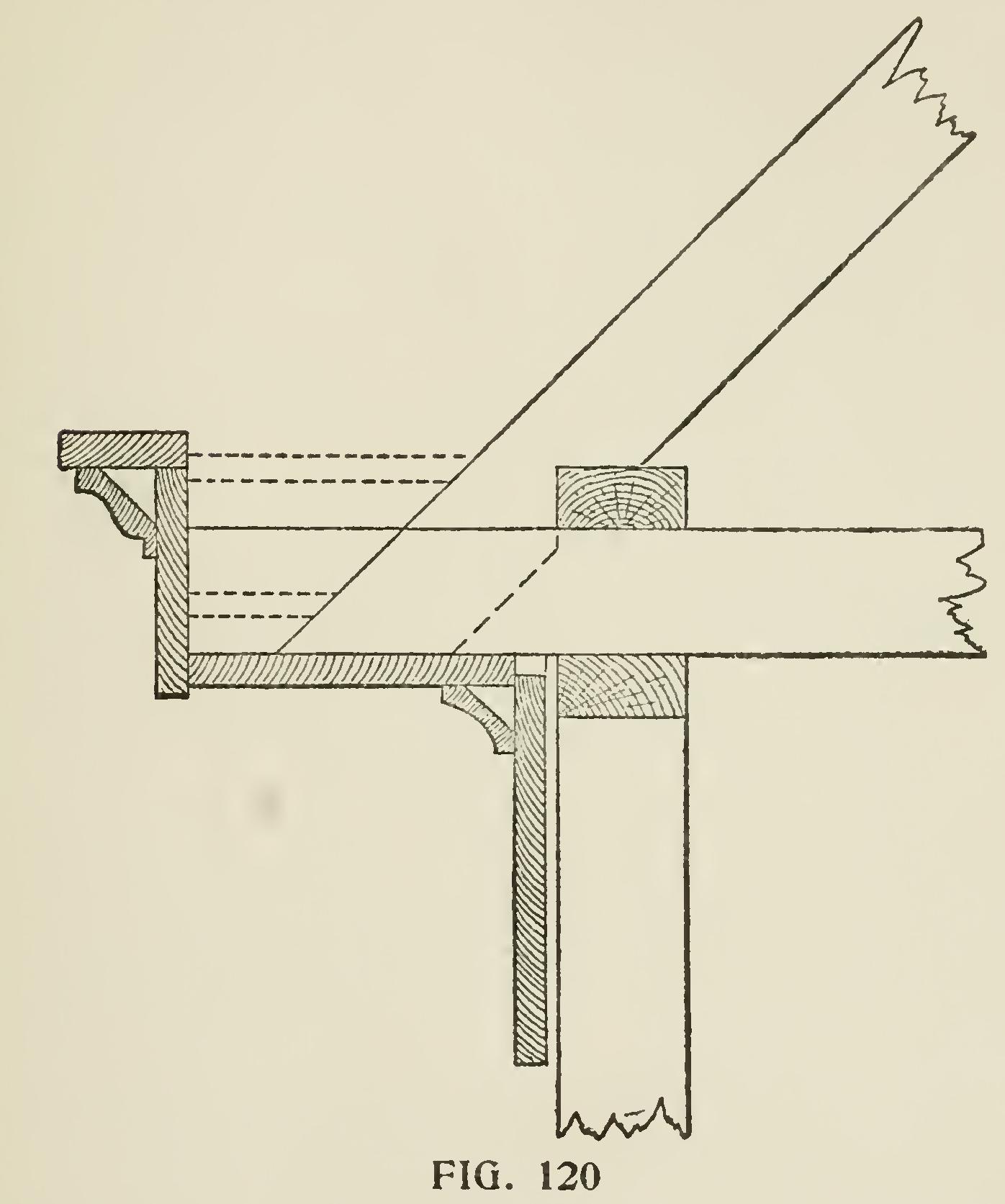
Fig. 120 illustrates the real cornice and can be constructed cheaply, as illustration shows, or can be made very expensive with many members, mouldings, brackets, etc., and it will practically last forever if a good gutter is kept in it, as there is no part of it exposed.
With clotted lines we have shown both ends of the gutter board in bottom.
Cutting Openings in Frame Work.
It some times seems to me that there is not a trade or calling that the boy falls into as naturally as the building trade, especially carpentering. We never saw a boy but what knew something about driv ing nails, and quite a large per cent have at least tried to use a saw. So it comes naturally, and they easily commence to nail on a few boards, which gives them a taste, and they start in to be a builder. Step by step they move along from rough work to siding, cornice and finally to inside finish, and if they have a desire to go ahead with the work they lay it out for themselves as well as others.
They get hold of some good work on the steel square, and if they are natural mechanics they soon become a good framer. And yet as easy as it is, and as natural also, to be a good carpenter and a building foreman, it is indeed surprising to know that there is probably not one carpenter in a hundred who can cut out the openings in the frame work, and get them so that when the frames come they will fit perfectly. We have heard good fore men say the only right way was to wait until the frames came and measure them and then cut out the openings. Some sheath a house all up solid, and when the frames come they cut out, which is perhaps a sure way, but it never seemed a very pleasant, easy or cheap way. Others set the stud ding all up, and then before they sheath cut out for openings, claiming it is a nice way, as the studding are all evenly spaced all over the build ing. Some of that theory is good, but we could always cut a studding better when it was lying down level on a pair of trestles than standing plumb nailed in a building.
We always found it a much better way to lay the openings out and frame them complete before they' are raised.
For a common 2 feet 8 inches by 8-foot door, get the exact height the bottom of the door should be from top of joist, then measure up 8 feet, which will give the top of door, then allow two or three inches for head jamb and space above the door. Always allow plenty of room; don't get the header so low that the lugs will have to be all cut off the jambs.
Now, as the majority of windows are the same height as doors, the measurement, when once gotten right, is good for many openings. Two inches on each side of door is generally enough, or four inches more than door measurement, is the measurement between studding, but as it is well to cut the double studding in under the header, the outside or main studding should be set about eight inches wider than the door.
Figs. 121 and 122 show it perhaps plainer than words, and also show an opening ready for a two-light 36 by 36-inch window.
A very good general rule, one easy to remem ber and one which works nicely on ordinary 5-inch casings, is to set the studding and headers just one foot more than glass measurement. For a house where the siding is put on the studding, in order to give room to nail and not split the ends of siding, it is well to make the opening a half or an inch wider.
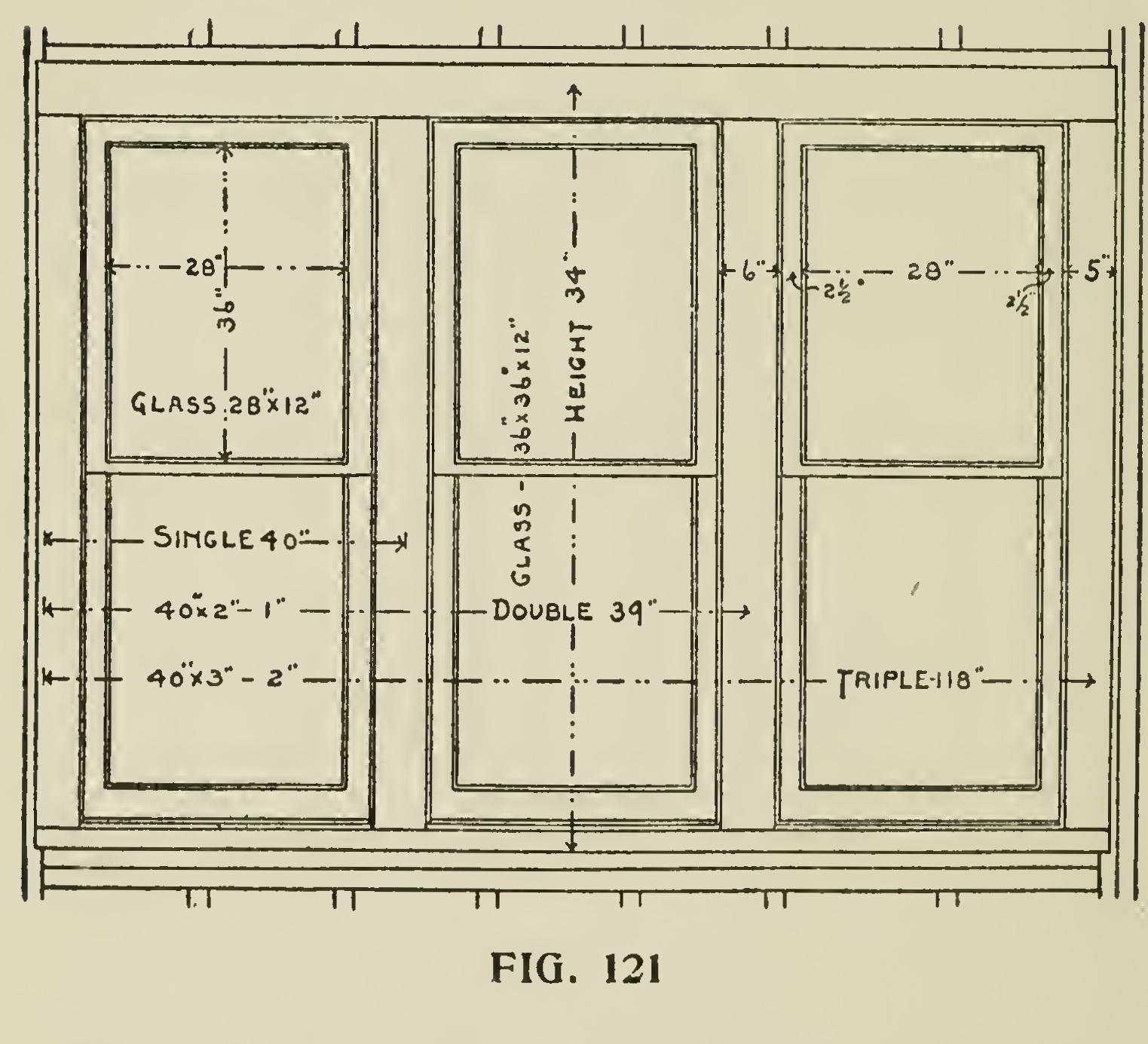
The double and triple windows are the ones that seem to give the most bother; and yet it is very simple. A double window (with a seven-inch mullion) is just double what a single one is. But perhaps the most common is as illustrated, a six inch mullion on the outside, which makes them all alike, if you wish, on the inside.
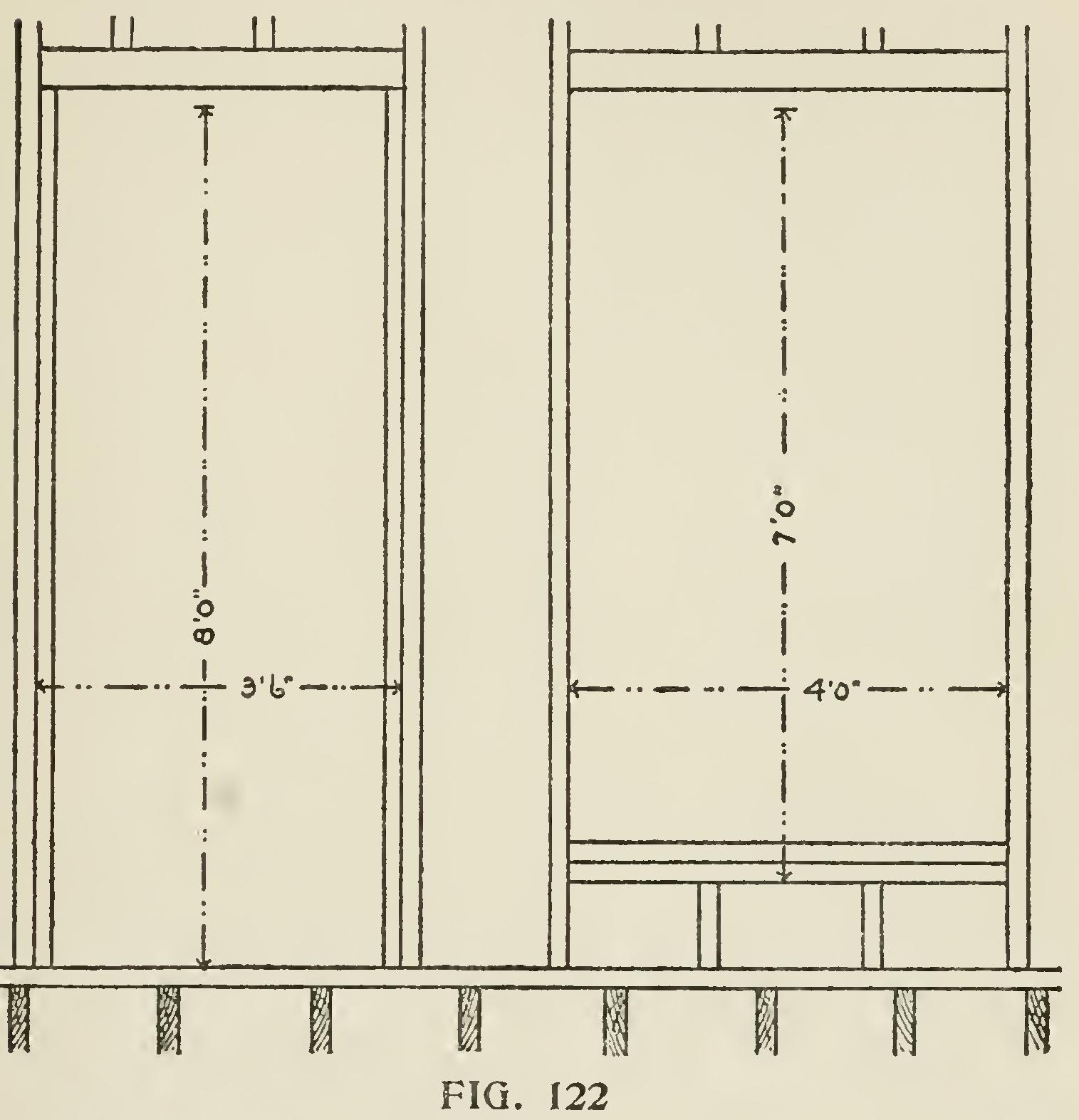
We hope that a careful study of these illus trations will make it plainer to many carpenters when they go to lay out their next openings.