Elements of House Framing
studding, joist, rail, porch, time, piece, ordinary, shown and floor
Framing Ordinary Studding.
Volumes could be written on roof framing alone and yet not completely cover the subject. We will mention a few simple matters of the most common fram ing. The best way to frame ordinary studding or joist is to make a good pattern of one, and for two men, one at each end to lay the pattern on and mark off the rest. Of course, in very heavy work it is well to make a pattern out of lighter material. It happens many times that one man is left to frame alone, and it is very inconvenient, especially in long work, to go back and forth to mark both ends. It is very handy to use a pat tern on each side and square over and lay off a dozen or so at a time, as illustrated in Fig. 97. Here we show a long studding notched for ribbon to put second floor joist on. This used to be con sidered much better than short studding for each story, but the majority seem to prefer the short studding for each story, as it is surely much easier to handle and, if properly made, is fully as strong.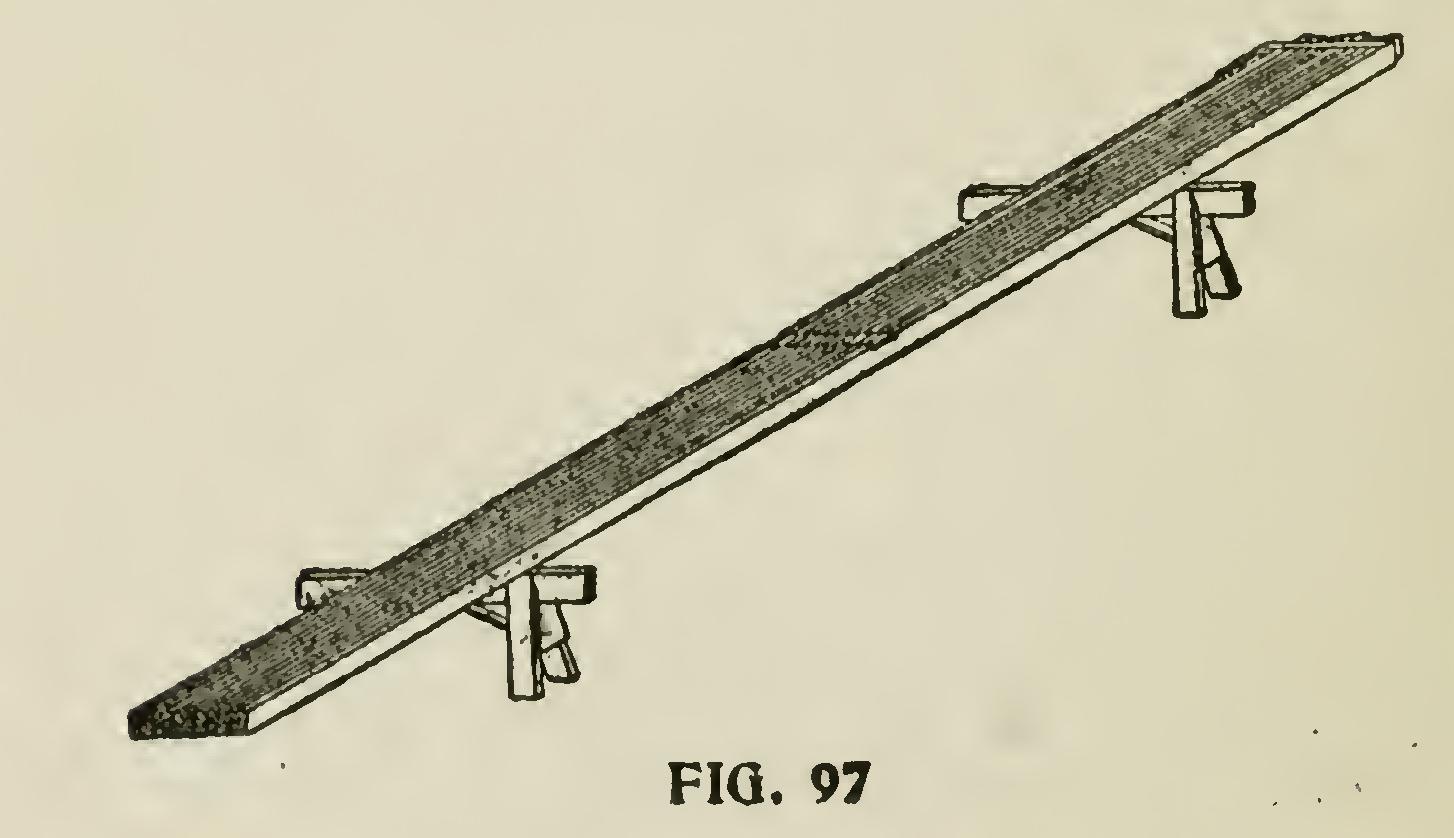
Of course, it could be made weak by only slightly nailing the upper studding and have a crack in the lining just at the bottom of the upper studding, etc., but these matters can be easily avoided and should be. The long studding can be made weak, and often are by carelessly sawing them almost in two when sawing for ribbon. Again, we often see a very weak building of this kind because many of the joists simply rest on the ribbon and are not spiked to the studding at all. Most of these weak points in either style could and should be avoided. The British Government has shear legs in their dockyard at Chatham that will raise a dead weight of 180 tons out of a ship and into the air 60 feet and place it in another ship, and it makes one realize that raising is a big subject, too.
But it is not the difficult things to raise that it is intended to call attention to as much as the simple and common ones. With all the modern derricks and shear legs and old-fashioned spike poles, which are all very useful in raising, the main thing necessary in ordinary house construc tion is plenty of men. A few to hold down the foot and plenty to raise the studding and the complete wall of a house goes up very quickly and easily.
While it is very necessary to have plenty of men it sometimes happens that we do not have them. Then by nailing together a section at a time, and having a lining board nailed at the bottom to hold the foot down and a studding at each end with a spike in each to help hold it, it is raised as illustrated in Fig. 98. Where there is plenty of help always finish the openings complete before raising, as it is much easier while the stud dings are lying down than it is to climb up and cripple them in.

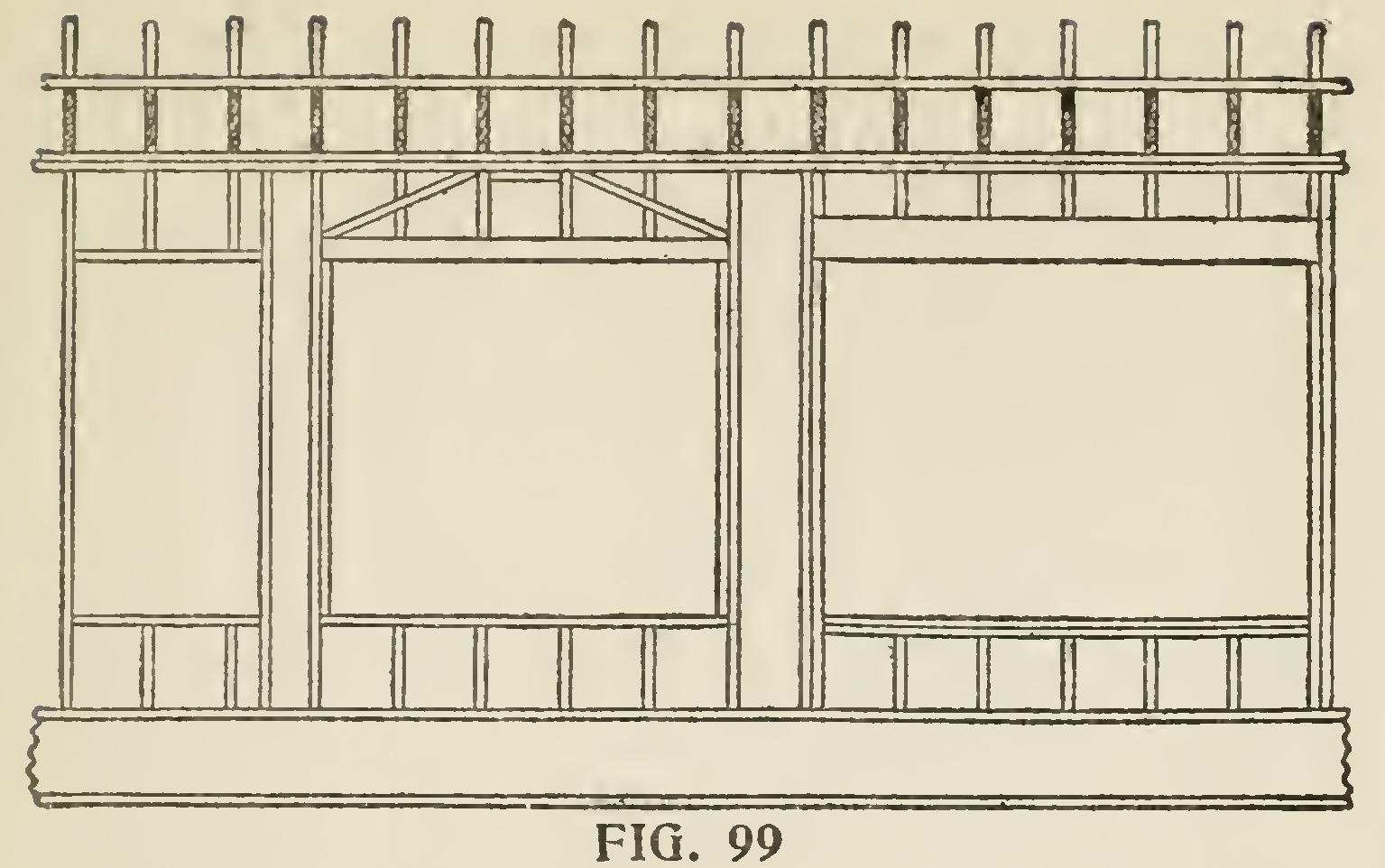
Fig. 99 illustrates a section complete. A com mon window opening may be made with single studding and headers flat ways; but for larger openings they should be doubled and the header put up • on edge and, where necessary, a brace should be cut in to form a kind of truss. For a
very large opening that kind of crippling gener ally makes a very poor job, and a much better way is to use a joist of sufficient width and strength. Many times we see a house with single dressed plate, which is only a little over 11 inches to carry heavy 12-inch joist, and the joist spaced without any regards for the studding below.
While it is true that the joist will probably not break through the plate, still how much better it would be to space the joist so they would come over the studding. In fact, it is not only much better, but it is much easier, too, for you to simply lay off the sill, and it is all carried along with that one laying off. Studding and joist are all 16 inches apart all over the building and ready to receive the lath.
There is no time spent at all in laying off the second floor except for laying out for the openings.
Constructing a porch.
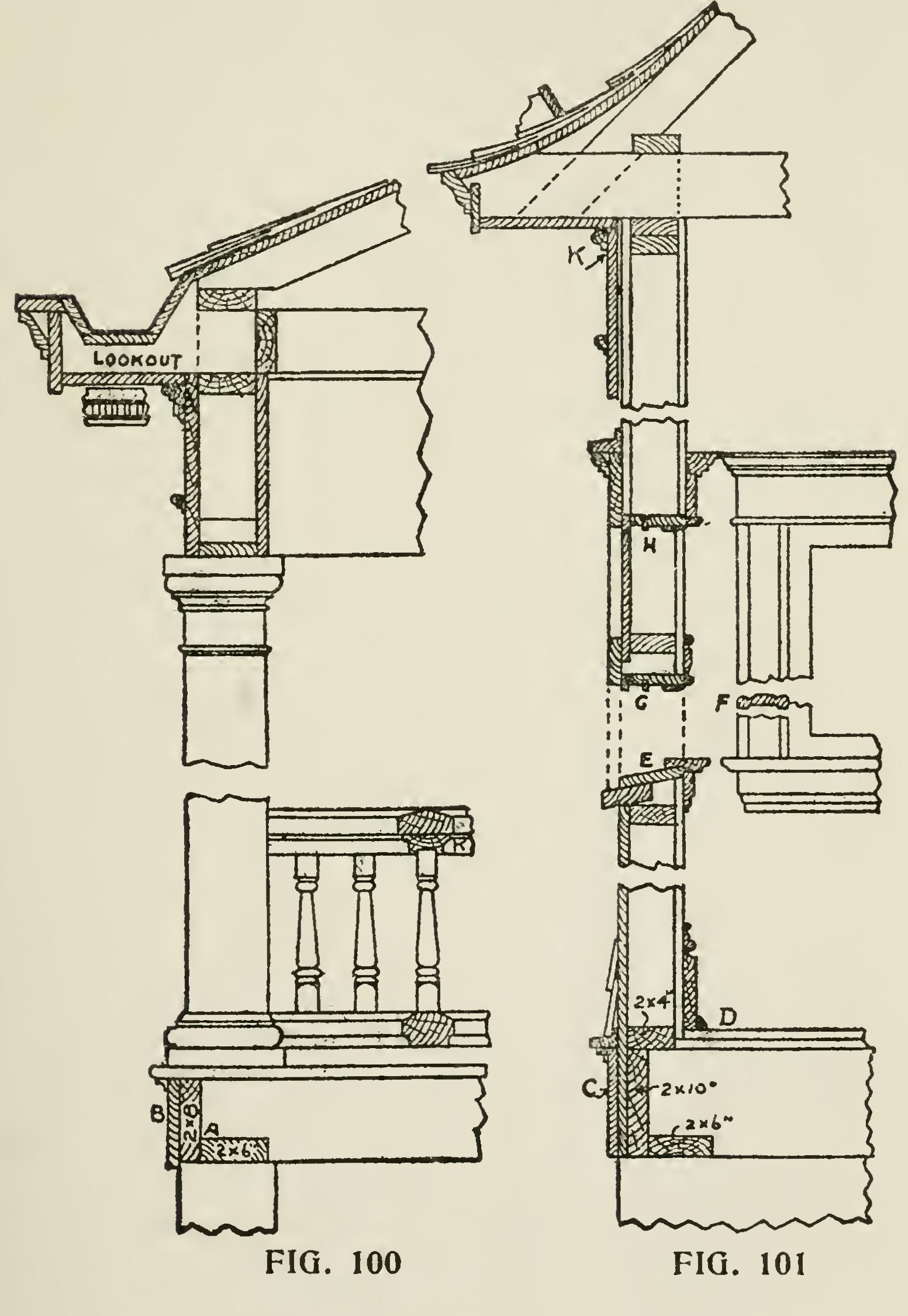
Fig. 100 shows the general construction and details in full of the framing and the various parts of an ordinary front porch. A special feature in the framing of this porch is the joists, which in most porches must also answer for the outside sills. In framing porches many carpenters and contractors frame the joists so that there is nothing but the narrow edge of a 2 by 6 or 2 by 8 that rests on the porch piers, and this small bearing, of course, must come all on the outside edge of the piers.
By the method which we refer to in our detail we take a 2 by 6 and a 2 by 8 and spike them together, as shown in the detail at A. This gives a full bearing on the pier, or very nearly so, and it will be found to make a much better job than the old custom of just having the narrow edge of the floor joists resting on the piers.
The facing shown at B should be from one half to three-quarters of an inch wider than the floor joist, so that it will project a little below the pier. This gives a good place to secure the lattice work from the back side.
The top rail in the porch rail is made of two pieces, as shown at R. It is difficult to get a single piece rail large enough for this kind of a porch. Many of the built up rails consist of from six to eight pieces, which make them more or less expensive. The rail, as shown in the sketch, is designed to work in between the small single rail and the.large six and eight piece rails, and will be found a very easy rail to make, an inexpensive one, and at the same time a good, serviceable rail and one that will look well. The bottom rail of this porch can be made in one or two pieces, as desired. If made from a 4 by 6 it could easily be made in one piece. The porch has a box frieze and cornice with a sunken gutter in cornice. The cornice has a wide frieze with a band mold and a bed and dental mold. A planceer, fascia, crown mold and cap piece complete the outline of the cornice.