Pitches and Roof Framing
pitch, run, lines, square, rise, rafter and common
PITCHES AND ROOF FRAMING The young mechanic who attacks the prob lem of roof framing will find that it involves many features entirely distinct from those that confronted him in framing ordinary walls, floors, etc. If the steel square was found of great assist ance in the latter, it will prove absolutely indis pensable in laying out the timber and lumber for roofs.
Examples and Explanations on Roof Framing. —The following examples and explana tions on roof framing are simple and easily understood, and cannot fail of being valuable to the young mechanic who aspires to become an expert roof framer.
Roof framing can be done in about as many different ways as there are mechanics. But un doubtedly the easiest, most rapid, and most practical is framing with the square. The fol lowing cuts will illustrate several applications of the square as applied to roof framing, and all who are interested in the subject can, by giving it careful study, be able to frame any ordinary roof the mechanic comes in contact with.
Pitches and Degrees.
Fig. 195 is an illustra tion that may well be given much study. It not only gives the most common pitches, but also gives the degrees. Most carpenters know that half pitch is 45 degrees, yet few know third pitch is nearly 34, and quarter-pitch about 27 degrees.
A building 24 feet wide (as the rafters come to the center) has a 12-foot run and half-pitch, the rise would also be 12 feet, and the length of the rafter would be 17 feet (the diagonal of 12). Length, cuts, etc., could all be figured from the one illus tration.
Pitch Lines and Reversed Pitch.
In the illus tration at Fig. 196 we show the pitch lines up to the full pitch, also the reversed pitch. That is, by letting the blade represent the run and the tongue the rise. The length of the pitch lines in that case becomes the length of the rafter for a one-foot rise to the inches in run taken on the blade. The reader will notice that several of the reversed pitches are to be found in the first column, though representing some other pitch, that is, the full pitch becomes the one-quarter pitch when reversed. The three-quarter, same as one-third, the two-thirds as three-eighths. The one-half being at the half-way point between horizontal and perpendicular, remains unchanged.
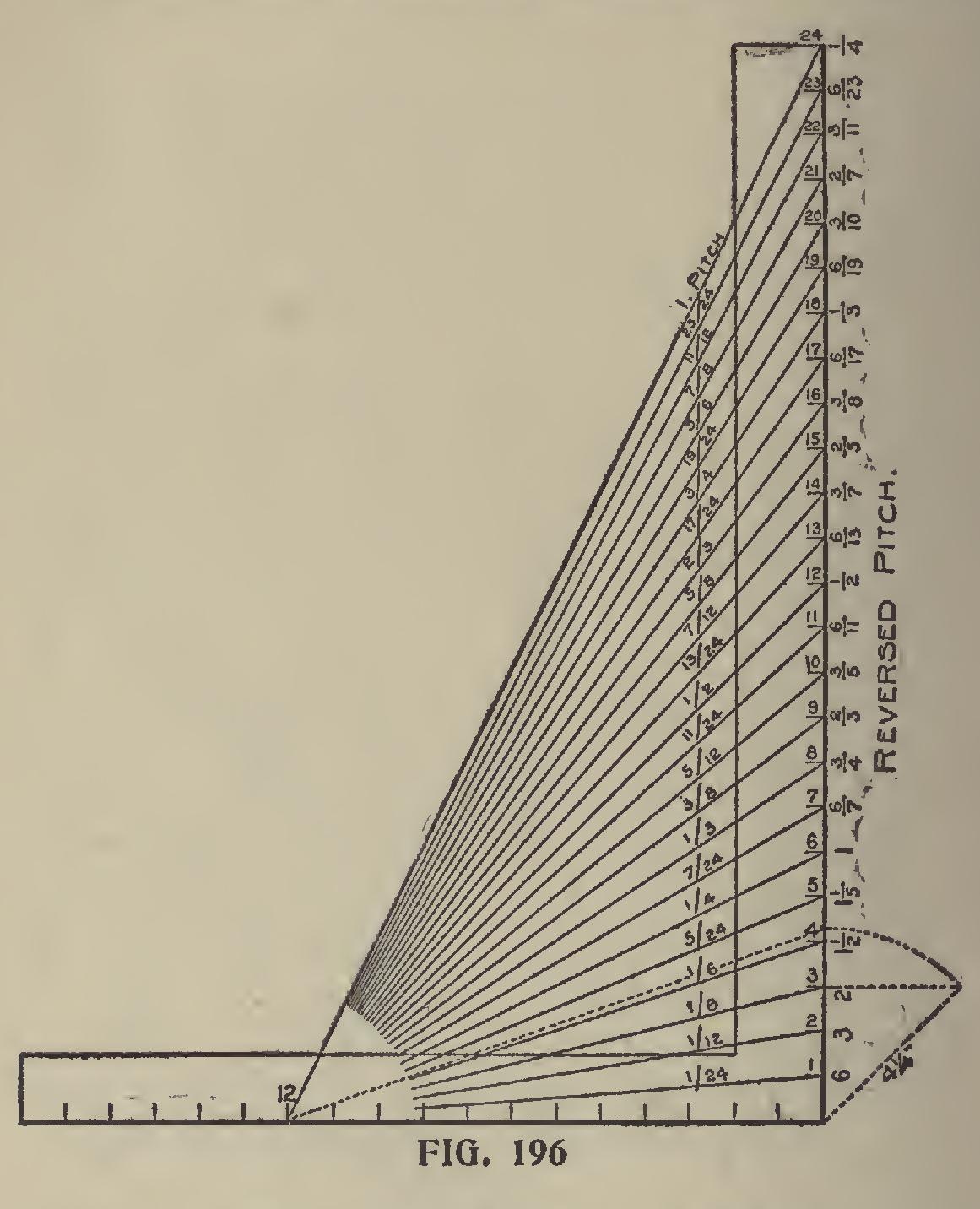
From this it will be seen that the low pitches become very steep when reversed. Thus, the one twenty-fourth pitch becomes 6 pitches or has a rise of 12 feet to a one-foot run. The one twelfth pitch has a rise equal to 3 feet to a one foot run, etc.
For the corresponding lengths of the hip or valley for these pitch lines, add five-twelfths to the run of the common rafter, which is the same as taking the diagonal of a square, whose sides equal the run as shown by the dotted lines for a 3-inch run, which in this case is equal to 41 inches, and measure diagonally across to 12 on the tongue will give the length per scale for the hip for each foot in rise of the common rafter. This, of course, reverses the seat and plumb cuts, on the square, and also causes a calculation that can be simplified by always reckoning the run on the tongue of the square regardless of the pitch given the common rafter.
Steep Pitches.—In Fig. 197 is shown how to apply the steel square for steep pitches, In this illustration we show all of the pitch lines up to 96-inch rise to one foot in run, or four full pitches.
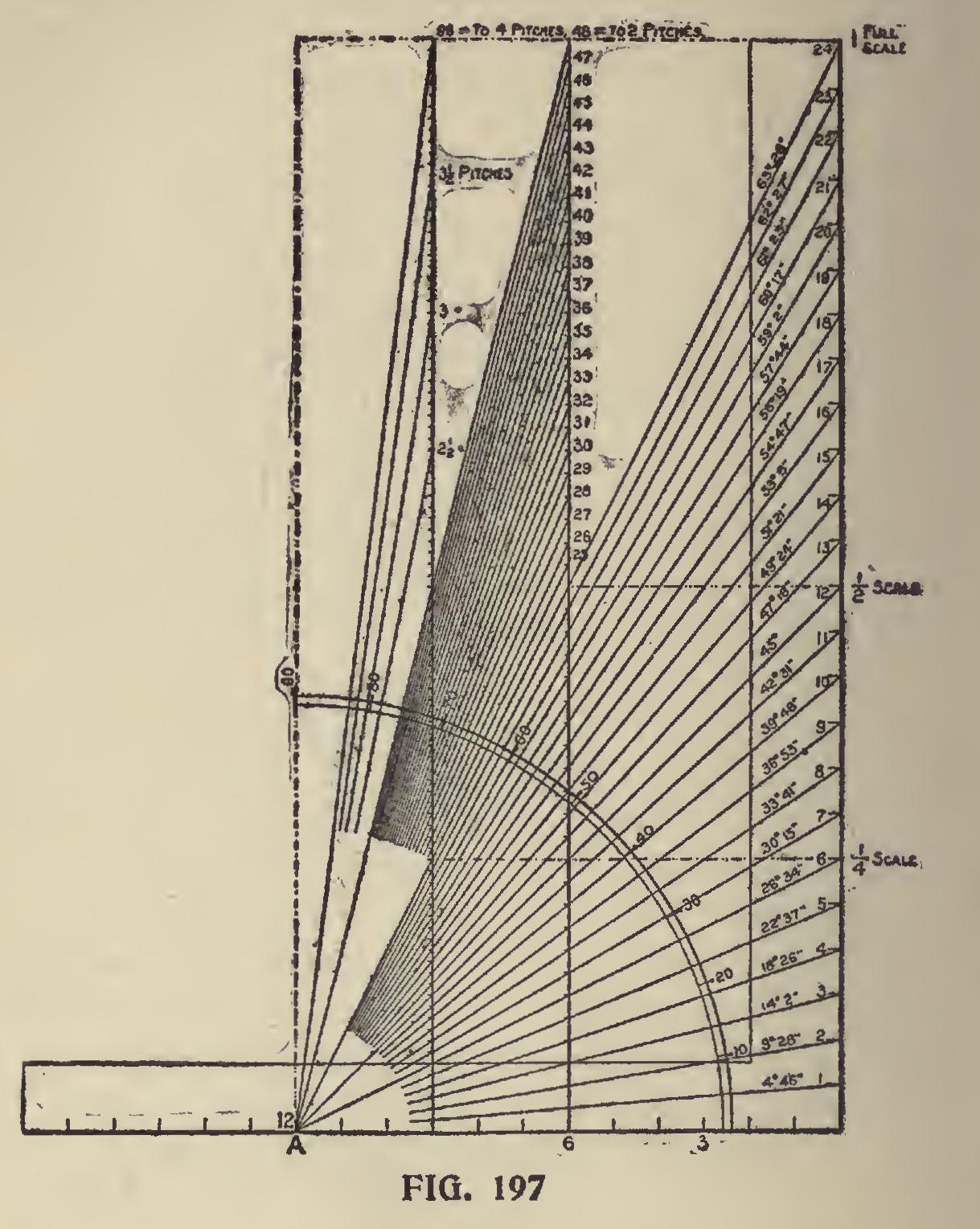
The pitch lines shown in connection with the steel square, represent the same up to the full pitch. Now leaving the pitch lines as they are and just imagine that we slide the square to the left until the 6-inch mark on the tongue rests at the starting point A, and it will be seen that the scale has been reduced one-half ; in other words, the pitch lines would intersect the blade at the i-inch marks, thereby permitting of a 48-inch rise to a one-foot run. The 48 being double 24 (the span) is there fore equal to two full pitches. If it is necessary for a still further reduction, just slide the square again to the left until the 3-inch mark on the tongue rests at the starting point. The pitch lines will then intersect the 1-inch marks on the blade and permitting of 96 inches rise to one foot in run, or four full pitches. These, of course, are unusual, but the rule that applies to the common pitches, that is, those most generally used, neces sarily applies to these.